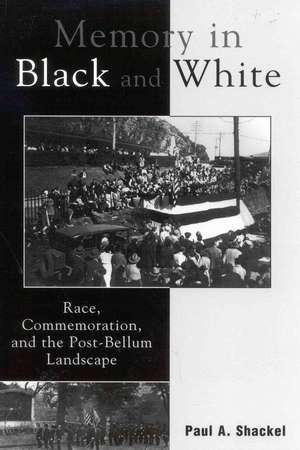
Memory in Black and White: Race, Commemoration, and the Post-Bellum Landscape
Autor Paul A. Shackel Cuvânt înainte de Dwight T. Pitcaithleyen Limba Engleză Paperback – 22 feb 2003
Preț: 316.55 lei
Preț vechi: 408.41 lei
-22%
Puncte Express: 475
Carte tipărită la comandă
Livrare economică 02-16 decembrie
Livrare prin curier în România Termenul estimat este afișat lângă disponibilitate.
Transport gratuit de la 400.00 lei Plată online sau ramburs, în funcție de opțiunile comenzii.
Retur gratuit în 14 zile Comandă securizată și suport în română.
Specificații
ISBN-13: 9780759102637
ISBN-10: 0759102635
Pagini: 272
Dimensiuni: 146 x 230 x 17 mm
Greutate: 0.44 kg
Ediția:2003. Corr. 5th
Editura: Bloomsbury Publishing
Colecția AltaMira Press
Locul publicării:New York, United States
ISBN-10: 0759102635
Pagini: 272
Dimensiuni: 146 x 230 x 17 mm
Greutate: 0.44 kg
Ediția:2003. Corr. 5th
Editura: Bloomsbury Publishing
Colecția AltaMira Press
Locul publicării:New York, United States
V-ar putea interesa
-
 The Big HouseChristopher Simon SykesPreț: 93.34 lei
 -
 Light In The WindowJune Goulding-25%Preț: 94.73 lei126.16 lei
 -
 SaltMark Kurlansky-18%Preț: 78.06 lei94.64 lei
 -
 -19%Preț: 57.63 lei71.40 lei
 -
 Big OysterMark Kurlansky-19%Preț: 74.47 lei92.01 lei
 -
 Sucking EggsPatricia NicolPreț: 115.81 lei
 -
 European Architecture 1750-1890Barry Bergdoll-22%Preț: 152.80 lei195.84 lei
 -
 Preț: 336.49 lei
 -
 Crime and the Courts in England 1660-1800J. M. Beattie-28%Preț: 527.74 lei730.04 lei
 -
 -21%Preț: 438.91 lei553.48 lei
 -
 Preț: 188.12 lei
 -
 The Slave TradeHugh ThomasPreț: 152.55 lei
 -
 -25%Preț: 219.85 lei292.52 lei
 -
 -15%Preț: 405.93 lei477.57 lei
 -
 Daily Life in the United States, 1920-1940David E. Kyvig-15%Preț: 127.36 lei149.87 lei
 -
 The Real Gorbals StoryColin MacFarlane-20%Preț: 74.63 lei92.85 lei
Cuprins
Part 1 Foreword
Part 2 Preface
Part 3 Introduction
Chapter 4 Chapter 1: Contested Memories of the Civil War
Chapter 5 Chapter 2: The John Brown Fort: Unwanted Symbol, Coveted Icon
Chapter 6 Chapter 3: Southern Heritage and the Faithful Slave Monuments: The Heyward Shepherd Memorial
Chapter 7 Chapter 4: Saint-Gaudens' Shaw Monument: Redefining the Role of the 54th Massachusetts Volunteer Infantry
Chapter 8 Chapter 5: Contradictions on the Landscape: Myth and Creation at Manassas National Battlefield Park
Chapter 9 Chapter 6: Remembering Landscapes of Conflict
Part 10 Epilogue: Approaches to Changing the Meaning of Commemoration
Part 2 Preface
Part 3 Introduction
Chapter 4 Chapter 1: Contested Memories of the Civil War
Chapter 5 Chapter 2: The John Brown Fort: Unwanted Symbol, Coveted Icon
Chapter 6 Chapter 3: Southern Heritage and the Faithful Slave Monuments: The Heyward Shepherd Memorial
Chapter 7 Chapter 4: Saint-Gaudens' Shaw Monument: Redefining the Role of the 54th Massachusetts Volunteer Infantry
Chapter 8 Chapter 5: Contradictions on the Landscape: Myth and Creation at Manassas National Battlefield Park
Chapter 9 Chapter 6: Remembering Landscapes of Conflict
Part 10 Epilogue: Approaches to Changing the Meaning of Commemoration
Recenzii
In this book, Paul Shackel accurately observes, 'Public memory is more a reflection of present political and social relations than a true reconstruction of the past.' Arguments over history today reflect deeply felt emotions about who we are as a society,who we have been, and where we think we should be headed. In an effort to parse out the inherent conflicts that have arisen over the remembering of history, Professor Paul Shackel focuses on the all important issue of race, and reminds us how race and racism have affected and continue to affect the popular presentation of the past and especially of the American Civil War. Memory in Black and White serves as a strong reminder of how ideas about race have influenced the preservation of places in the past and how it can affect, in both positive and negative ways, the interpretation of historic sites today. It is an important message for all of us who visit historic places, who are curious about the presentation of the past at historic sites and monuments, and who study the past/present dynamic in classrooms and public spaces. The case study approach taken here allows a detailed look at specific places where race and perceptions of race played a role in preserving and interpreting the past. By under
Shackel presents four case studies of commemorative Civil War sites and delivers powerful analyses of the social, political, regional and, above all, racst ideologies that generated and have sustained them... readers should embrace this book as an important step in understanding American politicized memory.
One of America's most gifted historical archaeologists provides a masterful examination of the relationship between race and national commemoration. Shackel's insightful analysis of four case studies deftly illustrates the unequal way in which history and memory can be created, and brilliantly shows the way in which various constituencies can seek to control the way history is remembered. This important book demands a prominent place on the bookshelves of archaeologists, historians, site managers, museum specialists, and everyone concerned with the way in which history is presented.
Shackel brings together history, anthropology, and archaeology in this must-read book that addresses a grievous wrong in the interpretation of the Civil War era.
Valuable reading. . . to provoke challenging conceptual questions, as any good book should.
Shackel has identified a promising niche from which to contribute to this literature...
Shackel has written a conscientious book that deserves sustained engagement from students of American history and education.
Paul A. Shackel's thoughtful new volume adds to the discourse on collective memory by offering a quartet of provocative case studies on the role of race in the creation of four sites interpreted by the National Park Service.
. . . will prove useful to beginning students in the field of public history.
Shackel presents four case studies of commemorative Civil War sites and delivers powerful analyses of the social, political, regional and, above all, racst ideologies that generated and have sustained them... readers should embrace this book as an important step in understanding American politicized memory.
One of America's most gifted historical archaeologists provides a masterful examination of the relationship between race and national commemoration. Shackel's insightful analysis of four case studies deftly illustrates the unequal way in which history and memory can be created, and brilliantly shows the way in which various constituencies can seek to control the way history is remembered. This important book demands a prominent place on the bookshelves of archaeologists, historians, site managers, museum specialists, and everyone concerned with the way in which history is presented.
Shackel brings together history, anthropology, and archaeology in this must-read book that addresses a grievous wrong in the interpretation of the Civil War era.
Valuable reading. . . to provoke challenging conceptual questions, as any good book should.
Shackel has identified a promising niche from which to contribute to this literature...
Shackel has written a conscientious book that deserves sustained engagement from students of American history and education.
Paul A. Shackel's thoughtful new volume adds to the discourse on collective memory by offering a quartet of provocative case studies on the role of race in the creation of four sites interpreted by the National Park Service.
. . . will prove useful to beginning students in the field of public history.