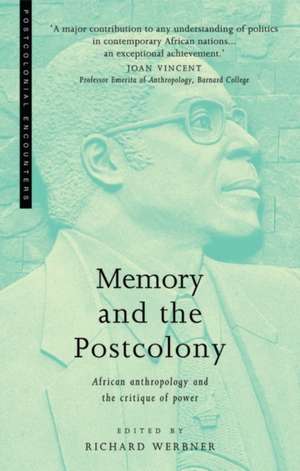
Memory and the Postcolony: African Anthropology and the Critique of Power: Postcolonial Encounters
Editat de Richard Werbneren Limba Engleză Paperback – sep 1998
Preț: 260.24 lei
Preț vechi: 308.81 lei
-16%
Puncte Express: 390
Carte tipărită la comandă
Livrare economică 28 noiembrie-12 decembrie
Livrare prin curier în România Termenul estimat este afișat lângă disponibilitate.
Transport gratuit de la 400.00 lei Plată online sau ramburs, în funcție de opțiunile comenzii.
Retur gratuit în 14 zile Comandă securizată și suport în română.
Specificații
ISBN-13: 9781856495929
ISBN-10: 1856495922
Pagini: 256
Ilustrații: index
Dimensiuni: 138 x 216 x 18 mm
Greutate: 0.33 kg
Editura: Bloomsbury Publishing
Colecția Zed Books
Seria Postcolonial Encounters
Locul publicării:London, United Kingdom
ISBN-10: 1856495922
Pagini: 256
Ilustrații: index
Dimensiuni: 138 x 216 x 18 mm
Greutate: 0.33 kg
Editura: Bloomsbury Publishing
Colecția Zed Books
Seria Postcolonial Encounters
Locul publicării:London, United Kingdom
V-ar putea interesa
-
 Empire of CottonSven Beckert-27%Preț: 90.83 lei123.62 lei
 -
 Appropriation and Invention of Tradition: The East India Company and Hindu Law in Early Colonial BengalNandini Bhattacharya-Panda-6%Preț: 115.86 lei122.69 lei
 -
 Imperial Justice: Africans in Empire's CourtBonny Ibhawoh-31%Preț: 709.10 lei1029.94 lei
 -
 -16%Preț: 106.47 lei126.42 lei
 -
 -34%Preț: 729.29 lei1102.11 lei
 -
 Masters of MankindNoam Chomsky-20%Preț: 60.94 lei76.62 lei
 -
 Preț: 412.99 lei
 -
 Colonialism in QuestionFrederick CooperPreț: 252.09 lei
 -
 Decolonization and Its ImpactShipwayPreț: 315.58 lei
 -
 Preț: 258.57 lei
 -
 Year 501Noam Chomsky-8%Preț: 648.14 lei704.49 lei
 -
 Legal Pluralism and Empires, 1500-1850Lauren BentonPreț: 295.95 lei
 -
 The Arab Spring: The End of PostcolonialismHamid Dabashi-10%Preț: 140.60 lei156.93 lei
 -
 The Assassination of LumumbaLudo de WittePreț: 159.75 lei
 -
 Out Of PlaceEdward W. SaidPreț: 93.44 lei
Cuprins
1. Introduction - Richard Werbner
2. Beyond the Grave: Death, Body and Memory in Postcolonial Zaire/Congo - Filip De Boeck
3. Death, Memory and the Politics of Legitimation: Nuer Experiences of the Continuing Sudanese Civil War - Sharon Hutchinson
4. Smoke from the Barrel of a Gun: Memory, Postwars of the Dead, and Reinscription in Zimbabwe - Richard Werbner
5. The Uses of Defeat: Memory and Political Morality in East Madagascar - Jennifer Cole
6. Systematic Judicial and Extra-Judicial Injustice: Preparations for Future Accountability - Sally Moore
7. Fundamentalism, Cultural Memory and the State: Contested Representations of Time in Postcolonial Malawi - Rikj van Dijk
8. 'Make a Complete Break with the Past': Memory and Postcolonial Modernity in Ghanian Pentecostalist Discourse - Birgit Meyer
9. Memory and Becoming Chosen Other: Fundamentalism and Elite-Making in a Zambian Catholic Mission School - Anthony Simpson
10. Afterword - Liisa Malkki
2. Beyond the Grave: Death, Body and Memory in Postcolonial Zaire/Congo - Filip De Boeck
3. Death, Memory and the Politics of Legitimation: Nuer Experiences of the Continuing Sudanese Civil War - Sharon Hutchinson
4. Smoke from the Barrel of a Gun: Memory, Postwars of the Dead, and Reinscription in Zimbabwe - Richard Werbner
5. The Uses of Defeat: Memory and Political Morality in East Madagascar - Jennifer Cole
6. Systematic Judicial and Extra-Judicial Injustice: Preparations for Future Accountability - Sally Moore
7. Fundamentalism, Cultural Memory and the State: Contested Representations of Time in Postcolonial Malawi - Rikj van Dijk
8. 'Make a Complete Break with the Past': Memory and Postcolonial Modernity in Ghanian Pentecostalist Discourse - Birgit Meyer
9. Memory and Becoming Chosen Other: Fundamentalism and Elite-Making in a Zambian Catholic Mission School - Anthony Simpson
10. Afterword - Liisa Malkki
Recenzii
The essays in this volume are must reading for all who contemplate life in the African postcolony
The preface 'post' in 'postcolony' alludes to a potent predicate that can never be erased. From the ashes and ruins of colonial memory arise the violence of Zaire and Sudan, the memorials of Zimbabwe, Madagascar and Malawi and the utopian dreams of Ghanaian and Zambian Pentecostals. Two questions arise: how much suffering died with the so-called end of the colonial era in Africa, and what is being remembered and regenerated? Drawing together a leading group of Africanists and anthropologists, Richard Werbner has assembled an excellent collection of original research and critical theoretical work about the role of the signs and symbols of Africa's colonial legacy in shaping attitudes toward power and the contemporary public spaces. The result is a stunning and first-rate anthology that uncovers the historical and ethnographic roots of the postcolonial condition.
Those who have come to fear that 'post-colonialism' is but another fashionable discourse destined to self-destruct in a cloud of specious theory and jargon will find proof to the contrary in this book. In the African 'crisis of memory' the contributors, distinguished senior and some of the most imaginative young scholars in the field, found a common theme and a complex of practises that holds these essays together. Above all, they demonstrate that anthropology's work did not end with the demise of colonialism and that it continues to produce findings and criticl insights worth to be pondered by historians, political scientists, students of law and religion, and many others.
The preface 'post' in 'postcolony' alludes to a potent predicate that can never be erased. From the ashes and ruins of colonial memory arise the violence of Zaire and Sudan, the memorials of Zimbabwe, Madagascar and Malawi and the utopian dreams of Ghanaian and Zambian Pentecostals. Two questions arise: how much suffering died with the so-called end of the colonial era in Africa, and what is being remembered and regenerated? Drawing together a leading group of Africanists and anthropologists, Richard Werbner has assembled an excellent collection of original research and critical theoretical work about the role of the signs and symbols of Africa's colonial legacy in shaping attitudes toward power and the contemporary public spaces. The result is a stunning and first-rate anthology that uncovers the historical and ethnographic roots of the postcolonial condition.
Those who have come to fear that 'post-colonialism' is but another fashionable discourse destined to self-destruct in a cloud of specious theory and jargon will find proof to the contrary in this book. In the African 'crisis of memory' the contributors, distinguished senior and some of the most imaginative young scholars in the field, found a common theme and a complex of practises that holds these essays together. Above all, they demonstrate that anthropology's work did not end with the demise of colonialism and that it continues to produce findings and criticl insights worth to be pondered by historians, political scientists, students of law and religion, and many others.