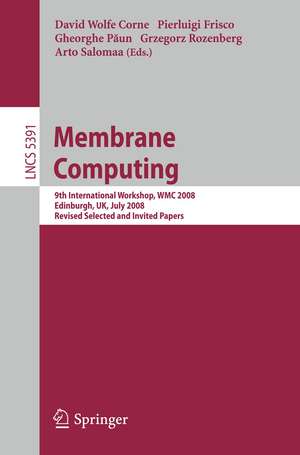
Membrane Computing
Editat de David Corne, Pierluigi Frisco, Gheorghe P¿un, Grzegorz Rozenberg, Arto Salomaaen Limba Engleză Paperback – 20 ian 2009
Preț: 327.12 lei
Preț vechi: 408.89 lei
-20%
Puncte Express: 491
Preț estimativ în valută:
57.84€ • 68.21$ • 50.41£
57.84€ • 68.21$ • 50.41£
Carte tipărită la comandă
Livrare economică 11-25 aprilie
Specificații
ISBN-13: 9783540958840
ISBN-10: 3540958843
Pagini: 416
Ilustrații: IX, 403 p.
Dimensiuni: 155 x 235 x 23 mm
Greutate: 0.63 kg
Ediția:2009
Editura: Springer
Locul publicării:Berlin, Heidelberg, Germany
ISBN-10: 3540958843
Pagini: 416
Ilustrații: IX, 403 p.
Dimensiuni: 155 x 235 x 23 mm
Greutate: 0.63 kg
Ediția:2009
Editura: Springer
Locul publicării:Berlin, Heidelberg, Germany
V-ar putea interesa
-
 Computer Vision: Models, Learning, and InferenceSimon J. D. Prince-20%Preț: 528.19 lei660.24 lei
 -
 -20%Preț: 496.11 lei620.15 lei
 -
 Spock – Up and RunningRob Fletcher-20%Preț: 333.29 lei416.62 lei
 -
 Tragic DesignJonathan Shariat-20%Preț: 177.31 lei221.64 lei
 -
 Thoughtful Machine Learning with PythonMatthew Kirk-20%Preț: 238.67 lei298.35 lei
 -
 This is Service Design DoingMarc Stickdorn-20%Preț: 243.74 lei304.68 lei
 -
 High Performance SparkHolden Karau-20%Preț: 232.55 lei290.68 lei
 -
 Practical TableauRyan Sleeper-20%Preț: 303.95 lei379.94 lei
 -
 A Course in Mathematical CryptographyGilbert Baumslag-20%Preț: 319.06 lei398.82 lei
 -
 Mobile Commerce: Grundlagen und TechnikenKlaus Turowski-20%Preț: 230.76 lei288.44 lei
 -
 -20%Preț: 158.30 lei197.87 lei
 -
 -20%Preț: 347.40 lei434.24 lei
 -
 Current Trends in Concurrency: Overviews and TutorialsJacobus W. De Bakker-20%Preț: 640.50 lei800.63 lei
 -
 Aspects of Molecular ComputingNatasha JonoskaPreț: 381.52 lei
 -
 Advances in Petri Nets 1990Grzegorz Rozenberg-20%Preț: 330.54 lei413.16 lei
 -
 -20%Preț: 1404.53 lei1755.66 lei
 -
 New Trends in Formal LanguagesGheorghe Paun-20%Preț: 330.58 lei413.22 lei
 -
 -20%Preț: 324.19 lei405.23 lei
 -
 System Configuration ManagementJacky Estublier-20%Preț: 319.52 lei399.41 lei
 -
 -20%Preț: 327.28 lei409.10 lei
 -
 -20%Preț: 326.91 lei408.64 lei
 -
 Membrane ComputingGeorge Eleftherakis-20%Preț: 329.74 lei412.17 lei
 -
 Formal Methods for Industrial Critical SystemsStefan Leue-20%Preț: 319.36 lei399.20 lei
 -
 Computer Science - Theory and ApplicationsEdward A. Hirsch-20%Preț: 327.92 lei409.90 lei
Public țintă
ResearchCuprins
Invited Lectures.- Investigation of a Biological Repair Scheme.- An Introduction to BioModel Engineering, Illustrated for Signal Transduction Pathways.- Multilevel Modeling of Morphogenesis.- A Definition of Cellular Interface Problems.- A Multiscale Modeling Framework Based on P Systems.- Regular Papers.- On the Qualitative Analysis of Conformon P Systems.- Dual P Systems.- Solving PP-Complete and #P-Complete Problems by P Systems with Active Membranes.- Fast Synchronization in P Systems.- Membrane Systems Using Noncooperative Rules with Unconditional Halting.- Modeling Ecosystems Using P Systems: The Bearded Vulture, a Case Study.- MetaPlab: A Computational Framework for Metabolic P Systems.- Usefulness States in New P System Communication Architectures.- A P-Lingua Programming Environment for Membrane Computing.- On Testing P Systems.- Hebbian Learning from Spiking Neural P Systems View.- Event-Driven Metamorphoses of P Systems.- Effects of HIV-1 Proteins on the Fas-Mediated Apoptotic Signaling Cascade: A Computational Study of Latent CD4+ T Cell Activation.- Transforming State-Based Models to P Systems Models in Practice.- How Redundant Is Your Universal Computation Device?.- Enumerating Membrane Structures.- Toward an MP Model of Non-Photochemical Quenching.- Applications of Page Ranking in P Systems.- An Algorithm for Non-deterministic Object Distribution in P Systems and Its Implementation in Hardware.- First Steps Towards a Wet Implementation for ?-DPP.- Defining and Executing P Systems with Structured Data in K.- Translating Multiset Tree Automata into P Systems.
Textul de pe ultima copertă
This book constitutes the thoroughly refereed extended postproceedings of the 9th International Workshop on Membrane Computing, WMC 2008, held in Edinburgh, UK, in July 2008 under the auspices of the European Molecular Computing Consortium (EMCC) and the Molecular Computing Task Force of IEEE Computational Intelligence Society.
The 22 revised full papers presented together with 5 invited papers went through two rounds of reviewing and improvement. The papers in this volume cover all the main directions of research in membrane computing, ranging from theoretical topics in mathematics and computer science to application issues. A special attention was paid to the interaction of membrane computing with biology and computer science, focusing both on the biological roots of membrane computing, on applications of membrane computing in biology and medicine, and on possible electronically based implementations.
The 22 revised full papers presented together with 5 invited papers went through two rounds of reviewing and improvement. The papers in this volume cover all the main directions of research in membrane computing, ranging from theoretical topics in mathematics and computer science to application issues. A special attention was paid to the interaction of membrane computing with biology and computer science, focusing both on the biological roots of membrane computing, on applications of membrane computing in biology and medicine, and on possible electronically based implementations.