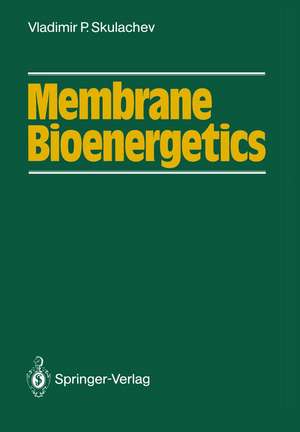
Membrane Bioenergetics
Autor Vladimir P. Skulacheven Limba Engleză Paperback – 23 aug 2014
Preț: 626.36 lei
Preț vechi: 736.90 lei
-15%
Puncte Express: 940
Carte tipărită la comandă
Livrare economică 30 noiembrie-14 decembrie
Livrare prin curier în România Termenul estimat este afișat lângă disponibilitate.
Transport gratuit pentru acest produs Plată online sau ramburs, în funcție de opțiunile comenzii.
Retur gratuit în 14 zile Comandă securizată și suport în română.
Specificații
ISBN-13: 9783642729805
ISBN-10: 3642729800
Pagini: 460
Ilustrații: XIV, 442 p. 44 illus.
Dimensiuni: 170 x 244 x 24 mm
Greutate: 0.73 kg
Ediția:Softcover reprint of the original 1st ed. 1988
Editura: Springer Berlin, Heidelberg
Colecția Springer
Locul publicării:Berlin, Heidelberg, Germany
ISBN-10: 3642729800
Pagini: 460
Ilustrații: XIV, 442 p. 44 illus.
Dimensiuni: 170 x 244 x 24 mm
Greutate: 0.73 kg
Ediția:Softcover reprint of the original 1st ed. 1988
Editura: Springer Berlin, Heidelberg
Colecția Springer
Locul publicării:Berlin, Heidelberg, Germany
V-ar putea interesa
-
 Energy for Animal LifeR. McNeill Alexander-29%Preț: 376.73 lei527.52 lei
 -
 Electricity and Magnetism in Biological SystemsDonald Edmonds-28%Preț: 439.40 lei613.09 lei
 -
 Molecular Theory of SolutionsArieh Ben-Naim-32%Preț: 667.93 lei985.92 lei
 -
 -23%Preț: 686.29 lei891.29 lei
 -
 Biological Physics of the Developing EmbryoGabor Forgacs-23%Preț: 745.68 lei968.41 lei
 -
 Physics in Molecular BiologyKim Sneppen-23%Preț: 779.32 lei1012.11 lei
 -
 Statistical Mechanics of Cellular Systems and ProcessesMuhammad H. Zaman-11%Preț: 609.30 lei684.60 lei
 -
 Random Walks in BiologyHoward C BergPreț: 341.45 lei
 -
 Fundamentals of BiophysicsAndrey B Rubin-9%Preț: 1250.81 lei1374.52 lei
 -
 -23%Preț: 619.66 lei804.75 lei
 -
 Single-Channel RecordingBert Sakmann-18%Preț: 2069.92 lei2524.28 lei
 -
 Ecological MicrocosmsRobert J. BeyersPreț: 408.37 lei
 -
 Continuum Mechanics of Anisotropic MaterialsStephen C. CowinPreț: 418.25 lei
 -
 -11%Preț: 430.95 lei484.20 lei
 -
 Design in Nature: Learning from TreesClaus Mattheck-18%Preț: 859.03 lei1047.60 lei
Public țintă
ResearchCuprins
1 Introduction.- 1.1 A “Biology Building” and the Place of Bioenergetics.- 1.2 Essential Definitions.- 1.3 ??¯H, ?p, ??¯Na and ?s.- 1.4 Adenosine Triphosphate.- 1.5 Membrane Lipids.- 1.6 Lipid Bilayer.- 1.7 Membrane Proteins.- 2 Specific Methods of Membrane Bioenergetics.- 2.1 Membrane Potential Measurement.- 2.2 ?pH Measurement.- 2.3 Measurement of Fast H+ Dissociation-Association.- 3 Primary ??¯H Generators.- 3.1 The Cyclic Photoredox Chain of Purple Bacteria.- 3.2 The Non-Cyclic Photoredox Chain of Green Bacteria.- 3.3 The Non-Cyclic Photoredox Chain of Chloroplasts and Cyanobacteria.- 3.4 The Respiratory Chain.- 3.5 Bacteriorhodopsin.- 3.6 Primary ??¯H Generators: Overview.- 4 Secondary ??¯H Generators: H+-ATPases.- 4.1 Definition and Classification.- 4.2 H+-ATPasesof Obligate Anaerobic Bacteria.- 4.3 H+-ATPase of the Plant and Fungal Outer Cell Membrane.- 4.4 H+-ATPase of Tonoplast.- 4.5 Non-Mitochondrial H+-ATPase in Animal Cells.- 4.6 Interrelation of Various Functions of H+-ATPase.- 5 ??¯H Consumers.- 5.1 ??¯H-Driven Chemical Work.- 5.2 ??¯H-Driven Osmotic Work.- 5.3 ??¯H-Driven Mechanical Work: Bacterial Motility.- 5.4 ??¯H as an Energy Source for Heat Production.- 6 ??¯H Regulation, Transmission and Buffering.- 6.1 Regulation of ??¯H.- 6.2 ??¯H Transmission.- 6.3 ??¯H Buffering.- 7 The Sodium World.- 7.1 ??¯Na Generators.- 7.2 Utilization of ??¯Na Produced by Primary ??¯Na Generators.- 7.3 How Often is the Na+ Cycle Used by Living Cells?.- 7.4 Probable Evolutionary Relationships of the Protonic and Sodium Worlds.- 7.5 Na+/H+ Antiport in the Animal Cell: H+ as a Secondary Messenger.- 7.6 A General Scheme of Interrelations of Protonic and Sodium Cycles.- 7.7 Membrane-Linked Energy Transductions whenNeither H+ nor Na+ is Involved.- 8 Membrane Bioenergetics Studies: An Outlook.- 8.1 Some Prospects for Fundamental Research.- 8.2 Towards Applied Membrane Bioenergetics.- 9 Membrane Bioenergetics: A Look into History.- 9.1 The First Ideas and Observations. Chemiosmotic Hypothesis.- 9.2 Uncouplers.- 9.3 ??¯H Across Natural Membranes.- 9.4 ??¯H Across Reconstituted Membranes.- 9.5 ATP Formation Supported by an Artifically Imposed ??¯H.- 9.6 Bacteriorhodopsin and Chimerical Proteoliposomes.- 9.7 The Latest History.- 9.8 Membrane Bioenergeticists and Their Outstanding Predecessors.- 10 References.- 11 Subject Index.