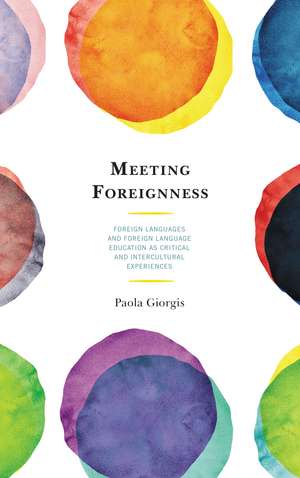
Meeting Foreignness: Foreign Languages and Foreign Language Education as Critical and Intercultural Experiences
Autor Paola Giorgisen Limba Engleză Paperback – 2 iun 2021
Though with a global perspective, the book also addresses the Italian context in particular: after introducing a brief historical background, it examines how 'foreignness' is addressed, portrayed, or questioned in contemporary socio-cultural and political debates, and presents practical activities to show how the foreign language can be used for intercultural purposes.
An original interdisciplinary approach, combining Critical Linguistics, Foreign Language Education, Intercultural Studies, and Critical Pedagogies, together with works of literature and examples from several fields, integrates theoretical references, practices and research methodologies to take the reader within the complex and fascinating world of languages, displaying how they inform individual and collective identities and representations, and how they can both serve processes of manipulation and domination, as well as those of empowerment and emancipation. For its interdisciplinary and integrated approach, this book aims to address teachers, educators, scholars, practitioners, researchers, and students, but also those readers who are curious to know more about languages, and about how they shape our identities, our meanings and our lives.
| Toate formatele și edițiile | Preț | Express |
|---|---|---|
| Paperback (1) | 241.05 lei 6-8 săpt. | |
| Bloomsbury Publishing – 2 iun 2021 | 241.05 lei 6-8 săpt. | |
| Hardback (1) | 652.61 lei 6-8 săpt. | |
| Bloomsbury Publishing – 15 oct 2018 | 652.61 lei 6-8 săpt. |
Preț: 241.05 lei
Preț vechi: 329.05 lei
-27%
Puncte Express: 362
Preț estimativ în valută:
42.69€ • 49.86$ • 37.08£
42.69€ • 49.86$ • 37.08£
Carte tipărită la comandă
Livrare economică 21 februarie-07 martie
Preluare comenzi: 021 569.72.76
Specificații
ISBN-13: 9781498560528
ISBN-10: 1498560520
Pagini: 142
Ilustrații: 4 b/w photos; 2 tables;
Dimensiuni: 154 x 218 x 11 mm
Greutate: 0.22 kg
Editura: Bloomsbury Publishing
Colecția Lexington Books
Locul publicării:New York, United States
ISBN-10: 1498560520
Pagini: 142
Ilustrații: 4 b/w photos; 2 tables;
Dimensiuni: 154 x 218 x 11 mm
Greutate: 0.22 kg
Editura: Bloomsbury Publishing
Colecția Lexington Books
Locul publicării:New York, United States
Cuprins
Introduction
The Missing Link: Presenting What, How, from Where and to Whom
Part One
Within Praxis
1.The Context
1.1Made in Italies
1.2Native or Foreign?
1.3Languages, Identities, Migrations
2.The Educational Perspective
2.1The Activities
2.1.1Intercultural Grammar
2.1.2Intercultural Poetry
2.1.3Intercultural Citizenship
2.1.4A Comment on the Activities
Part Two
Within Theory
1.Introduction: What's in a Word?
2.Foreign
3.Language
3.1mOther tongue
3.2Other Languages
3.3Language and Power
4.Education
4.1Critical Pedagogies
5.Critical
6.Intercultural
6.1Intercultural Education
7.Experience
Part Three
Within Research
1.Introducing the Research Study
2.The Contexts
3.The Participants
4.Methodology and Data Collecting
4.1General Considerations on Methodology
4.2Data Collecting: Sampling
4.3Some Issues Regarding Data Collecting
4.3.1In/Out Issue
4.3.2Objectivity/Subjectivity
4.3.3Ethical Issues
4.4Interviews and Back-talk Focus Groups
4.4.1Motivation and Procedures
4.4.2Theoretical References
5.Analysis of Data
5.1Main Principles
5.1.1Reflexivity
5.1.2Text Construction and Rhetorical Figures
5.1.3Dialogue Between the Data and the Framework
5.1.4Triangulation and Accountability
6.The Findings
7.Discussion
7.1On the Study
7.2On the Research Methods
Part Four
Meeting Foreignness. Foreign Language Education as a Critical (and) Intercultural Experience
1.Meeting Foreignness
2.Foreign Language Education as a Critical (and) Intercultural Experience
2.1English and English Language Teaching
2.2English as a Foreign Language and English as a Lingua Franca
2.3English as a Lingua Franca and English Language Teaching. An Impossible Match?
3.Foreign Languages and the Intercultural
4.What's Next?
4.1How to Do It
A Final Note
The Bigger Picture. A Few Remarks on Some fin-de-siècle Fascinations
The Missing Link: Presenting What, How, from Where and to Whom
Part One
Within Praxis
1.The Context
1.1Made in Italies
1.2Native or Foreign?
1.3Languages, Identities, Migrations
2.The Educational Perspective
2.1The Activities
2.1.1Intercultural Grammar
2.1.2Intercultural Poetry
2.1.3Intercultural Citizenship
2.1.4A Comment on the Activities
Part Two
Within Theory
1.Introduction: What's in a Word?
2.Foreign
3.Language
3.1mOther tongue
3.2Other Languages
3.3Language and Power
4.Education
4.1Critical Pedagogies
5.Critical
6.Intercultural
6.1Intercultural Education
7.Experience
Part Three
Within Research
1.Introducing the Research Study
2.The Contexts
3.The Participants
4.Methodology and Data Collecting
4.1General Considerations on Methodology
4.2Data Collecting: Sampling
4.3Some Issues Regarding Data Collecting
4.3.1In/Out Issue
4.3.2Objectivity/Subjectivity
4.3.3Ethical Issues
4.4Interviews and Back-talk Focus Groups
4.4.1Motivation and Procedures
4.4.2Theoretical References
5.Analysis of Data
5.1Main Principles
5.1.1Reflexivity
5.1.2Text Construction and Rhetorical Figures
5.1.3Dialogue Between the Data and the Framework
5.1.4Triangulation and Accountability
6.The Findings
7.Discussion
7.1On the Study
7.2On the Research Methods
Part Four
Meeting Foreignness. Foreign Language Education as a Critical (and) Intercultural Experience
1.Meeting Foreignness
2.Foreign Language Education as a Critical (and) Intercultural Experience
2.1English and English Language Teaching
2.2English as a Foreign Language and English as a Lingua Franca
2.3English as a Lingua Franca and English Language Teaching. An Impossible Match?
3.Foreign Languages and the Intercultural
4.What's Next?
4.1How to Do It
A Final Note
The Bigger Picture. A Few Remarks on Some fin-de-siècle Fascinations
Recenzii
Paola Giorgis' strength is praxis: she shows how to turn theoretical writings into informed applied choices. She presents the foreign language classroom as both a critical and an intercultural space - as indeed it is.
Paola Giorgis combined the doggedness of the white truffle hunter and the deftness of the master cook to prepare this highly original intercultural and interdisciplinary reflection on foreign languages and Foreign Language Education.
Paola Giorgis has created a written work of art bringing together contemporary ways of knowing within foreignness, interculturality, and linguistic diversity. Moving seamlessly between classroom, philosophy, and scholarship, Giorgis has given us an emancipatory praxis which understands power, communication, and context.
Giorgis herself remains predominantly upbeat-and for good reason: she has identified and operationalised an armoury of specific research strategies and tools, all the more powerfully with which to argue her case for a liberalising form of language education today. This has the dual purpose of being enormously helpful for research students in Higher Education; demonstrating in clear and rational terms how a methodological framework for constructing, conducting and analysing educational research can-and I would say must-emerge from the theoretically informed, politically overt stance of the researcher. . . . From my reading of Paola Georgis I now understand-and can argue more cogently-why foreign language teaching and the meeting of foreignness through foreign languages is axiomatic to arriving at an understanding of self and others that constitutes meaningful maturity.
Paola Giorgis combined the doggedness of the white truffle hunter and the deftness of the master cook to prepare this highly original intercultural and interdisciplinary reflection on foreign languages and Foreign Language Education.
Paola Giorgis has created a written work of art bringing together contemporary ways of knowing within foreignness, interculturality, and linguistic diversity. Moving seamlessly between classroom, philosophy, and scholarship, Giorgis has given us an emancipatory praxis which understands power, communication, and context.
Giorgis herself remains predominantly upbeat-and for good reason: she has identified and operationalised an armoury of specific research strategies and tools, all the more powerfully with which to argue her case for a liberalising form of language education today. This has the dual purpose of being enormously helpful for research students in Higher Education; demonstrating in clear and rational terms how a methodological framework for constructing, conducting and analysing educational research can-and I would say must-emerge from the theoretically informed, politically overt stance of the researcher. . . . From my reading of Paola Georgis I now understand-and can argue more cogently-why foreign language teaching and the meeting of foreignness through foreign languages is axiomatic to arriving at an understanding of self and others that constitutes meaningful maturity.