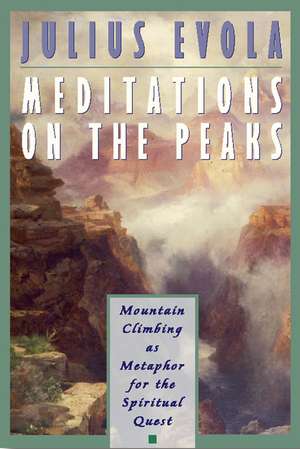
Meditations on the Peaks: Mountain Climbing as Metaphor for the Spiritual Quest
Autor Julius Evolaen Limba Engleză Paperback – feb 1998
Julius Evola, a leading exponent of esoteric thought, was also an ardent mountain climber who personally scaled the peaks of the Tyrols, Alps, and Dolomites. For Evola the physical conquest of a mountain, with all the courage, self-transcendence and mental lucidity that it entails, becomes an inseparable and complementary part of spiritual awakening. It is no coincidence that many ancient cultures chose mountains as the abodes of their gods and considered the rigorous ascent of peaks as the task of heroes and initiates. In modern times, which tend to suffocate the heroic with naked self interest, the mountain still forms part of the profound dimension of spirit where the soul finds within itself more than what it thought itself to be. In Meditations on the Peaks, Evola combines recollections of his own experiences with reflections on other inspirational men and women who shared his view of the transcendent greatness of mountains.
Preț: 58.13 lei
Preț vechi: 76.86 lei
-24%
Puncte Express: 87
Carte disponibilă
Livrare economică 20 noiembrie-02 decembrie
Livrare prin curier în România Termenul estimat este afișat lângă disponibilitate.
Transport gratuit de la 400.00 lei Plată online sau ramburs, în funcție de opțiunile comenzii.
Retur gratuit în 14 zile Comandă securizată și suport în română.
Specificații
ISBN-13: 9780892816576
ISBN-10: 0892816570
Pagini: 144
Dimensiuni: 152 x 229 x 15 mm
Greutate: 0.18 kg
Ediția:Us edition
Editura: Inner Traditions/Bear & Company
Colecția Inner Traditions
ISBN-10: 0892816570
Pagini: 144
Dimensiuni: 152 x 229 x 15 mm
Greutate: 0.18 kg
Ediția:Us edition
Editura: Inner Traditions/Bear & Company
Colecția Inner Traditions
Notă biografică
A controversial philosopher and critic of modern Western civilization, Julius Evola (1898-1974) wrote widely on Eastern religions, alchemy, sexuality, politics, and mythology. Inner Traditions has published his Eros and the Mysteries of Love: The Metaphysics of Sex, The Yoga of Power, The Hermetic Tradition, Revolt Against the Modern World, The Mystery of the Grail and Ride The Tiger.
Cuprins
Foreword
Part One: Doctrine
1. The Mountain and Spirituality
2. Some Remarks Concerning the Divinity of the Mountains
3. Spirituality of the Mountain
4. A Mystic of the Tibetan Mountains
5. Race and the Mountain
6. The Mountain, Sport, and Contemplation
7. Ascending and Descending
Part Two: Experiences
8. The Northern Wall of Eastern Lyskamm
9. Notes Concerning Psychic Training in the Mountains
10. The Ascent of Mount Langkopfel
11. Ice and the Spirit
12. The Valley of the Wind
13. The Ascent of Mount Gross-Glockner
14. Meditations on the Peaks
15. A Storm on Mount Rosa
Part Three: Appendices
Appendix A. An Artist of the Heights: Nicholas Roerich
Appendix B. Art and Symbol in the Seat of the Snows
Appendix C. Religiosity of Tyrol
Appendix D. The Kingdom of the Demon of the Peaks
Appendix E. Height
Index
Part One: Doctrine
1. The Mountain and Spirituality
2. Some Remarks Concerning the Divinity of the Mountains
3. Spirituality of the Mountain
4. A Mystic of the Tibetan Mountains
5. Race and the Mountain
6. The Mountain, Sport, and Contemplation
7. Ascending and Descending
Part Two: Experiences
8. The Northern Wall of Eastern Lyskamm
9. Notes Concerning Psychic Training in the Mountains
10. The Ascent of Mount Langkopfel
11. Ice and the Spirit
12. The Valley of the Wind
13. The Ascent of Mount Gross-Glockner
14. Meditations on the Peaks
15. A Storm on Mount Rosa
Part Three: Appendices
Appendix A. An Artist of the Heights: Nicholas Roerich
Appendix B. Art and Symbol in the Seat of the Snows
Appendix C. Religiosity of Tyrol
Appendix D. The Kingdom of the Demon of the Peaks
Appendix E. Height
Index
Recenzii
"Evola writes in lively prose, filled with fascinating and concrete detail...To read his descriptions of the higher spiritual states is like watching a champion mountain-climber on a vertical glacier."
"[Evola's] engaging and poetic look at mountain climbing through the eyes of awareness creates an artistic dance of words and images. Feeling the landscape of both mind and matter, [he] brings deeper meaning to the struggles of everyday life."
"[Evola's] engaging and poetic look at mountain climbing through the eyes of awareness creates an artistic dance of words and images. Feeling the landscape of both mind and matter, [he] brings deeper meaning to the struggles of everyday life."
Descriere
Evola articulates the close relationship between the physical rigors of mountain climbing and the ascent of the initiate toward self-transcendence.