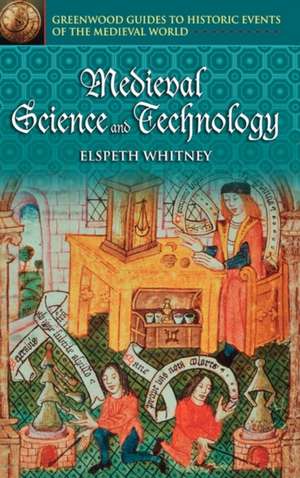
Medieval Science and Technology: Greenwood Guides to Historic Events of the Medieval World
Autor Elspeth Whitneyen Limba Engleză Hardback – 30 oct 2004
Considerăm că Medieval Science and Technology reprezintă un instrument de referință esențial pentru nivelul academic și preuniversitar, reușind să demonteze mitul „Epocii Întunecate” printr-o analiză riguroasă a continuității intelectuale. Volumul dezvoltă competențe de analiză istorică, explicând cum filosofia naturală aristotelică a fost conservată de savanții musulmani înainte de a fundamenta expansiunea europeană. Ca și Science and Religion, 400 B.C. to A.D. 1550 de Edward Grant, lucrarea explorează relația dintre credință și rațiune, însă Elspeth Whitney pune un accent deosebit pe aplicațiile practice și inovațiile tehnologice care au transformat societatea medievală.
Structura volumului este una progresivă și tematică. Primele capitole stabilesc contextul instituțional și filosofic, trecând de la tradiția clasică la universitățile medievale. Ulterior, cuprinsul ghidează cititorul prin ramuri specifice: de la științele exacte precum dinamica și optica, la alchimie și geografie. Apreciem în mod deosebit includerea celor 11 documente primare care permit contactul direct cu modul de gândire al epocii. Spre deosebire de abordarea enciclopedică a Routledge Revivals: Medieval Science, Technology and Medicine (2006), acest volum oferă o narațiune coerentă și o metodologie axată pe sinteză, fiind ideal pentru studenții care doresc să înțeleagă fundamentele Revoluției Științifice. Tonul este echilibrat, subliniind că progresul tehnic — de la armele de foc la furnale — nu a fost un accident, ci rezultatul unei curiozități intelectuale susținute.

Preț: 328.26 lei
Preț vechi: 599.64 lei
-45%
Carte tipărită la comandă
Livrare economică 08-22 decembrie
Specificații
ISBN-10: 0313325197
Pagini: 304
Dimensiuni: 156 x 235 x 27 mm
Greutate: 0.6 kg
Editura: Bloomsbury Publishing
Colecția Greenwood
Seria Greenwood Guides to Historic Events of the Medieval World
Locul publicării:New York, United States
V-ar putea interesa
-
 Medieval Writings on Secular WomenElisabeth Van HoutsPreț: 109.47 lei
 -
 Pope Urban II's Council of PiacenzaRobert Somerville-30%Preț: 829.24 lei1188.58 lei
 -
 -30%Preț: 765.10 lei1095.00 lei
 -
 Preț: 385.08 lei
 -
 -15%Preț: 606.29 lei713.29 lei
 -
 Instruments and Experimentation in the History of ChemistryFrederic HolmesPreț: 108.56 lei
 -
 Max Ernst and Alchemy: A Magician in Search of MythM. E. WarlickPreț: 241.75 lei
 -
 From Alchemy to Chemistry in Picture and StoryArthur Greenberg-8%Preț: 728.13 lei791.44 lei
 -
 de Re MetallicaGeorgius Agricola-23%Preț: 262.49 lei342.28 lei
 -
 A Dictionary of Alchemical ImageryLyndy AbrahamPreț: 265.48 lei
 -
 Preț: 255.99 lei
 -
 History and the Supernatural in Medieval EnglandC. S. WatkinsPreț: 327.16 lei
 -
 Preț: 416.66 lei
 -
 Preț: 220.99 lei
 -
 -5%Preț: 94.53 lei99.50 lei
 -
 Wonders and the Order of Nature 1150-1750Lorraine DastonPreț: 268.53 lei
 -
 Edison's EveGaby WoodPreț: 115.98 lei
 -
 -23%Preț: 95.03 lei124.16 lei
 -
 Art & AlchemyJacob Wamberg-18%Preț: 311.12 lei377.29 lei
De ce să citești această carte
Recomandăm această carte studenților și pasionaților de istorie care doresc să descopere rădăcinile științei moderne. Cititorul câștigă o perspectivă nuanțată asupra contribuțiilor interculturale (grecești, islamice și creștine) și înțelege cum inovațiile medievale au modelat lumea. Este un volum indispensabil pentru claritatea cu care explică concepte complexe și pentru resursele didactice incluse, precum glosarul și documentele originale.
Despre autor
Elspeth Whitney este profesor asociat de istorie la University of Nevada, Las Vegas, fiind o specialistă recunoscută în studiul tehnologiei și culturii medievale. Expertiza sa se concentrează pe intersecția dintre artele mecanice, religie și istoria ideilor. Este autoarea lucrării „Paradise Restored: The Mechanical Arts from Antiquity through the 13th Century” și a publicat numeroase articole în jurnale academice de prestigiu precum „Journal of Women's History” și „Annals of Scholarship”. Cercetările sale subliniază adesea rolul femeilor și diversitatea culturală în dezvoltarea spiritului științific medieval.
Descriere
Medieval scientists, or natural philosophers, as they were then called, were powerfully influenced by the authority of older traditions, including Christianity and scientific ideas dating back to Plato, Aristotle, and Ptolemy. Yet their respect for these traditions was balanced by an equal respect for reason and the spirit of inquiry. Religious faith, far from dampening scientific and technological innovation, actually buttressed their efforts to understand the natural world as it was generally taken for granted that knowledge acquired through reason would harmonize with religious beliefs. While medieval science and technology did not seek to overthrow the prevailing worldviews of the time, their accomplishments did lay the groundwork for the scientific revolution and European global expansion of the early modern age.
Cuprins
Glossary
Series Foreword
Preface
Chronology of Events
Overview and History: The Classical Tradition and the Early Middle Ages
Institutional History: The High and Late Middle Ages
Aristotle's Natural Philosophy and the Medieval Scientific World View
The Exact Sciences: Mathematics, Astronomy and Cosmology, Astrology, Statics, Kinematics and Dynamics, Optics
The Biological and Earth Sciences: The Sciences of Matter (Chemistry and Alchemy), Medicine, Zoology, Botany, Geology and Meteorology, Geography
Medieval Technology
The Impact of Medieval Science and Technology
Biographies
Primary Documents
Annotated Bibliography