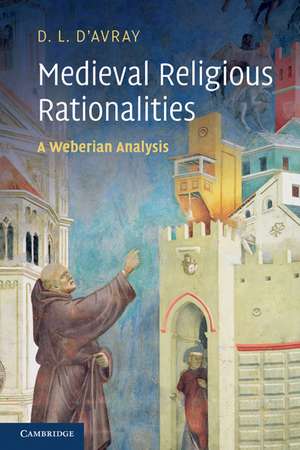
Medieval Religious Rationalities
Autor D. L. D'Avrayen Limba Engleză Paperback – 23 sep 2010
În peisajul studiilor universitare dedicate istoriei mentalităților, Medieval Religious Rationalities ocupă un loc central, propunând o recalibrare a modului în care înțelegem logica internă a credinței premoderne. Remarcăm modul în care D. L. d'Avray refuză să trateze religia medievală ca pe un fenomen pur mistic sau irațional, utilizând în schimb instrumentarul sociologic al lui Max Weber pentru a evidenția structurile de gândire coerente din spatele practicilor ecleziastice. Cartea extinde cadrul propus de Rationalities in History cu date noi extrase din analiza mecanismelor de conversie, a miracolelor și a guvernării papale, demonstrând că raționalitatea instrumentală și valorile religioase nu erau sfere izolate, ci forțe care se modelau reciproc. Credem că forța acestui volum rezidă în capacitatea autorului de a face tranziția de la teorie pură la studiu de caz empiric. În timp ce în lucrări anterioare, precum Papal Jurisprudence, 385-1234 sau Dissolving Royal Marriages, D. L. d'Avray s-a concentrat pe aspecte juridice și politice specifice, aici el sintetizează aceste direcții sub cupola unei analize a raționalității formale și substanțiale. Structura cărții reflectă această progresie: primele capitole definesc dinamica valorilor medievale, urmate de o analiză riguroasă a interfeței dintre legea religioasă și sistemul de dispense. Comparativ cu Schools of Asceticism de Lutz Kaelber, care investighează modul în care organizarea socială a modelat conduita ascetică, volumul de față merge mai adânc în arhitectura cognitivă a dogmei, analizând inclusiv Trinitarismul prin prisma tipurilor de raționalitate. Abordarea este tehnică, dar extrem de clară, oferind o perspectivă asupra istoriei europene care depășește simpla cronică, devenind o analiză a modului în care ideile devin forțe sociale prin structurare logică.
Preț: 210.16 lei
Carte tipărită la comandă
Livrare economică 20 iulie-03 august
Specificații
ISBN-10: 052118682X
Pagini: 210
Dimensiuni: 152 x 229 x 12 mm
Greutate: 0.31 kg
Editura: Cambridge University Press
Locul publicării:Cambridge, United Kingdom
V-ar putea interesa
-
 Medieval Writings on Secular WomenElisabeth van HoutsPreț: 102.15 lei
 -
 -15%Preț: 573.81 lei675.08 lei
 -
 Preț: 384.02 lei
 -
 Preț: 235.54 lei
 -
 History and the Supernatural in Medieval EnglandC. S. WatkinsPreț: 327.16 lei
 -
 Medieval Polities and Modern MentalitiesTimothy ReuterPreț: 427.43 lei
 -
 The Cambridge History of Magic and Witchcraft in the WestDavid J Collins S J-23%Preț: 1154.93 lei1499.91 lei
 -
 The Jews of Medieval Western ChristendomRobert ChazanPreț: 334.40 lei
 -
 The Medieval Discovery of NatureSteven A. Epstein-30%Preț: 647.31 lei922.24 lei
 -
 Medieval Intrigue: Decoding Royal ConspiraciesDr Ian Mortimer-41%Preț: 98.21 lei166.97 lei
 -
 Holy WarriorsJonathan PhillipsPreț: 123.05 lei
De ce să citești această carte
Apreciem această lucrare pentru rigoarea cu care demontează mitul evului mediu irațional. Este o resursă esențială pentru cercetătorii în istorie și sociologie, oferind un model metodologic despre cum pot fi aplicate teoriile sociale pe surse istorice complexe. Cititorul va câștiga o înțelegere profundă a modului în care autoritatea papală și mișcările carismatice au funcționat pe baze logice și structurale surprinzător de moderne.
Descriere scurtă
Cuprins
Recenzii
'Medieval Religious Rationalities is a challenging but rewarding book. David d'Avray sets himself the task of applying to medieval religion Max Weber's categories for the analysis of reason … Throughout the book d'Avray's style is engaging, and he takes pains to explain technicalities for the benefit of non-medievalists.' Norman Housley, Journal of Ecclesiastical History
'D. L. d'Avray excels at inquiring into networks of conviction … [he] has special expertise in the study of preaching, scholastic [thought], the papacy, and marriage in the late Middle Ages, and many of his very well-chosen illustrations reflect this … a rich mine of information about medieval mentalities and procedures.' David Luscombe, The American Historical Review
'Unlike those historians who prefer to remain the prisoner of theories which are held unconsciously, David d'Avray's aim … is to engage explicitly with the 'ideal types' of rationality catalogued in Max Weber's work in order to show their empirical value in the study of the religion of the medieval West … constitute[s] a model of how historians can engage with social theory … clearly and wittily written and resort[s] to technical jargon in order to clarify the argument rather than to obscure it … logically structured and address[es] issues which are of interest not just to medievalists but also to historians of other periods, as well as to philosophers, anthropologists, sociologists and social theorists … draw[s] effortlessly on an impressive range of empirical examples and [is] the product of wide reading in philosophy and social science.' S. H. Rigby, English Historical Review