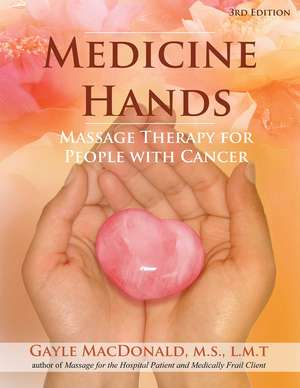
Medicine Hands: Massage Therapy for People with Cancer
Autor Gayle MacDonalden Limba Engleză Paperback – 3 mar 2014
The field of oncology massage is maturing into a discipline with a deeper and deeper body of knowledge. The 3rd edition of Medicine Hands reflects this maturation.
Every chapter contains updated information and insights into massaging people affected by cancer. New chapters have been added to cover each stage of the cancer experience: treatment, recovery, survivorship, side effects from the disease, and end of life. These new chapters and organizational structure will make it easier for the reader to find the information needed to plan the massage session for a given client. In addition, a new chapter has been added that focuses on the Pressure/Site/Positioning framework. This is the clinical framework around which the massage session is planned.
Every chapter contains updated information and insights into massaging people affected by cancer. New chapters have been added to cover each stage of the cancer experience: treatment, recovery, survivorship, side effects from the disease, and end of life. These new chapters and organizational structure will make it easier for the reader to find the information needed to plan the massage session for a given client. In addition, a new chapter has been added that focuses on the Pressure/Site/Positioning framework. This is the clinical framework around which the massage session is planned.
Preț: 172.85 lei
Preț vechi: 250.09 lei
-31%
Puncte Express: 259
Carte disponibilă
Livrare economică 30 octombrie-11 noiembrie
Livrare prin curier în România Termenul estimat este afișat lângă disponibilitate.
Transport gratuit de la 400.00 lei Plată online sau ramburs, în funcție de opțiunile comenzii.
Retur gratuit în 14 zile Comandă securizată și suport în română.
Specificații
ISBN-13: 9781844096398
ISBN-10: 1844096394
Pagini: 336
Ilustrații: Full-color throughout
Dimensiuni: 191 x 254 x 28 mm
Greutate: 1.09 kg
Ediția:Revizuită
Editura: Inner Traditions/Bear & Company
Colecția Findhorn Press
Locul publicării:United Kingdom
ISBN-10: 1844096394
Pagini: 336
Ilustrații: Full-color throughout
Dimensiuni: 191 x 254 x 28 mm
Greutate: 1.09 kg
Ediția:Revizuită
Editura: Inner Traditions/Bear & Company
Colecția Findhorn Press
Locul publicării:United Kingdom
V-ar putea interesa
-
 Oxford Handbook of CardiologyPunit RamrakhaPreț: 292.04 leiRecomandat
 -
 Oxford Handbook of OncologyMiranda PaynePreț: 290.68 lei
 -
 Mosby's Pathology for Massage ProfessionalsSusan G. Salvo-29%Preț: 471.83 lei662.56 lei
 -
 -29%Preț: 680.81 lei952.70 lei
 -
 OncologyAlfred E Chang-5%Preț: 1554.23 lei1636.03 lei
 -
 Massachusetts General Hospital Handbook of General Hospital PsychiatryTheodore A. Stern-27%Preț: 507.04 lei694.90 lei
 -
 Sabiston Textbook of Surgery: The Biological Basis of Modern Surgical PracticeDouglas Scott Tyler-29%Preț: 1162.18 lei1642.82 leiRecomandat
 -
 Evidence-based Therapeutic Massage: A Practical Guide for TherapistsElizabeth A. Holey-24%Preț: 320.51 lei420.05 lei
 -
 -5%Preț: 139.26 lei146.59 lei
 -
 -5%Preț: 1499.72 lei1578.65 leiRecomandat
 -
 -28%Preț: 463.31 lei644.12 lei
 -
 Manual of Clinical OncologyBartosz Chmielowski M.D., Ph.D-32%Preț: 366.02 lei538.35 lei
 -
 -22%Preț: 61.22 lei78.71 leiRecomandat
 -
 Deep Tissue Massage, Revised EditionArt Riggs-30%Preț: 215.07 lei308.26 lei
 -
 Safe and SoundStephen W. Porges-5%Preț: 116.23 lei122.34 lei
 -
 It Didn't Start With You WorkbookMark WolynnPreț: 121.05 lei
 -
 -22%Preț: 80.25 lei102.44 lei
 -
 -28%Preț: 380.75 lei530.66 lei
 -
 -19%Preț: 384.75 lei476.37 lei
 -
 Preț: 250.17 lei
Notă biografică
Gayle MacDonald: M.S., L.M.T., began her career as a teacher in 1973 and as a massage therapist in 1989. In 1991, she blended her two career paths. Since 1994, she has given massage to cancer patients and supervised massage therapists on the oncology units of Oregon Health and Science University. MacDonald is a frequent contributor to the three main massage journals in the US. Presently, she travels the US teaching continuing education courses in oncology massage.
Extras
Introduction: Cancer—A Part of Life
Cancer is not a modern disease. The attempts to understand and treat it did not burst onto the scene just recently. Cancer has been observed and described for millennia. Evidence of it has been found in human remains that go back many thousands of years. The famous anthropolo- gist Louis Leakey found the oldest possible tumor in a fossil jawbone in Kenya that dates back 6,000 years. Chinese folklore makes reference to esophageal and throat cancer. Ayurvedic medical books describe tumors and how to treat them. Hippocrates, the Greek physician, de- scribed cancer as a condition of excess black bile, which was one of the four humors. At that time, illnesses were categorized in terms of excesses of various bodily fluids—blood, phlegm, yellow bile, and the most malevolent of all, black bile.
It was not until the Renaissance in the 15th century that more was known about the anatomy and physiology of the human body. This knowledge, often gained from autopsies, eventually brought an end to the ‘excess of black bile’ theory of cancer. By the 1700s and 1800s the foundations were being laid for the use of surgery to remove cancerous tissues. Greater under- standing of cellular pathology followed this. In the mid-1900s, the structure of DNA was discov- ered, which has moved science and medicine to its present understanding of cancer. Yet, as advanced as genetic and epigenetic knowledge has become, it is certain that there will be more chapters to the story of cancer.
Cancer in Modern Times
Cancer in modern times can be distinguished from the past by the dramatic rate at which the disease has increased. Since the end of WWII in 1945, there have been exponential rises in the incidence of some cancers, particularly in the developed world. Lung cancer is a prime ex- ample. Breast cancer is another; according to King et al., a woman’s risk of getting breast can- cer in the 1940s was 1 in 22, whereas in 1970 it was 1 in 10 according to SEER (Surveillance, Epidemiology, and End Results) statistics, and today’s risk is 1 in 8.
Part of the increase can be explained by a greater life expectancy. In 1900, the average life expectancy in the U.S. was 47. Today, in most of the developed world, life expectancies ranges between the mid-70s to the early 80s. As cancer is predominately a disease of the aging, the longer people live, the higher the cancer rates will be.
Aging does not account for all of the increase. Some of the rise can also be attributed to fac- tors such as obesity, which is now the second leading cause of cancer behind smoking, as well as exposure to toxic substances and radioactive sources. Exposure to hormone disrupting chem- icals, and bacterial, viral and parasitical infections also account for significant number of can- cer occurrences.
In 1971 there were three million cancer survivors in the United States. The American Cancer Society estimates that in 2012 there were nearly 14 million Americans with a history of cancer, and by 2022 that number is expected to be 18 million. Each year since 1993, survival rates have improved. In 1975, the 5-year survival rate for Americans was 50%. In 2001 it was 65%. According to the most recent figures, that number is up to 68%. This trend is similar for most de- veloped nations.
Despite the improvement in mortality levels, the rate of cancer incidence remains sobering. At some point in their lives, usually later in life, a staggering number of people will be diag- nosed with cancer. In the United States, more than a third of women and nearly half of men are affected. One in three Australian women and one in two men will develop cancer by the age of 85. And in the UK, more than one in three will be di- agnosed at some point in their lives. These num- bers will only rise as the baby boomer generation ages. As the population grows older through the early 21st century, the number of people with cancer will also increase.
In 1970, 15% of American adults were obese. By 2010 more than 35% were obese. Even more concerning, 4% of children aged 6 to 11 were obese in 1970; 20% of that group were obese in 2010. While overall there is presently a decline in cancer mortality, the obesity epidemic may be responsible for pushing it back up.
Many thought that cancer would be solved by
now. That was the goal in 1971 when Richard
Nixon, then president of the United States, signed
the National Cancer Act, which became known as the War on Cancer. This euphemism is a re- flection on how modern-day thinking has militarized the relationship with cancer. However, the process of figuring out cancer is not a war; it cannot be eradicated with spectacular bombing raids or the use of a sledgehammer.
Cancer is not a modern disease. The attempts to understand and treat it did not burst onto the scene just recently. Cancer has been observed and described for millennia. Evidence of it has been found in human remains that go back many thousands of years. The famous anthropolo- gist Louis Leakey found the oldest possible tumor in a fossil jawbone in Kenya that dates back 6,000 years. Chinese folklore makes reference to esophageal and throat cancer. Ayurvedic medical books describe tumors and how to treat them. Hippocrates, the Greek physician, de- scribed cancer as a condition of excess black bile, which was one of the four humors. At that time, illnesses were categorized in terms of excesses of various bodily fluids—blood, phlegm, yellow bile, and the most malevolent of all, black bile.
It was not until the Renaissance in the 15th century that more was known about the anatomy and physiology of the human body. This knowledge, often gained from autopsies, eventually brought an end to the ‘excess of black bile’ theory of cancer. By the 1700s and 1800s the foundations were being laid for the use of surgery to remove cancerous tissues. Greater under- standing of cellular pathology followed this. In the mid-1900s, the structure of DNA was discov- ered, which has moved science and medicine to its present understanding of cancer. Yet, as advanced as genetic and epigenetic knowledge has become, it is certain that there will be more chapters to the story of cancer.
Cancer in Modern Times
Cancer in modern times can be distinguished from the past by the dramatic rate at which the disease has increased. Since the end of WWII in 1945, there have been exponential rises in the incidence of some cancers, particularly in the developed world. Lung cancer is a prime ex- ample. Breast cancer is another; according to King et al., a woman’s risk of getting breast can- cer in the 1940s was 1 in 22, whereas in 1970 it was 1 in 10 according to SEER (Surveillance, Epidemiology, and End Results) statistics, and today’s risk is 1 in 8.
Part of the increase can be explained by a greater life expectancy. In 1900, the average life expectancy in the U.S. was 47. Today, in most of the developed world, life expectancies ranges between the mid-70s to the early 80s. As cancer is predominately a disease of the aging, the longer people live, the higher the cancer rates will be.
Aging does not account for all of the increase. Some of the rise can also be attributed to fac- tors such as obesity, which is now the second leading cause of cancer behind smoking, as well as exposure to toxic substances and radioactive sources. Exposure to hormone disrupting chem- icals, and bacterial, viral and parasitical infections also account for significant number of can- cer occurrences.
In 1971 there were three million cancer survivors in the United States. The American Cancer Society estimates that in 2012 there were nearly 14 million Americans with a history of cancer, and by 2022 that number is expected to be 18 million. Each year since 1993, survival rates have improved. In 1975, the 5-year survival rate for Americans was 50%. In 2001 it was 65%. According to the most recent figures, that number is up to 68%. This trend is similar for most de- veloped nations.
Despite the improvement in mortality levels, the rate of cancer incidence remains sobering. At some point in their lives, usually later in life, a staggering number of people will be diag- nosed with cancer. In the United States, more than a third of women and nearly half of men are affected. One in three Australian women and one in two men will develop cancer by the age of 85. And in the UK, more than one in three will be di- agnosed at some point in their lives. These num- bers will only rise as the baby boomer generation ages. As the population grows older through the early 21st century, the number of people with cancer will also increase.
In 1970, 15% of American adults were obese. By 2010 more than 35% were obese. Even more concerning, 4% of children aged 6 to 11 were obese in 1970; 20% of that group were obese in 2010. While overall there is presently a decline in cancer mortality, the obesity epidemic may be responsible for pushing it back up.
Many thought that cancer would be solved by
now. That was the goal in 1971 when Richard
Nixon, then president of the United States, signed
the National Cancer Act, which became known as the War on Cancer. This euphemism is a re- flection on how modern-day thinking has militarized the relationship with cancer. However, the process of figuring out cancer is not a war; it cannot be eradicated with spectacular bombing raids or the use of a sledgehammer.
Recenzii
"An excellent resource which has long been needed by health professionals."
"Every Licensed massage therapist should have this book. Why? Because a large portion of our population has had a journey with cancer. After they are released from the Dr. and finished with treatment there may still be plenty of contra indications to consider. This book goes over them all clearly and fully. Loved the book, loved the class even more. It will be in my reference library forever!"
"I couldn't hold back the tears while reading the personal stories throughout this book, which is unusual in its compassion and information content. I cannot recommend it highly enough for anyone with an interest in Cancer and Bodywork."
"This is a large format, comprehensive, fully illustrated book by Gayle MacDonald, MS, LMT, about massage therapy for people with cancer. Its credentials include the fact that it has now been published as a 3rd edition. If the subject is relevant for you, then you will do no better than to purchase, read, absorb and be inspired by this professional and sensitive book. The entire focus is on providing comfort and ameliorating the side effects of conventional cancer treatment."
"Massage therapists who work with cancer patients will want to get a copy of this third edition of Medicine Hands… Much more than simply a how to book, it offers support, direction, answers, and inspiration for those working in the field of oncology massage. Caregivers will also find the information enlightening and helpful as they walk this path with their loved one or client. I think this book would be very helpful for anyone who provides some form of healing touch such as reiki, since it gives a ton of information related to issues surrounding chemotherapy, radiation and surgery for cancer patients."
"Gayle's book is by my side as I massage clients diagnosed with cancer in hospital, hospice, and palliative care. It's in my massage office and goes 'on the road' with me when I make home visits. This is the 'go to' oncology massage resource for Massage Therapists at Wellspring Journey Project."
"Every Licensed massage therapist should have this book. Why? Because a large portion of our population has had a journey with cancer. After they are released from the Dr. and finished with treatment there may still be plenty of contra indications to consider. This book goes over them all clearly and fully. Loved the book, loved the class even more. It will be in my reference library forever!"
"I couldn't hold back the tears while reading the personal stories throughout this book, which is unusual in its compassion and information content. I cannot recommend it highly enough for anyone with an interest in Cancer and Bodywork."
"This is a large format, comprehensive, fully illustrated book by Gayle MacDonald, MS, LMT, about massage therapy for people with cancer. Its credentials include the fact that it has now been published as a 3rd edition. If the subject is relevant for you, then you will do no better than to purchase, read, absorb and be inspired by this professional and sensitive book. The entire focus is on providing comfort and ameliorating the side effects of conventional cancer treatment."
"Massage therapists who work with cancer patients will want to get a copy of this third edition of Medicine Hands… Much more than simply a how to book, it offers support, direction, answers, and inspiration for those working in the field of oncology massage. Caregivers will also find the information enlightening and helpful as they walk this path with their loved one or client. I think this book would be very helpful for anyone who provides some form of healing touch such as reiki, since it gives a ton of information related to issues surrounding chemotherapy, radiation and surgery for cancer patients."
"Gayle's book is by my side as I massage clients diagnosed with cancer in hospital, hospice, and palliative care. It's in my massage office and goes 'on the road' with me when I make home visits. This is the 'go to' oncology massage resource for Massage Therapists at Wellspring Journey Project."