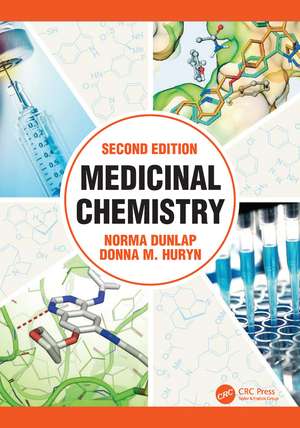
Medicinal Chemistry
Autor Norma K Dunlap, Donna M Hurynen Limba Engleză Hardback – 9 dec 2025
- Written by experts in the field, this outstanding new edition explains medicinal chemistry on chemical mechanism terms, allowing for a more interesting and user-friendly text.
- Includes valuable insights toward the various pathways taken by the pharmaceutical industry in drug discoveries.
- Enhanced text includes questions raised and suggestions made from students in the authors’ medicinal chemistry class.
- Content provided to enhance the text includes a solutions manual, PowerPoint slides for lecture outlines, and especially for the earlier chapters, a selection of videos. An accompanying website will be updated to include additional material: (1) Journal Club exercises—current journal articles with guiding questions for student analysis (two per chapter); (2) additional case studies; (3) organic synthesis analysis—selected syntheses, both discovery and process, will be discussed; and (4) updates on current advances in the field of medicinal chemistry.
- The book benefits a diverse audience, including upper-level undergraduates and graduates who are studying in the fields of medicinal chemistry and drug discovery, as well as scientists working in the pharmaceutical industry.
Preț: 1397.43 lei
Preț vechi: 1470.98 lei
-5%
Puncte Express: 2096
Carte disponibilă
Livrare economică 03-17 noiembrie
Livrare express 17-23 octombrie pentru 76.43 lei
Livrare prin curier în România Termenul estimat este afișat lângă disponibilitate.
Transport gratuit pentru acest produs Plată online sau ramburs, în funcție de opțiunile comenzii.
Retur gratuit în 14 zile Comandă securizată și suport în română.
Specificații
ISBN-13: 9781032737164
ISBN-10: 1032737166
Pagini: 482
Ilustrații: 902
Dimensiuni: 210 x 280 x 30 mm
Greutate: 1.5 kg
Ediția:2. Auflage
Editura: CRC Press
Colecția CRC Press
ISBN-10: 1032737166
Pagini: 482
Ilustrații: 902
Dimensiuni: 210 x 280 x 30 mm
Greutate: 1.5 kg
Ediția:2. Auflage
Editura: CRC Press
Colecția CRC Press
V-ar putea interesa
-
 Pesticides and Neurological DiseasesDonald J. Ecobichon-18%Preț: 1400.17 lei1707.52 lei
 -
 Mixture Toxicity: Linking Approaches from Ecological and Human ToxicologyCornelis A. M. van GestelPreț: 342.62 lei
 -
 -15%Preț: 675.65 lei794.88 lei
 -
 Scorpions of Medical ImportanceHugh L. Keegan-5%Preț: 191.49 lei201.56 lei
 -
 Molecular ToxicologyNick Plant-15%Preț: 603.00 lei709.40 lei
 -
 Betriebswirtschaft für die ApothekeThomas Müller-Bohn-5%Preț: 216.98 lei228.40 lei
 -
 Innovative ArzneiformenUwe Weidenauer-5%Preț: 462.36 lei486.69 lei
Public țintă
Academic, Postgraduate, Professional Reference, Professional Training, and Undergraduate AdvancedCuprins
PART I: DRUG DISCOVERY AND DEVELOPMENT
Chapter 1: Historical Perspective and Overview of Drug Discovery
Chapter 2: Drug Discovery: Hit and Lead Identification
Chapter 3: Lead Optimization: Drug-Target Interactions and the Pharmacophore
Chapter 4: Lead Optimization: Properties Optimized and Medicinal Chemistry Strategies
Chapter 5: The Process of Developing a Drug from an Optimized Lead
PART II: CLASSES OF DRUG TARGETS
Chapter 6: Receptors, Ion Channels, and Transporters as Drug Targets
Chapter 7: Enzymes as Drug Targets
Chapter 8: Protein–Protein and Lipid Structure Interactions as Drug Targets
Chapter 9: DNA and RNA as Drug Targets
PART III: SELECTED THERAPEUTIC AREAS
Chapter 10: Anti-Cancer Drugs
Chapter 11: Antiviral and Antifungal Agents
Chapter 12: Antibacterial and Antiparasitic Drugs
Chapter 13: Drugs Acting on the Central Nervous System
Chapter 1: Historical Perspective and Overview of Drug Discovery
Chapter 2: Drug Discovery: Hit and Lead Identification
Chapter 3: Lead Optimization: Drug-Target Interactions and the Pharmacophore
Chapter 4: Lead Optimization: Properties Optimized and Medicinal Chemistry Strategies
Chapter 5: The Process of Developing a Drug from an Optimized Lead
PART II: CLASSES OF DRUG TARGETS
Chapter 6: Receptors, Ion Channels, and Transporters as Drug Targets
Chapter 7: Enzymes as Drug Targets
Chapter 8: Protein–Protein and Lipid Structure Interactions as Drug Targets
Chapter 9: DNA and RNA as Drug Targets
PART III: SELECTED THERAPEUTIC AREAS
Chapter 10: Anti-Cancer Drugs
Chapter 11: Antiviral and Antifungal Agents
Chapter 12: Antibacterial and Antiparasitic Drugs
Chapter 13: Drugs Acting on the Central Nervous System
Notă biografică
Norma Dunlap is Professor Emerita of Chemistry at Middle Tennessee State University, where she specialized in synthetic organic chemistry and medicinal chemistry. Her research, done primarily with undergraduates and M.S. students, was focused on design and synthesis of bioactive peptidomimetics. She holds a Ph.D. in organic chemistry from the University of Wyoming and was an NIH postdoctoral fellow at the University of Pennsylvania. She began her career as a Senior Research Scientist at Hoffmann-La Roche, in drug discovery. After moving to academia, she was a Lecturer at Vanderbilt University before moving to Middle Tennessee State University.
Donna M. Huryn is Professor of Practice in the Chemistry Department at the University of Pennsylvania where her research focuses on medicinal chemistry projects on novel drugs to treat kidney disease, cancer and rare genetic diseases. She holds a Ph.D. from the University of Pennsylvania. She started her career in industry at Hoffmann-LaRoche and then Wyeth Research before joining academia; she was previously a faculty member at the University of Pittsburgh School of Pharmacy. She is a Fellow of the American Association for the Advancement of Science and the American Chemical Society and was inducted into the ACS Division of Medicinal Chemistry Hall of Fame. She is recipient of the ACS Philadelphia Local Section Award, the Philip S. Portoghese Lectureship, and the Garvin-Olin Medal. From 2014-2023 was Associate Editor of ACS Medicinal Chemistry Letters. In 2019, she co-founded Empowering Women in Organic Chemistry (EWOC), and continues to serve on the organizing committee.
Donna M. Huryn is Professor of Practice in the Chemistry Department at the University of Pennsylvania where her research focuses on medicinal chemistry projects on novel drugs to treat kidney disease, cancer and rare genetic diseases. She holds a Ph.D. from the University of Pennsylvania. She started her career in industry at Hoffmann-LaRoche and then Wyeth Research before joining academia; she was previously a faculty member at the University of Pittsburgh School of Pharmacy. She is a Fellow of the American Association for the Advancement of Science and the American Chemical Society and was inducted into the ACS Division of Medicinal Chemistry Hall of Fame. She is recipient of the ACS Philadelphia Local Section Award, the Philip S. Portoghese Lectureship, and the Garvin-Olin Medal. From 2014-2023 was Associate Editor of ACS Medicinal Chemistry Letters. In 2019, she co-founded Empowering Women in Organic Chemistry (EWOC), and continues to serve on the organizing committee.
Descriere
This book provides a concise introduction to the medicinal chemistry of therapeutically active compounds. Written in an accessible style, it offers a brief overview of the drug development process, from discovery to approved drug.