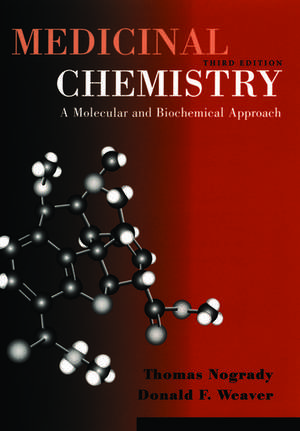
Medicinal Chemistry: A Molecular and Biochemical Approach
Thomas Nogrady, Donald F. Weaveren Limba Engleză Paperback – 18 aug 2005
Preț: 553.63 lei
Preț vechi: 658.74 lei
-16%
Puncte Express: 830
Carte tipărită la comandă
Livrare economică 20 noiembrie-01 decembrie
Livrare prin curier în România Termenul estimat este afișat lângă disponibilitate.
Transport gratuit pentru acest produs Plată online sau ramburs, în funcție de opțiunile comenzii.
Retur gratuit în 14 zile Comandă securizată și suport în română.
Specificații
ISBN-13: 9780195104561
ISBN-10: 0195104560
Pagini: 672
Ilustrații: numerous line drawings, chemical structures and tables
Dimensiuni: 180 x 231 x 30 mm
Greutate: 0.97 kg
Ediția:3
Editura: Oxford University Press
Colecția OUP USA
Locul publicării:New York, United States
ISBN-10: 0195104560
Pagini: 672
Ilustrații: numerous line drawings, chemical structures and tables
Dimensiuni: 180 x 231 x 30 mm
Greutate: 0.97 kg
Ediția:3
Editura: Oxford University Press
Colecția OUP USA
Locul publicării:New York, United States
V-ar putea interesa
-
 Oxford Handbook of CardiologyPunit RamrakhaPreț: 294.58 leiRecomandat
 -
 An Introduction to Medicinal ChemistryGraham L. Patrick-17%Preț: 447.70 lei538.93 lei
 -
 Oxford Handbook of Practical Drug TherapyDuncan Richards-18%Preț: 276.05 lei335.31 lei
 -
 Brody's Human PharmacologyLynn Wecker-5%Preț: 563.21 lei592.85 lei
 -
 Brody's Human PharmacologyLynn Wecker-28%Preț: 421.13 lei581.51 lei
 -
 Rang & Dale's PharmacologyJames M. Ritter-26%Preț: 427.65 lei578.72 lei
 -
 Pharmacology: A Patient-Centered Nursing Process ApproachLinda E. McCuistion-29%Preț: 681.22 lei961.83 lei
 -
 Kumar and Clark's Clinical MedicineDavid Randall-26%Preț: 489.85 lei660.08 leiRecomandat
 -
 -28%Preț: 810.11 lei1121.58 leiRecomandat
 -
 Cellular and Molecular ImmunologyAbul K. Abbas-28%Preț: 508.36 lei710.57 leiRecomandat
 -
 Clinical ChemistryWilliam J. Marshall-5%Preț: 355.95 lei374.69 leiRecomandat
 -
 Dale's Pharmacology CondensedClive P. Page-29%Preț: 216.89 lei306.92 lei
 -
 Medical Pharmacology and TherapeuticsDerek G. Waller-27%Preț: 400.83 lei552.71 lei
 -
 Essentials of Pharmaceutical ChemistryDonald Cairns-6%Preț: 352.10 lei373.93 lei
 -
 Medicinal ChemistryNorma K Dunlap-5%Preț: 1020.26 lei1073.96 lei
 -
 Principles of Pharmacology: The Pathophysiologic Basis of Drug TherapyDavid E. Golan MD, PhD-5%Preț: 676.19 lei711.78 lei
 -
 -5%Preț: 359.06 lei377.96 lei
 -
 Foye's Principles of Medicinal ChemistryKimberly Beck-18%Preț: 683.55 lei832.09 lei
Recenzii
From reviews of previous editions:
"The book is a welcome and refreshing approach to the presentation of medicinal chemistry, and it should prove valuable to the audience for which it was intended."
"This book would be a valuable addition to any library that supports programs in medicinal chemistry or the other pharmaceutical sciences."
"The text is very readable and each chapter has a bibliogrpahy for further reading. The book will be very useful for those wishing to understand the mechanisms of drug action and how to design new drugs."
"The book is a welcome and refreshing approach to the presentation of medicinal chemistry, and it should prove valuable to the audience for which it was intended."
"This book would be a valuable addition to any library that supports programs in medicinal chemistry or the other pharmaceutical sciences."
"The text is very readable and each chapter has a bibliogrpahy for further reading. The book will be very useful for those wishing to understand the mechanisms of drug action and how to design new drugs."
Cuprins
- Part A: General Molecular Principles of Drug Design
- 1: Basic Principles of Drug Design I: Drug Molecules: Structure and Properties
- 2: Basic Principles of Drug Design II: Receptors: Structures and Properties
- 3: Basic Principles of Drug Design III: Designing Drug Molecules to Fit Receptors
- Part B: Biochemical Considerations in Drug Design
- 4: Messenger Targets for Drug Action I: Neurotransmitters and Their Receptors
- 5: Messenger Targets for Drug Action II: Hormones and Their Receptors
- 6: Messenger Targets for Drug Action III: Immunomodulators and Their Receptors
- 7: Nonmessenger Targets for Drug Action I: Endogenous Cellular Structures
- 8: Nonmessenger Targets for Drug Action II: Endogenous Macromolecules
- 9: Nonmessenger Targets for Drug Action III: Exogenous "Nonself" Pathogens
- Appendix A: Drugs arranged by pharmacologic activity