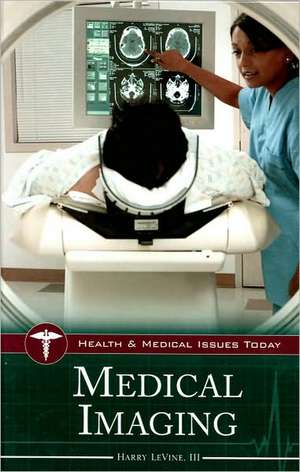
Medical Imaging
Autor Harry LeVine IIIen Limba Engleză Hardback – 9 apr 2010
Medical Imaging describes the discovery and development of diagnostic imaging technologies, explaining how the technologies work and exploring some of the issues that such powerful and expensive technologies create. The book begins with the discovery of X-rays in 1895 and traces the history of imaging technology through today's tools, such as X-ray computed tomography, magnetic resonance imaging (MRI), functional imaging by positron emission tomography (PET), and single photon emission computed tomography (SPECT).
The contribution of these expensive technologies to the rising cost of healthcare in the United States and the unequal distribution of imaging diagnostic facilities, particularly in developing countries, is also considered. In addition, the book explores ethical questions that have surfaced in the past, including the reportability of incidental findings during a scan and admissibility of medical images as evidence in courts of law , and such newly emerging issues as the application of imaging tools in lie detection and the mammography guidelines controversy of 2009.
Preț: 155.11 lei
Preț vechi: 163.27 lei
-5%
Puncte Express: 233
Carte tipărită la comandă
Livrare economică 06-20 noiembrie
Livrare prin curier în România Termenul estimat este afișat lângă disponibilitate.
Transport gratuit de la 400.00 lei Plată online sau ramburs, în funcție de opțiunile comenzii.
Retur gratuit în 14 zile Comandă securizată și suport în română.
Specificații
ISBN-13: 9780313359699
ISBN-10: 0313359695
Pagini: 224
Dimensiuni: 156 x 235 x 23 mm
Greutate: 0.48 kg
Editura: Bloomsbury Publishing
Colecția Greenwood
Locul publicării:New York, United States
ISBN-10: 0313359695
Pagini: 224
Dimensiuni: 156 x 235 x 23 mm
Greutate: 0.48 kg
Editura: Bloomsbury Publishing
Colecția Greenwood
Locul publicării:New York, United States
V-ar putea interesa
-
 X-Ray Vision: The Evolution of Medical Imaging and Its Human SignificanceRichard B. Gunderman-26%Preț: 734.81 lei995.66 lei
 -
 Neuromuscular Ultrasound: Expert Consult - Online and PrintFrancis Walker-32%Preț: 691.00 lei1013.61 lei
 -
 -5%Preț: 828.15 lei871.74 lei
 -
 Autonomic Innervation of the HeartRiemer H. J. A. Slart-5%Preț: 730.68 lei769.14 lei
Recenzii
In the two major sections, Le Vine (Univ. of Kentucky in Lexington) offers a fascinating history of the various forms of medical imaging and the current controversies surrounding their uses. He describes the most current technologies in sufficient detail so that readers obtain the requisite knowledge base. The second section is the gem. Against a background of today's rising health care costs and the misinformation provided on the Internet, the author clarifies many of the urban legends surrounding imaging technologies. The final section provides a highly current and comprehensive set of references and resources. Charts, illustrations, and a glossary are included. Summing Up: Highly recommended. General audience, health care students, and perhaps entry-level health care practitioners.