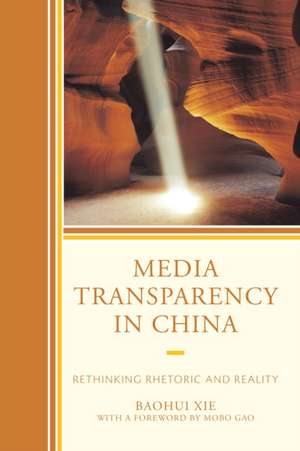
Media Transparency in China: Rethinking Rhetoric and Reality
Autor Baohui Xie Cuvânt înainte de Mobo Gaoen Limba Engleză Paperback – 24 mar 2017
Preț: 328.98 lei
Preț vechi: 426.17 lei
-23%
Puncte Express: 493
Carte tipărită la comandă
Livrare economică 12-26 noiembrie
Livrare prin curier în România Termenul estimat este afișat lângă disponibilitate.
Transport gratuit de la 400.00 lei Plată online sau ramburs, în funcție de opțiunile comenzii.
Retur gratuit în 14 zile Comandă securizată și suport în română.
Specificații
ISBN-13: 9781498502139
ISBN-10: 149850213X
Pagini: 218
Ilustrații: 7 Charts
Dimensiuni: 150 x 228 x 16 mm
Greutate: 0.34 kg
Editura: Bloomsbury Publishing
Colecția Lexington Books
Locul publicării:New York, United States
ISBN-10: 149850213X
Pagini: 218
Ilustrații: 7 Charts
Dimensiuni: 150 x 228 x 16 mm
Greutate: 0.34 kg
Editura: Bloomsbury Publishing
Colecția Lexington Books
Locul publicării:New York, United States
Cuprins
Chapter 1: Press Freedom and Transparency in China
Chapter 2: Media Transparency
Chapter 3: Meta-Censorship
Chapter 4: Pandemic Media Corruption
Chapter 5: Marketisation and Conglomeration of State-owned Media
Chapter 6: "Opening a Skylight"
Chapter 7: Transparency Illusion and Disjuncture of Representation
Chapter 2: Media Transparency
Chapter 3: Meta-Censorship
Chapter 4: Pandemic Media Corruption
Chapter 5: Marketisation and Conglomeration of State-owned Media
Chapter 6: "Opening a Skylight"
Chapter 7: Transparency Illusion and Disjuncture of Representation
Recenzii
This book is more than a study of contemporary Chinese media and should be of interest to anyone who cares about the general social and political developments of the country. The author goes beyond the usual discussion of censorship and authoritarianism. With revealing evidence and a careful examination of the working structure of the Chinese media, he argues convincingly that a discrepancy between reality and the Party/state's claim and a consequential 'disjuncture of political representation,' rather than 'media transparency,' should be the issue.
Why has the media boom in post-Mao China failed to lead to adequate media transparency? Why is censorship denied by both the Party-state and the mass media? What has resulted in the rampant media corruption hampering transparency? These are the main questions that Baohui Xie raises in this rich, engaging, and thought-provoking volume. The book makes a very important contribution to the effort to find a new framework for analyzing press freedom, or the lack of it, in the People's Republic of China. It shifts the discussion away from individual freedom and assumptions of a state-versus-market dichotomy towards the substance of media transparency and supervision by public opinion. Instead of rejecting press freedom as a desirable value, it questions the 'liberal market logic' that simplistically attributes the lack of freedom to censorship and control by the Party-state. Xie argues vigorously and elegantly about the complicity of the Party-state and the media in jointly suppressing the voice of the disfranchised, especially the poor and disadvantaged social groups.
Whether one agrees with Xie's argument or not, there can be no doubt that the book has the power to make one look at China's mass media, state control, and a broad range of media issues differently. The book is remarkable in its unity and conceptual clarity. It will be of great value to scholars and students of China's mediascape and media politics. A must-read of anyone attempting to understand the Chinese media's adaptive strategies as they are caught between the state and market as well as the trajectories of change in state-media and market-media relations.
Why has the media boom in post-Mao China failed to lead to adequate media transparency? Why is censorship denied by both the Party-state and the mass media? What has resulted in the rampant media corruption hampering transparency? These are the main questions that Baohui Xie raises in this rich, engaging, and thought-provoking volume. The book makes a very important contribution to the effort to find a new framework for analyzing press freedom, or the lack of it, in the People's Republic of China. It shifts the discussion away from individual freedom and assumptions of a state-versus-market dichotomy towards the substance of media transparency and supervision by public opinion. Instead of rejecting press freedom as a desirable value, it questions the 'liberal market logic' that simplistically attributes the lack of freedom to censorship and control by the Party-state. Xie argues vigorously and elegantly about the complicity of the Party-state and the media in jointly suppressing the voice of the disfranchised, especially the poor and disadvantaged social groups.
Whether one agrees with Xie's argument or not, there can be no doubt that the book has the power to make one look at China's mass media, state control, and a broad range of media issues differently. The book is remarkable in its unity and conceptual clarity. It will be of great value to scholars and students of China's mediascape and media politics. A must-read of anyone attempting to understand the Chinese media's adaptive strategies as they are caught between the state and market as well as the trajectories of change in state-media and market-media relations.