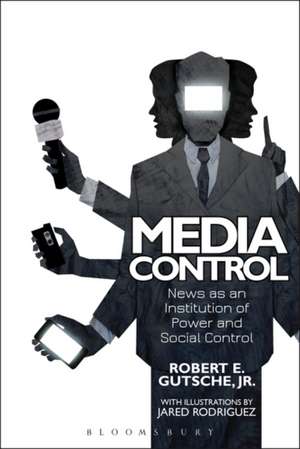
Media Control: News as an Institution of Power and Social Control
Autor Dr Robert E. Gutsche, Jr., Jr.en Limba Engleză Paperback – 20 apr 2017
From analysing how the press operate as police agents by conducting surveillance and instituting social order through its coverage of crime and police action to bolstering private business and neoliberal principles by covering the news through notions of boosterism, Media Control presents the news through a cultural lens. Robert E. Gutsche, Jr. introduces or advances readers' applications of critical race theory and cultural studies scholarship to explore cultural meanings within news coverage of police action, the criminal justice system, and embedding into the news democratic values that are later used by the power elite to oppress and repress portions of the citizenry. Media Control helps the reader explicate how the power elite use the press and the veil of the Fourth Estate to further white ideologies and American Imperialism.
Preț: 282.33 lei
Preț vechi: 371.85 lei
-24%
Puncte Express: 423
Carte tipărită la comandă
Livrare economică 19 noiembrie-03 decembrie
Livrare prin curier în România Termenul estimat este afișat lângă disponibilitate.
Transport gratuit de la 400.00 lei Plată online sau ramburs, în funcție de opțiunile comenzii.
Retur gratuit în 14 zile Comandă securizată și suport în română.
Specificații
ISBN-13: 9781501320132
ISBN-10: 1501320130
Pagini: 400
Ilustrații: 10 bw illus
Dimensiuni: 152 x 234 x 22 mm
Greutate: 0.55 kg
Ediția:NIPPOD
Editura: Bloomsbury Publishing
Colecția Bloomsbury Academic
Locul publicării:New York, United States
ISBN-10: 1501320130
Pagini: 400
Ilustrații: 10 bw illus
Dimensiuni: 152 x 234 x 22 mm
Greutate: 0.55 kg
Ediția:NIPPOD
Editura: Bloomsbury Publishing
Colecția Bloomsbury Academic
Locul publicării:New York, United States
V-ar putea interesa
-
 -29%Preț: 376.76 lei527.54 lei
 -
 Preț: 405.86 lei
 -
 ITV Cultures: Independent Television Over Fifty YearsCatherine Johnson-29%Preț: 170.42 lei240.65 lei
 -
 Media and SocietyGraeme Burton-27%Preț: 218.98 lei300.55 lei
 -
 FrostNeil HegartyPreț: 123.38 lei
 -
 Textual AnalysisAlan Mckee-15%Preț: 616.69 lei725.52 lei
 -
 International Communications: A Media Literacy ApproachArt SilverblattPreț: 476.61 lei
 -
 Westminster Tales: The Twenty-first-Century Crisis in Political JournalismProfessor Steven Barnett-22%Preț: 500.11 lei639.84 lei
 -
 The Global Media AtlasProf. Mark Balnaves-23%Preț: 249.66 lei325.98 lei
 -
 European Media in Crisis: Values, Risks and PoliciesJosef Trappel-18%Preț: 1245.04 lei1518.35 lei
 -
 Stardom and CelebritySu Holmes-8%Preț: 470.32 lei511.21 lei
 -
 News DiscourseDr. Monika Bednarek-25%Preț: 1106.58 lei1467.31 lei
 -
 How to Launch a Magazine in this Digital AgeJohn Jenkins-16%Preț: 207.74 lei248.61 lei
 -
 Media and Translation: An Interdisciplinary ApproachDr Dror Abend-David-24%Preț: 281.65 lei371.49 lei
 -
 Barnett, S: Media Ownership, Journalism and DiversitySteven Barnett-25%Preț: 140.96 lei188.76 lei
 -
 Content is King: News Media Management in the Digital AgeLecturer in Service Operations Gary Graham-16%Preț: 278.68 lei329.91 lei
 -
 -15%Preț: 163.07 lei192.20 lei
 -
 Open SkyPaul VirilioPreț: 91.90 lei
Cuprins
Acknowledgements
Preface
Introduction
I. The Experience of Experiencing Power: A Beginning
II. Purpose of the Book
III. Plan of the Book
1. Power, Propaganda & the Purpose of News
I. Explicating the Embassy Evacuations: The Purpose of Banal News
II. Power: A Briefing on News as Commodity
III. Incorporating the News: Joining 'The Power Elite'
IV. Conclusion: Interpreting News as Propaganda
2. Making News: Purposes, Practices & Pandering
I. News as National Rhetoric: The Boston Bombing
II. Narratives of Journalism Studies: Politics, Profits & Media-making
III. From Social Power to 'Media Power'
IV. Interpreting Journalism Through Levels of Analysis
3. Displacement & Punishment: The Press as Place-makers
I. Here is Not There: Place Ideologies in the Press
II. The Power of 'Othering' in Press Characterizations of Place & Race
III. News Place-making as 'The New Jim Crow'
IV. Conclusion: Media Displacement as Punishment
4. News as Cultural Distraction: Controversy, Conspiracy & Collective Forgetting
I. Controversy or Bust: Media Commitment to Crazy in National Crises
II. The Distraction of 'Conspiracy Theory': News, Fear & The Need for Protection
III. Militarization & Media Violence: The Warfare of Urban Memory
IV. Conclusion: Collective Forgetting & Media Control
5. Normalizing Media Surveillance: Media Waiting, Watching & Shaming
I. Media Waiting: Fearing South Beach's Urban Beach Week
II. Media Watching: The Function of Media Surveillance
III. Media Shaming: Normalizing 'Correction'-as-Control
IV. Conclusion: Media Surveillance as Punishment
6. The Violence of Media Souseveillance: Identifying the Press as Police
I. Police Myth: Media Adoption of Police Power
II. Journalistic Information & (Questioned) Collaboration
III. Controlled Monitoring as Mediated Practice
IV. Conclusion: The Virtuous Violence of Media Souseveillance
Conclusion: The Myth of Being "Post-Media" & Why Americans Will Always be Media Illiterate
I. Media Control: An Assessment & Reminder
II. The Death of Media Literacy: The Force of Digital Distractions & Corporatization
III. Media Socialization & Press Pacification Through Journalism Education
IV. Conclusion: Complicating Media Control's Collective Identity
Glossary
Index
Preface
Introduction
I. The Experience of Experiencing Power: A Beginning
II. Purpose of the Book
III. Plan of the Book
1. Power, Propaganda & the Purpose of News
I. Explicating the Embassy Evacuations: The Purpose of Banal News
II. Power: A Briefing on News as Commodity
III. Incorporating the News: Joining 'The Power Elite'
IV. Conclusion: Interpreting News as Propaganda
2. Making News: Purposes, Practices & Pandering
I. News as National Rhetoric: The Boston Bombing
II. Narratives of Journalism Studies: Politics, Profits & Media-making
III. From Social Power to 'Media Power'
IV. Interpreting Journalism Through Levels of Analysis
3. Displacement & Punishment: The Press as Place-makers
I. Here is Not There: Place Ideologies in the Press
II. The Power of 'Othering' in Press Characterizations of Place & Race
III. News Place-making as 'The New Jim Crow'
IV. Conclusion: Media Displacement as Punishment
4. News as Cultural Distraction: Controversy, Conspiracy & Collective Forgetting
I. Controversy or Bust: Media Commitment to Crazy in National Crises
II. The Distraction of 'Conspiracy Theory': News, Fear & The Need for Protection
III. Militarization & Media Violence: The Warfare of Urban Memory
IV. Conclusion: Collective Forgetting & Media Control
5. Normalizing Media Surveillance: Media Waiting, Watching & Shaming
I. Media Waiting: Fearing South Beach's Urban Beach Week
II. Media Watching: The Function of Media Surveillance
III. Media Shaming: Normalizing 'Correction'-as-Control
IV. Conclusion: Media Surveillance as Punishment
6. The Violence of Media Souseveillance: Identifying the Press as Police
I. Police Myth: Media Adoption of Police Power
II. Journalistic Information & (Questioned) Collaboration
III. Controlled Monitoring as Mediated Practice
IV. Conclusion: The Virtuous Violence of Media Souseveillance
Conclusion: The Myth of Being "Post-Media" & Why Americans Will Always be Media Illiterate
I. Media Control: An Assessment & Reminder
II. The Death of Media Literacy: The Force of Digital Distractions & Corporatization
III. Media Socialization & Press Pacification Through Journalism Education
IV. Conclusion: Complicating Media Control's Collective Identity
Glossary
Index
Recenzii
Media Control is a rare, critical look at the power of news at a time of increased surveillance and policing. It's a must read for journalists, citizens and scholars who are concerned about the future of a free society-and their role in it.
In a reflexive account of media control, Robert Gutsche revives the news-as-propaganda model of journalism. He argues that news of fear today justifies government surveillance and militaristic force, reifies power structures that privilege the rich and well positioned, and establishes stark and helpful good-evil demarcations in society. Whether or not you agree with his assessments, Gutsche's work is a radical statement about the complicit role the press has in promoting fear, violence, and social control. Media Control offers an alternative perspective about the role of journalism reminiscent of Noam Chomsky, and represents a conversation piece that would be useful in journalism classes and among those interested in assessing media, journalism education and their function in a democratic society.
This brave and groundbreaking book in critical journalism throws a devastating blow to the myth about the media and police neutrality. Far from it, Robert Gutsche posits, these two centers of power share the same objective: social control of local communities. Local 'news' about crime, the argument goes, create the local community in its own image; in such capacity, 'news' about crime acts as a symbolic police force patrolling the very space it has created and owns, as its own beat. To the extent that Gutsche takes a cue from Chomsky's and Greenwald's scrutiny of the global media, and shifts the critical focus onto local media and its coverage of a crime, Media Control is a must read for every student studying journalism.
Although not explicitly stated by the founding fathers, but clearly explicated here, is that ultimately what the media has today (and perhaps has always had) is power; specifically, the power to inform, the power to persuade, and the power to help steer the opinions of vast swaths of the population on topics ranging from perceptions of war to their perception of politicians. In this clearly elucidated book, Robert Gutsche helps readers understand how the media wield power. It is a must-read for scholars, laypeople, and anyone who is just interested in knowing about the workings of the media, the construction of news, and ultimately what effect the media does, and does not have, on people's perception of reality.
As the battle to control information in a digital world intensifies, this book places front and center the media's ability to shape meaning in our everyday lives and its relationship to the 'Power Elite.' Through notions of propaganda, controversy, conspiracy and place-making, this book won't just rattle some journalism cages that seek to preserve classical notions of news media and power - it will shatter them. The book also addresses a paucity of scholarly work on the local press by examining issues of media control closest to home. This is a timely and valuable contribution to the field. A must read.
In contrast to books on modern media that examine control of media by financial elites and corporations, Gutsche's important study provides a rare look at how media collaborate with power elites in order to maintain social control. . He builds his study on theory developed by cultural studies scholars Stuart Hall and James Carey and critical studies media scholar Robert McChesney. . His analyses of the local media are helpful as a starting point for understanding the role of newspapers and radio and television stations sprinkled throughout the US. Summing Up: Recommended. Lower-division undergraduates through faculty and professionals; general readers.
Gutsche succeeds in what he set out to do. He contributes critical, nuanced, accessible analysis of the press as an act of power. The book succeeds for three reasons. First, Gutsche effectively married theory to analysis. No one will accuse him of academic laziness. Second, his use of recent events such as the Sandy Hook massacre capitalizes on reader memory. Finally, Gutsche's passion bleeds from each page. If it is true that all research is autobiographical, then may we all be so willing to look within ourselves for what needs to be studied next.
In a reflexive account of media control, Robert Gutsche revives the news-as-propaganda model of journalism. He argues that news of fear today justifies government surveillance and militaristic force, reifies power structures that privilege the rich and well positioned, and establishes stark and helpful good-evil demarcations in society. Whether or not you agree with his assessments, Gutsche's work is a radical statement about the complicit role the press has in promoting fear, violence, and social control. Media Control offers an alternative perspective about the role of journalism reminiscent of Noam Chomsky, and represents a conversation piece that would be useful in journalism classes and among those interested in assessing media, journalism education and their function in a democratic society.
This brave and groundbreaking book in critical journalism throws a devastating blow to the myth about the media and police neutrality. Far from it, Robert Gutsche posits, these two centers of power share the same objective: social control of local communities. Local 'news' about crime, the argument goes, create the local community in its own image; in such capacity, 'news' about crime acts as a symbolic police force patrolling the very space it has created and owns, as its own beat. To the extent that Gutsche takes a cue from Chomsky's and Greenwald's scrutiny of the global media, and shifts the critical focus onto local media and its coverage of a crime, Media Control is a must read for every student studying journalism.
Although not explicitly stated by the founding fathers, but clearly explicated here, is that ultimately what the media has today (and perhaps has always had) is power; specifically, the power to inform, the power to persuade, and the power to help steer the opinions of vast swaths of the population on topics ranging from perceptions of war to their perception of politicians. In this clearly elucidated book, Robert Gutsche helps readers understand how the media wield power. It is a must-read for scholars, laypeople, and anyone who is just interested in knowing about the workings of the media, the construction of news, and ultimately what effect the media does, and does not have, on people's perception of reality.
As the battle to control information in a digital world intensifies, this book places front and center the media's ability to shape meaning in our everyday lives and its relationship to the 'Power Elite.' Through notions of propaganda, controversy, conspiracy and place-making, this book won't just rattle some journalism cages that seek to preserve classical notions of news media and power - it will shatter them. The book also addresses a paucity of scholarly work on the local press by examining issues of media control closest to home. This is a timely and valuable contribution to the field. A must read.
In contrast to books on modern media that examine control of media by financial elites and corporations, Gutsche's important study provides a rare look at how media collaborate with power elites in order to maintain social control. . He builds his study on theory developed by cultural studies scholars Stuart Hall and James Carey and critical studies media scholar Robert McChesney. . His analyses of the local media are helpful as a starting point for understanding the role of newspapers and radio and television stations sprinkled throughout the US. Summing Up: Recommended. Lower-division undergraduates through faculty and professionals; general readers.
Gutsche succeeds in what he set out to do. He contributes critical, nuanced, accessible analysis of the press as an act of power. The book succeeds for three reasons. First, Gutsche effectively married theory to analysis. No one will accuse him of academic laziness. Second, his use of recent events such as the Sandy Hook massacre capitalizes on reader memory. Finally, Gutsche's passion bleeds from each page. If it is true that all research is autobiographical, then may we all be so willing to look within ourselves for what needs to be studied next.
Notă biografică
Robert E. Gutsche, Jr. is Assistant Professor in the School of Journalism and Mass Communication at Florida International University, USA. He has published in journals such as Journalism & Mass Communication Quarterly, Journalism, Journalism Studies, and Journalism Practice. His first book deals with news coverage of black diaspora in the U.S. and is due out in Spring
2014.