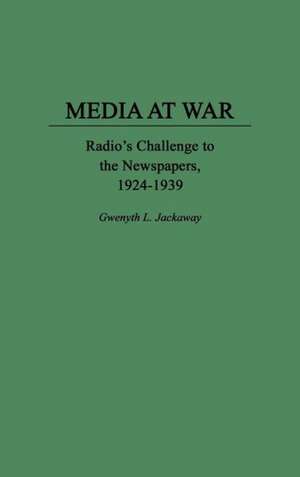
Media at War: Radio's Challenge to the Newspapers, 1924-1939
Autor Gwenyth L. Jackawayen Limba Engleză Hardback – 20 noi 1995
Preț: 392.35 lei
Preț vechi: 534.28 lei
-27%
Puncte Express: 589
Carte tipărită la comandă
Livrare economică 30 noiembrie-14 decembrie
Livrare prin curier în România Termenul estimat este afișat lângă disponibilitate.
Transport gratuit de la 400.00 lei Plată online sau ramburs, în funcție de opțiunile comenzii.
Retur gratuit în 14 zile Comandă securizată și suport în română.
Specificații
ISBN-13: 9780275952570
ISBN-10: 0275952576
Pagini: 184
Dimensiuni: 156 x 235 x 19 mm
Greutate: 0.42 kg
Ediția:New.
Editura: Bloomsbury Publishing
Colecția Praeger
Locul publicării:New York, United States
ISBN-10: 0275952576
Pagini: 184
Dimensiuni: 156 x 235 x 19 mm
Greutate: 0.42 kg
Ediția:New.
Editura: Bloomsbury Publishing
Colecția Praeger
Locul publicării:New York, United States
V-ar putea interesa
-
 The Decline and Fall of Public Service BroadcastingMichael Tracey-28%Preț: 362.04 lei502.61 lei
 -
 Television, the Public Sphere, and National IdentityMonroe E. Price-19%Preț: 338.14 lei417.92 lei
 -
 New Patterns in Global Television: Peripheral VisionJohn Sinclair-21%Preț: 250.14 lei315.17 lei
 -
 Broadcasting in the 21st CenturyRichard RudinPreț: 256.34 lei
 -
 Preț: 384.85 lei
 -
 Creating Preschool TelevisionJ. SteemersPreț: 384.57 lei
 -
 Basic Radio JournalismPaul ChantlerPreț: 394.29 lei
 -
 Branding TV: Principles and PracticesWalter McDowell-15%Preț: 468.70 lei551.41 lei
 -
 My Life So FarSir Denis FormanPreț: 88.22 lei
 -
 -23%Preț: 494.87 lei642.69 lei
 -
 TV Brand BuildersAndy BryantPreț: 288.92 lei
 -
 The Internet and the Mass MediaLucy Küng-18%Preț: 692.76 lei844.83 lei
 -
 Arab Television TodayNaomi Sakr-26%Preț: 164.17 lei222.87 lei
Cuprins
Media Wars and Resistance to New Technologies
The Life Cycle of a Media War: The Three Stages of the Press-Radio War
Radio's Threat to the Institutional Identity of the Press
Radio's Threat to the Institutional Structure of the Press
Radio's Threat to the Institutional Function of the Press
Epilogue
Selected Bibliography
Index
The Life Cycle of a Media War: The Three Stages of the Press-Radio War
Radio's Threat to the Institutional Identity of the Press
Radio's Threat to the Institutional Structure of the Press
Radio's Threat to the Institutional Function of the Press
Epilogue
Selected Bibliography
Index
Recenzii
Media at War is a case study of the period from 1924, the year in which the airways first reposted election returns, through 1939, the year that the Associated Press finally lifted its ban on providing news briefs to radio. During these years most newspapers attempted to block the development of broadcast journalism. At stake was the power to control news distribution--the power to shape public opinion and set the national political agenda.
In her deeply researched 1995 book, Media at War: Radio's Challenge to the Newspapers, 1924-1939, scholar Gwenyth L. Jackaway charts a similar set of complaints leveled by newspapers against the upstart medium of radio in the 1920s and 1930s.
In her deeply researched 1995 book, Media at War: Radio's Challenge to the Newspapers, 1924-1939, scholar Gwenyth L. Jackaway charts a similar set of complaints leveled by newspapers against the upstart medium of radio in the 1920s and 1930s.