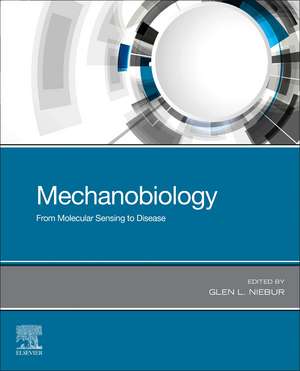
Mechanobiology: From Molecular Sensing to Disease
Autor Glen L. Nieburen Limba Engleză Paperback – 4 dec 2019
- Presents our current understanding of the main molecular pathways by which cells sense and respond to mechanical stimuli
- Provides a review of diseases with known or purported mechanobiological underpinnings
- Includes the role of mechanobiology in tissue engineering and regenerative medicine
- Covers experimental methods to capture mechanobiological phenomena
Preț: 472.40 lei
Preț vechi: 645.66 lei
-27%
Puncte Express: 709
Carte tipărită la comandă
Livrare economică 28 noiembrie-12 decembrie
Livrare prin curier în România Termenul estimat este afișat lângă disponibilitate.
Transport gratuit pentru acest produs Plată online sau ramburs, în funcție de opțiunile comenzii.
Retur gratuit în 14 zile Comandă securizată și suport în română.
Specificații
ISBN-13: 9780128179314
ISBN-10: 0128179317
Pagini: 254
Dimensiuni: 191 x 235 x 20 mm
Greutate: 0.52 kg
Editura: ELSEVIER SCIENCE
ISBN-10: 0128179317
Pagini: 254
Dimensiuni: 191 x 235 x 20 mm
Greutate: 0.52 kg
Editura: ELSEVIER SCIENCE
V-ar putea interesa
-
 -42%Preț: 961.28 lei1643.41 lei
 -
 DNA Structures, Part A, Synthesis and Physical Analysis of DNAJohn N. Abelson-27%Preț: 746.19 lei1022.18 lei
 -
 Molecular ChaperonesJohn N. Abelson-27%Preț: 744.08 lei1019.29 lei
 -
 Caged CompoundsJohn N. Abelson-44%Preț: 744.77 lei1340.54 lei
 -
 ABC Transporters: Biochemical, Cellular, and Molecular AspectsJohn N. Abelson-34%Preț: 798.66 lei1215.34 lei
 -
 Biophysical Tools for Biologists: In Vivo TechniquesJohn J. Correia-34%Preț: 707.69 lei1076.10 lei
 -
 Plant EnergeticsOctavian S. Ksenzhek-27%Preț: 618.26 lei846.93 lei
 -
 BiomathematicsS. Andersson-14%Preț: 2314.33 lei2691.07 lei
 -
 -14%Preț: 2694.29 lei3132.90 lei
 -
 Infrared Spectroscopy of BiomoleculesHenry H Mantsch-9%Preț: 1816.89 lei1996.58 lei
 -
 -19%Preț: 535.75 lei661.68 lei
 -
 Air and WaterMark Denny-19%Preț: 605.12 lei747.05 lei
 -
 The Physics of SportsAngelo Jr. Armenti-8%Preț: 599.31 lei651.43 lei
 -
 Introduction to the Biophysics of Activated WaterIgor V SmirnovPreț: 192.78 lei
 -
 Preț: 71.41 lei
 -
 Thermodynamic Bases of Biological ProcessesA. I. Zotin-23%Preț: 2450.68 lei3182.70 lei
Public țintă
Research, post-doctoral scholars, graduate students, Medical device and regenerative medicine designers and manufacturersCuprins
Section 1: Mechanobiological basis of diseases1.1 Osteoporosis1.2 Cardiovascular mechanics and disease1.3 Glaucoma and eye diseases1.4 Growth and development1.5 Tissue engineering and regenerative medicine
Section 2: Cellular basis of Mechanobiology 2.1 Cells as strain gages and load cells2.2 Cell – extracellular matrix interactions2.3 Mechanobiological pathways2.4 Mechanically mediated epigenetics
Section 3: Experimental methods3.1 Effects of shear stress on cells3.2 Three-dimensional culture systems3.3 Bioreactors3.4 Tissue and organ on a chip systems
Section 4: Computational simulations in mechanobiology4.1 Cell aggregation4.2 Growth models5. Future prospects and challenges6. Bibliography7. Glossary
Section 2: Cellular basis of Mechanobiology 2.1 Cells as strain gages and load cells2.2 Cell – extracellular matrix interactions2.3 Mechanobiological pathways2.4 Mechanically mediated epigenetics
Section 3: Experimental methods3.1 Effects of shear stress on cells3.2 Three-dimensional culture systems3.3 Bioreactors3.4 Tissue and organ on a chip systems
Section 4: Computational simulations in mechanobiology4.1 Cell aggregation4.2 Growth models5. Future prospects and challenges6. Bibliography7. Glossary
Notă biografică
Glen Niebur is a professor of Aerospace and Mechanical Engineering at the University of Notre Dame. He holds bachelor's and master's degrees from the University of Minnesota, and the Ph.D. from the University of California. Research is focused on orthopedics, including bone quality, damage mechanics of trabecular bone, mechanobiology of bone, hard and soft tissue constitutive modeling, computational mechanics of tissues, and genetic factors affecting bone quality.
Current projects are investigating the interactions between microdamage formation in bone and the changes in bone porosity and structure that accompany osteoporosis. Osteoporosis results in changes at multiple levels of the hierarchical structure of bone, and these can either compensate for or enhance fracture risk. Medical imaging methods, especially computed tomography (CT) are used to image and quantify bone structures in bone samples and in live animals. A current project is using medical imaging to longitudinally monitor and understand fracture healing. Most recently, work has begun in the area of bone marrow mechanics, affects of aging and disease on bone marrow morphology, and interactions between bone and bone marrow.
Current projects are investigating the interactions between microdamage formation in bone and the changes in bone porosity and structure that accompany osteoporosis. Osteoporosis results in changes at multiple levels of the hierarchical structure of bone, and these can either compensate for or enhance fracture risk. Medical imaging methods, especially computed tomography (CT) are used to image and quantify bone structures in bone samples and in live animals. A current project is using medical imaging to longitudinally monitor and understand fracture healing. Most recently, work has begun in the area of bone marrow mechanics, affects of aging and disease on bone marrow morphology, and interactions between bone and bone marrow.