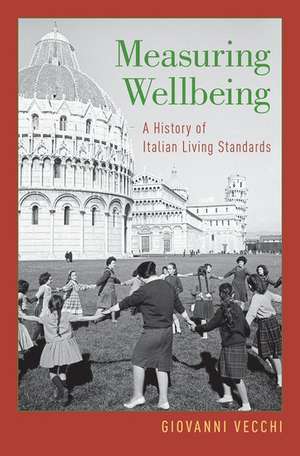
Measuring Wellbeing: A History of Italian Living Standards
Autor Giovanni Vecchien Limba Engleză Hardback – 9 mar 2017
Preț: 866.17 lei
Preț vechi: 1007.17 lei
-14%
Puncte Express: 1299
Carte disponibilă
Livrare economică 06-11 noiembrie
Livrare prin curier în România Termenul estimat este afișat lângă disponibilitate.
Transport gratuit pentru acest produs Plată online sau ramburs, în funcție de opțiunile comenzii.
Retur gratuit în 14 zile Comandă securizată și suport în română.
Specificații
ISBN-13: 9780199944590
ISBN-10: 0199944598
Pagini: 672
Dimensiuni: 160 x 239 x 38 mm
Greutate: 1.27 kg
Editura: Oxford University Press
Colecția OUP USA
Locul publicării:New York, United States
ISBN-10: 0199944598
Pagini: 672
Dimensiuni: 160 x 239 x 38 mm
Greutate: 1.27 kg
Editura: Oxford University Press
Colecția OUP USA
Locul publicării:New York, United States
V-ar putea interesa
-
 Leading Issues in Economic DevelopmentJames Rauch-27%Preț: 1257.97 lei1723.25 lei
 -
 -31%Preț: 543.07 lei788.12 lei
 -
 -14%Preț: 84.79 lei98.71 lei
 -
 -19%Preț: 352.29 lei436.13 lei
 -
 Clusters, Networks, and InnovationStefano Breschi-24%Preț: 538.07 lei705.21 lei
 -
 State Level Reforms, Growth, and Development in Indian StatesArvind Panagariya-14%Preț: 540.09 lei628.02 lei
 -
 -15%Preț: 665.66 lei783.13 lei
 -
 -15%Preț: 658.21 lei774.36 lei
 -
 But Will the Planet Notice?Gernot WagnerPreț: 108.67 lei
 -
 Landscape, Process and PowerSerena HecklerPreț: 232.17 lei
 -
 -15%Preț: 667.33 lei785.10 lei
 -
 United States Assistance for the PalestiniansJames Bailey-27%Preț: 888.98 lei1210.63 lei
Recenzii
This is an important book for Italians, and it makes a remarkable contribution to the description of the long-term evolution of standards of living in Italy.
This amazing and novel book on Italian inequality, poverty, and living standards since unification has no competitor. Certainly not in English, which is used here with great elegance. And perhaps not even in the whole EU. Anyone involved in policy debate over inequality and poverty in modern Italy and the EU must read this book about origins.
A fascinating economic history of how Italian living standards have evolved over 150 years emerges from this studys painstaking work assembling and harmonizing historical data on household budgets, in combination with modern surveys and other data. Long-run social progress is evident, but so are the challenges for the future. I look forward to seeing further work from this project.
In this pioneering book, Giovanni Vecchi traces welfare, inequality and poverty of Italy from its reunification to today. Very few countries may boast of such a panoramic view of their economic history, as Italy can, thanks to Vecchi's work. His methodological innovation, the use of historical household budgetsmonthly or weekly expenses written down by thousands of familiesto study the evolution of living standards enables us to learn about the lives of the previous generations more than we ever expected. We are thus, through Vecchi's approach, rediscovering own economic history.
This amazing and novel book on Italian inequality, poverty, and living standards since unification has no competitor. Certainly not in English, which is used here with great elegance. And perhaps not even in the whole EU. Anyone involved in policy debate over inequality and poverty in modern Italy and the EU must read this book about origins.
A fascinating economic history of how Italian living standards have evolved over 150 years emerges from this studys painstaking work assembling and harmonizing historical data on household budgets, in combination with modern surveys and other data. Long-run social progress is evident, but so are the challenges for the future. I look forward to seeing further work from this project.
In this pioneering book, Giovanni Vecchi traces welfare, inequality and poverty of Italy from its reunification to today. Very few countries may boast of such a panoramic view of their economic history, as Italy can, thanks to Vecchi's work. His methodological innovation, the use of historical household budgetsmonthly or weekly expenses written down by thousands of familiesto study the evolution of living standards enables us to learn about the lives of the previous generations more than we ever expected. We are thus, through Vecchi's approach, rediscovering own economic history.
Notă biografică
Giovanni Vecchi is a Professor of Economics at the University of Rome "Tor Vergata". He specializes in the theory, measurement and history of welfare, as well as economic history. His scholarly articles have appeared in a number of international, peer-reviewed journals. He is a regular consultant to the World Bank on issues related to the measurement of poverty and inequality. He is President of the Italian Economic History Association (Associazione per la Storia Economica) and co-editor of the Rivista di Storia Economica.
Cuprins
- Chapter 1 - Nutrition
- Chapter 2 - Height
- Chapter 3 - Health
- Chapter 4 - Child Labour
- Chapter 5 - Education
- Chapter 6 - Migration
- Chapter 7 - Income
- Chapter 8 - Inequality
- Chapter 9 - Poverty
- Chapter 10 - Wealth
- Chapter 11 - Vulnerability
- Chapter 12 - Human Development
- Chapter 13 - Household Budgets
- Chapter 14 - Cost of Living