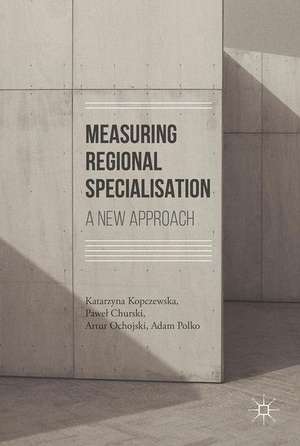
Measuring Regional Specialisation
Autor Katarzyna Kopczewska, Pawe¿ Churski, Artur Ochojski, Adam Polkoen Limba Engleză Hardback – 11 sep 2017
This book explores statistical models in regional specialization, presenting a brand new measure. It begins by reviewing existing indicators and models of regional specialization before outlining a newly created, spatially embedded model of specialization based on the spatial distribution of firms. It addresses the various applications of the model, and how the model can be used in regional policy.
Preț: 764.50 lei
Preț vechi: 932.32 lei
-18%
Puncte Express: 1147
Carte tipărită la comandă
Livrare economică 07-21 decembrie
Livrare prin curier în România Termenul estimat este afișat lângă disponibilitate.
Transport gratuit pentru acest produs Plată online sau ramburs, în funcție de opțiunile comenzii.
Retur gratuit în 14 zile Comandă securizată și suport în română.
Specificații
ISBN-13: 9783319515045
ISBN-10: 3319515047
Pagini: 500
Ilustrații: XXXI, 466 p. 59 illus.
Dimensiuni: 153 x 216 x 32 mm
Greutate: 0.71 kg
Ediția:1st edition 2017
Editura: Springer International Publishing
Locul publicării:Cham, Switzerland
ISBN-10: 3319515047
Pagini: 500
Ilustrații: XXXI, 466 p. 59 illus.
Dimensiuni: 153 x 216 x 32 mm
Greutate: 0.71 kg
Ediția:1st edition 2017
Editura: Springer International Publishing
Locul publicării:Cham, Switzerland
V-ar putea interesa
-
 Spatial Regression Analysis Using Eigenvector Spatial FilteringDaniel Griffith-28%Preț: 763.16 lei1066.49 lei
 -
 -15%Preț: 170.94 lei201.35 lei
 -
 -17%Preț: 394.45 lei475.97 lei
 -
 Street Vendors in the Global Urban EconomySharit Bhowmik-18%Preț: 1124.23 lei1371.02 lei
 -
 Hosting the Olympic Games: The Real Costs for CitiesJohn Rennie Short-15%Preț: 467.08 lei549.51 lei
 -
 High Rise and Fall: The Making of the European Real Estate IndustryAndrea Carpenter-18%Preț: 1002.46 lei1222.51 lei
 -
 High Rise and Fall: The Making of the European Real Estate IndustryAndrea Carpenter-15%Preț: 417.39 lei491.05 lei
 -
 -28%Preț: 582.20 lei804.79 lei
 -
 -18%Preț: 1248.98 lei1523.15 lei
 -
 Affordable Housing DevelopmentJaime P. Luque-15%Preț: 591.25 lei695.59 lei
 -
 Hot PropertyRob NijskensPreț: 439.79 lei
 -
 The Organization of CitiesJohn R Miron-15%Preț: 686.27 lei807.37 lei
 -
 Creative Economies in Peripheral RegionsPatrick Collins-18%Preț: 753.31 lei918.68 lei
 -
 Policy Innovations for Affordable Housing In SingaporeSock-Yong Phang-18%Preț: 752.78 lei918.03 lei
 -
 Preț: 416.56 lei
 -
 European Cities in Dynamic CompetitionHorst Albach-18%Preț: 925.62 lei1128.80 lei
 -
 Preț: 283.17 lei
 -
 Preț: 240.74 lei
 -
 Caribbean TourismJean S. HolderPreț: 305.79 lei
 -
 Economics of Urban ExternalitiesShiva Raj AdhikariPreț: 393.85 lei
 -
 Cities Network Along the Silk RoadPengfei Ni-15%Preț: 671.37 lei789.85 lei
 -
 -15%Preț: 670.25 lei788.53 lei
Cuprins
Introduction.- 1. The theoretical foundations of specialization, agglomeration and concentration.- 2. A review of localization measures.- 3. An empirical comparison of localization measures.- 4. Smart specialization and place-based policy. -5. Conclusion.
Notă biografică
Katarzyna Kopczewska – quantitative regional economist, spatial econometrician, works at Department of Statistics and Econometrics at the Faculty of Economic Sciences at the University of Warsaw, Poland.
Paweł Churski - economic geographer, works in the Department of Regional Analysis at the Institute of Socio-Economic Geography and Spatial Management at the Adam Mickiewicz University in Poznań, Poland.
Adam Polko – urban economist, works in the Department of Spatial Economics at the University of Economics in Katowice, Poland.
Artur Ochojski – urban and innovation economist, works in the Department of Strategic and Regional Research at the University of Economics in Katowice, Poland.
Paweł Churski - economic geographer, works in the Department of Regional Analysis at the Institute of Socio-Economic Geography and Spatial Management at the Adam Mickiewicz University in Poznań, Poland.
Adam Polko – urban economist, works in the Department of Spatial Economics at the University of Economics in Katowice, Poland.
Artur Ochojski – urban and innovation economist, works in the Department of Strategic and Regional Research at the University of Economics in Katowice, Poland.
Textul de pe ultima copertă
This book explores statistical models in regional specialization, presenting a brand new measure. It begins by reviewing existing indicators and models of regional specialization before outlining a newly created, spatially embedded model of specialization based on the spatial distribution of firms. It addresses the various applications of the model, and how the model can be used in regional policy.
With its interdisciplinary application, this book should appeal to academics, applied researchers and policy makers as well as newcomers to the field of regional specialisation.
With its interdisciplinary application, this book should appeal to academics, applied researchers and policy makers as well as newcomers to the field of regional specialisation.
Caracteristici
Presents a brand new measure for regional specialization Covers measures and interpretations of specialization which will be of use to policy makers Presents a comparative analysis of measures Features empirical case studies exploring examples of regional specialisation Supports the ongoing regional policy in the EU