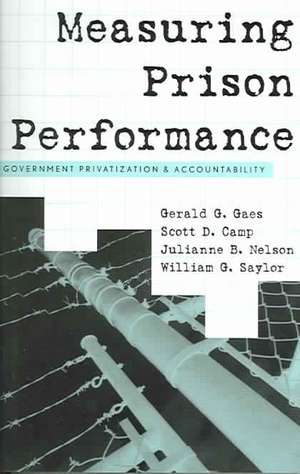
Measuring Prison Performance: Government Privatization and Accountability: Violence Prevention and Policy
Autor Gerald G. Gaes, Scott D. Camp, Julianne B. Nelson, William G. Sayloren Limba Engleză Paperback – 14 sep 2004



Preț: 264.21 lei
Preț vechi: 344.20 lei
-23%
Puncte Express: 396
Carte tipărită la comandă
Livrare economică 26 noiembrie-10 decembrie
Livrare prin curier în România Termenul estimat este afișat lângă disponibilitate.
Transport gratuit de la 400.00 lei Plată online sau ramburs, în funcție de opțiunile comenzii.
Retur gratuit în 14 zile Comandă securizată și suport în română.
Specificații
ISBN-13: 9780759105874
ISBN-10: 0759105871
Pagini: 223
Dimensiuni: 188 x 227 x 15 mm
Greutate: 0.37 kg
Editura: Bloomsbury Publishing
Colecția AltaMira Press
Seria Violence Prevention and Policy
Locul publicării:New York, United States
ISBN-10: 0759105871
Pagini: 223
Dimensiuni: 188 x 227 x 15 mm
Greutate: 0.37 kg
Editura: Bloomsbury Publishing
Colecția AltaMira Press
Seria Violence Prevention and Policy
Locul publicării:New York, United States
Cuprins
Chapter 1 Introduction: The Motivation for the Book and a Statement of the Issues
Chapter 2 Chapter 1. Conceptualizing Prison Performance
Chapter 3 Chapter 2. Prison Audits
Chapter 4 Chapter 3: Understanding The Measurement Context-Qualitative Assessment
Chapter 5 Chapter 4: Multilevel Models and Behavioral Performance Measures
Chapter 6 Chapter 5: Staff and Inmate Surveys as Performance Measures
Chapter 7 Chapter 6: Cost Analyses
Chapter 8 Chapter 7: The Relationship between Cost and Performance and the Role of Prison Labor
Chapter 9 Chapter 8: System Level Measurement
Chapter 10 Chapter 9: A Life Course Perspective of Recidivism
Chapter 11 Chapter 10: Prison Performance Templates, User Friendly Performance Measurement Tools, and Contract Compliance
Chapter 12 Chapter 11: Lessons from the Public Administration Literature
Chapter 13 Chapter 12: Looking Backward and Looking Forward
Chapter 14 References
Chapter 15 Index
Chapter 16 About the Author
Chapter 2 Chapter 1. Conceptualizing Prison Performance
Chapter 3 Chapter 2. Prison Audits
Chapter 4 Chapter 3: Understanding The Measurement Context-Qualitative Assessment
Chapter 5 Chapter 4: Multilevel Models and Behavioral Performance Measures
Chapter 6 Chapter 5: Staff and Inmate Surveys as Performance Measures
Chapter 7 Chapter 6: Cost Analyses
Chapter 8 Chapter 7: The Relationship between Cost and Performance and the Role of Prison Labor
Chapter 9 Chapter 8: System Level Measurement
Chapter 10 Chapter 9: A Life Course Perspective of Recidivism
Chapter 11 Chapter 10: Prison Performance Templates, User Friendly Performance Measurement Tools, and Contract Compliance
Chapter 12 Chapter 11: Lessons from the Public Administration Literature
Chapter 13 Chapter 12: Looking Backward and Looking Forward
Chapter 14 References
Chapter 15 Index
Chapter 16 About the Author
Recenzii
Measuring Prison Performance breaks new ground in corrections. Long overdue, this book lays out the theory and methods to develop a practical way to evaluate prison performance. It integrates topics from the disciplines of public administration, economics, criminology, and criminal justice to provide unique insights. More than that, this book can be used as a paradigm to evaluate the performance of any public agency, and can be used as a model to make decisions about the privatization of public services.
Gerald Gaes and co-authors Camp, Nelson, and Saylor have written what will undoubtedly be a preeminent resource in the analysis of performance from a multitude of perspectives in not only correctional environments but across the public sector as a whole. As governmental entities are called upon with increasing frequency to justify the allocation and utilization of scarce resources, they will turn to this work to help define and improve the substance and structure of their response. Other stakeholders will also benefit significantly from application of the principles outlined.
As America has constructed a far-flung network of penal institutions, the obvious question remains unanswered: how should we measure the performance of prisons? This practical and provocative book presents a long overdue framework for evaluating the utility of these unique institutions. We can only hope that policymakers and practitioners will follow the illuminated path.
Measuring Prison Performance is a must read for any practitioner, researcher, or public policy analyst who cares about the functioning of our nation's penal institutions. The book shows administrators how data can be used to supplement knowledge gained from audits, inmate data bases, and 'management by walking around.' The authors show us how to translate some of our nation's best practices into tangible and meaningful data, and by doing so, increase our ability to manage our prisons. The added bonus is that these same procedures can be applied to any government agency interested in increasing productivity, efficiency, and accountability.
Bravo. Measuring Prison Performance marries public administration and corrections. This is an extremely important book by a team of sophisticated researchers who really know their stuff. A must-read for people who work at or just care about improving our prisons.
Gerald Gaes and co-authors Camp, Nelson, and Saylor have written what will undoubtedly be a preeminent resource in the analysis of performance from a multitude of perspectives in not only correctional environments but across the public sector as a whole. As governmental entities are called upon with increasing frequency to justify the allocation and utilization of scarce resources, they will turn to this work to help define and improve the substance and structure of their response. Other stakeholders will also benefit significantly from application of the principles outlined.
As America has constructed a far-flung network of penal institutions, the obvious question remains unanswered: how should we measure the performance of prisons? This practical and provocative book presents a long overdue framework for evaluating the utility of these unique institutions. We can only hope that policymakers and practitioners will follow the illuminated path.
Measuring Prison Performance is a must read for any practitioner, researcher, or public policy analyst who cares about the functioning of our nation's penal institutions. The book shows administrators how data can be used to supplement knowledge gained from audits, inmate data bases, and 'management by walking around.' The authors show us how to translate some of our nation's best practices into tangible and meaningful data, and by doing so, increase our ability to manage our prisons. The added bonus is that these same procedures can be applied to any government agency interested in increasing productivity, efficiency, and accountability.
Bravo. Measuring Prison Performance marries public administration and corrections. This is an extremely important book by a team of sophisticated researchers who really know their stuff. A must-read for people who work at or just care about improving our prisons.