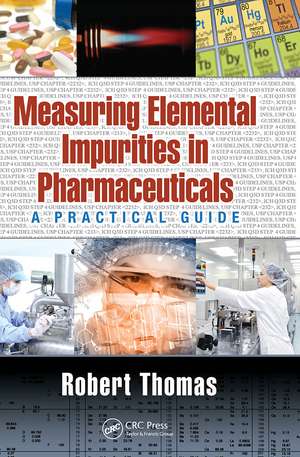
Measuring Elemental Impurities in Pharmaceuticals: A Practical Guide: Practical Spectroscopy
Autor Robert Thomasen Limba Engleză Paperback – 13 dec 2021
It offers readers the tools to better understand plasma spectrochemistry to optimize detection capability for the full suite of elemental PDE (Permitted Daily Exposure) levels in the various drug delivery categories. Other relevant information covered in the book includes:
- The complete guide to measuring elemental impurities in pharmaceutical and nutraceutical materials.
- Covers heavy metals testing in the pharmaceutical industry from an historical perspective.
- Gives an overview of current USP Chapters <232> <233> and <2232> and ICH Q3D Step 4 Guidelines.
- Explains the purpose of validation protocols used in Chapter <233>, including how J-values are calculated
- Describes fundamental principles and practical capabilities of ICP-MS and ICP-OES.
- Offers guidelines about the optimum strategy for risk assessment
- Provides tips on how best to prepare and present your data for regulatory inspection.


Preț: 477.59 lei
Puncte Express: 716
Carte tipărită la comandă
Livrare economică 16-30 noiembrie
Livrare prin curier în România Termenul estimat este afișat lângă disponibilitate.
Transport gratuit pentru acest produs Plată online sau ramburs, în funcție de opțiunile comenzii.
Retur gratuit în 14 zile Comandă securizată și suport în română.
Specificații
ISBN-13: 9781032240893
ISBN-10: 103224089X
Pagini: 502
Dimensiuni: 156 x 234 x 26 mm
Greutate: 0.45 kg
Ediția:1
Editura: CRC Press
Colecția CRC Press
Seria Practical Spectroscopy
ISBN-10: 103224089X
Pagini: 502
Dimensiuni: 156 x 234 x 26 mm
Greutate: 0.45 kg
Ediția:1
Editura: CRC Press
Colecția CRC Press
Seria Practical Spectroscopy
Public țintă
Professional Practice & DevelopmentCuprins
Overview of the USP Mission. Traditional Heavy Metals Testing Under Chapter 231. The Process for Change? Proposed New Chatpers <232> <233> and <2232>. The Role/Mission of th eICH and EMA in Setting Global Standards for Elemental Impurities in Drug Products. The ICH/USP Alignment Process. Understanding PDE Limits Defined in Chapter <232> and <2232>. Speciated Form: When is it Required. Options for Compliance. Testing-based, Risk-based Approach. Anaylytical Procedures and Validation Protocols Described in Chapter <233>. Sample Preparation Procedures. Which Techniques are Suggested. Validation Protocols. J Values. Calibration. Drift. Detectability. Precision. Specificity. Accuracy. Ruggedness. Limit of Quantification. Linear Range. Comparison of Plasma Spectrochemical Techniques Defined in Chapter <233>. Guidance on what is the Most Appropriate Technique to use. Productivity Enhancement Tools. Regulatory Compliance. Is Your Laboratory Ready for the FDA?. 21CFR Prat 11 Qualification. Computer Systems Validation/Electronic Records. Fundamentals Principles of ICP-OES. Principles of Atomic Excitation/Emission. Sample Introduction. Plasma Source. Opticial Configurations. Solid State Detector Technology. Understanding Interferences. Fundamental Principles of ICP-MS. Principles of Ion Formation. Sample Introduction. Plasma Source. Interface Region. Ion Focusing System. Mass Analyzers. Ion Detection. Peak Measurement Protocol. Methods of Quantitation. Review of Interferences. Contamination Issues. Routine Maintenance. Alternative Sample Introduction Techniques. Trace Element Speciation. Glossary of Terms Used in ICP-MS. References. Final Thoughts, Useful Contact Information. Index.
Notă biografică
Robert J. Thomas has worked in the field of trace element analysis for over 40 years, including 24 years for an ICP-MS manufacturer and 15 years as a principal of his own consulting company. He has served on the ACS (American Chemical Society) Reagent Chemical Committee for the past 17 years as leader of the elemental impurities task force where he has worked closely with the USP to align heavy metal testing procedures in analytical reagents with those of pharmaceutical materials. He has authored almost 100 publications on trace element analysis and written three textbooks on ICP-MS and related topics, including this new book, which focuses on the new global directives on elemental impurities in pharmaceutical materials and dietary supplements. He is currently editor and frequent contributor to the Atomic Perspectives Column in Spectroscopy Magazine. He has a graduate degree in Analytical Chemistry from the University of Wales in the UK and is a Fellow of the Royal Society of Chemistry (FRSC, and a Chartered Chemist (CChem
Descriere
A dedicated guide for the pharmaceutical/nutraceutical QA/QC communities about the new USP Chapters covering metal impurities. The fundamental principles and practical benefits of ICP-OES and ICP-MS are covered in a reader-friendly format that a novice in the pharmaceutical and nutraceutical industries will find easy to understand.