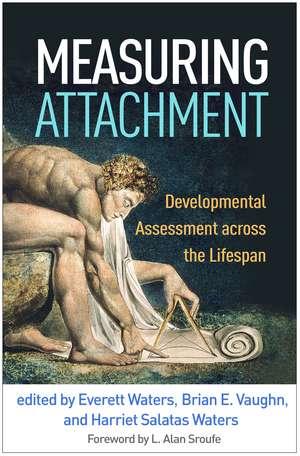
Measuring Attachment: Developmental Assessment across the Lifespan
Editat de Everett Waters, Brian E. Vaughn, Harriet Salatas Watersen Limba Engleză Hardback – 7 iun 2021
Preț: 527.35 lei
Preț vechi: 555.10 lei
-5%
Carte disponibilă
Livrare economică 13-27 noiembrie
Livrare express 29 octombrie-04 noiembrie pentru 49.39 lei
Specificații
ISBN-10: 1462546471
Pagini: 478
Dimensiuni: 156 x 234 x 33 mm
Greutate: 0.82 kg
Ediția:1
Editura: Guilford Publications
Colecția Guilford Press
V-ar putea interesa
-
 Developments in Attachment ResearchRobbie Duschinsky-31%Preț: 961.56 lei1399.64 lei
 -
 Attachment and Family TherapyPatricia Crittenden-32%Preț: 207.10 lei304.10 lei
 -
 The Little Book of AttachmentBen Gurney-Smith-5%Preț: 180.64 lei190.15 lei
 -
 Strange SituationBethany SaltmanPreț: 102.33 lei
 -
 Preț: 257.81 lei
 -
 AttachmentE J M Bowlby-18%Preț: 101.98 lei123.94 lei
 -
 Attachment across the LifecourseDavid Howe-19%Preț: 207.79 lei255.03 lei
 -
 -5%Preț: 411.77 lei433.43 lei
 -
 Treating Attachment Disorders, Second Edition: From Theory to TherapyKarl Heinz Brisch-5%Preț: 361.52 lei380.54 lei
 -
 Attachment in PsychotherapyDavid J. Wallin-5%Preț: 333.68 lei351.24 lei
 -
 -5%Preț: 310.68 lei327.03 lei
 -
 -5%Preț: 425.85 lei448.26 lei
 -
 -5%Preț: 653.14 lei687.51 lei
 -
 Handbook of Attachment-Based InterventionsHoward Steele-5%Preț: 456.12 lei480.13 lei
 -
 Attachment: The Fundamental QuestionsRoss A. Thompson-5%Preț: 441.76 lei465.01 lei
 -
 AttachedAmir Levine-37%Preț: 50.17 lei79.05 lei
 -
 -5%Preț: 86.84 lei91.41 lei
 -
 Attachment-Based Practice with AdultsTony MorrisonPreț: 233.04 lei
 -
 Patterns of Attachment: A Psychological Study of the Strange SituationMary D. Salter Ainsworth-15%Preț: 437.65 lei514.88 lei
Public țintă
Professional Practice & DevelopmentNotă biografică
Brian E. Vaughn, PhD, holds the Human Sciences Professor of Human Development Chair in the Department of Human Development and Family Science at Auburn University. A graduate of the University of Minnesota’s Institute of Child Development, he has published widely on attachment and temperament and the relation of infant attachment to social competence in early childhood. He is a recipient of the 2011 Bowlby–Ainsworth Award for advancing ethological methods in attachment study.
Harriet Salatas Waters, PhD, is Emerita Professor of Psychology at Stony Brook University, State University of New York. A graduate of the University of Minnesota’s Institute of Child Development, she has made significant contributions to research on attachment narratives in middle childhood, adolescence, and adulthood. She is a recipient of the 2021 Bowlby–Ainsworth Award for contributions to the theory and measurement of attachment representations.
Cuprins
2. Assessing Secure Base Behavior in Naturalistic Environments: The Attachment Q-Set, Brian E. Vaughn, Everett Waters, & Douglas M. Teti
3. The Strange Situation: Paradigm, Practique, and FAQs, Everett Waters, Brian E. Vaughn, & Kristin Bernard
4. Attachment Disturbance: Disorganization and Disorder, Elizabeth A. Carlson
5. Issues of Method in the Assessment of Disorganized Attachment, Judith Solomon, Robbie Duschinsky, Lianne Bakkum, & Carlo Schuengel
6. Promising Approaches to Assessing Attachment in Middle Childhood: Navigating the Options, Kathryn A. Kerns & Ashley C. Seibert
7. Assessing Attachment in Adolescence, Joseph P. Allen
8. Measuring Attachment Representations as Secure Base Script Knowledge: The Prompt-Word Outline Method in Adulthood, Adolescence, and Middle Childhood, Harriet Salatas Waters and Theodore E. A. Waters
9. The Adult Attachment Interview: A Guide for New Researchers and Research Consumers, Judith A. Crowell
10. Measuring Secure Base Script Knowledge in the Adult Attachment Interview, Theodore E. A. Waters & Christopher R. Facompré
11. Laboratory Methods for Assessing Secure Base Use and Support in Adult Relationships, Brooke C. Feeney
12. The Associative Structure of Adult Attachment Representations: Priming Methods for Assessing Implicit Knowledge and Expectations, Markus A. Maier, Annie Bernier, & David M. Corcoran
13. The Adult Attachment Projective Picture System: Representational Assessment of Attachment in Adolescents and Adults, Carol George & Malcolm West
14. Measuring Attachment: Legacy and Prospects, Everett Waters, Brian E. Vaughn, & Harriet Salatas Waters
Index
Recenzii
"Rich in history and theory, this is a compelling work for researchers, clinicians, and students interested in the assessment, measurement, and definition of constructs critical to the attachment system. All in one place, readers can find thorough consideration of the best-validated, state-of-the-art methodologies used to assess attachment throughout the lifespan (including the neglected periods of middle childhood and adolescence). This important guide provides links to measurement manuals; offers insightful tips for observation, scoring, interpretation, and the training of coders and research assistants; and explains key constructs. This is an impressive reference for scholars and practitioners at any level interested in the developmental continuity and intergenerational transmission of attachment."--Jennifer C. Ablow, PhD, Department of Psychology, University of Oregon
"In my teaching and advising, I am always asking students: 'How was attachment measured?' Student responses indicate how little attention is given to attachment measurement, making this a timely and needed resource. I can see assigning this book in my doctoral seminar on attachment theory and research. The chapters are written by the leading figures in the field and provide essential information for new and more seasoned researchers, students, and clinicians. This invaluable contribution is a one-stop shop to compare and evaluate attachment measures across the lifespan."--Richard Lanthier, PhD, Graduate School of Education and Human Development, The George Washington University
-
Descriere
This volume provides an in-depth examination of traditional and emerging measures of attachment behavior and representations from infancy to adulthood. Leading authorities share their expertise on the Strange Situation, the Attachment Q-set, Ainsworth's Maternal Sensitivity Scales, the Adult Attachment Interview, the Attachment Script Assessments, and the Adult Attachment Projective Picture System, as well as analogue and experimental methods. The book clarifies the conceptual and empirical underpinnings of the various measures and shows how they fit into a coherent developmental framework. Offering detailed discussions of key constructs such as attachment security, the secure base phenomenon, disorganization, and narrative structure, this is a valuable resource for both researchers and practitioners who use attachment assessments in their work.