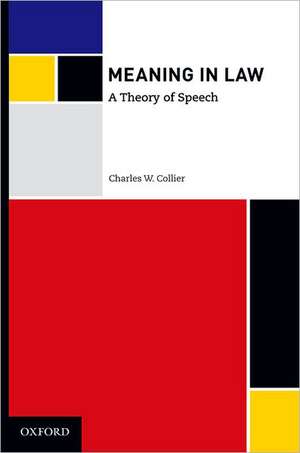
Meaning in Law: A Theory of Speech
Autor Charles W. Collieren Limba Engleză Hardback – 13 aug 2009
Preț: 640.88 lei
Preț vechi: 915.84 lei
-30%
Puncte Express: 961
Carte tipărită la comandă
Livrare economică 10-15 decembrie
Livrare prin curier în România Termenul estimat este afișat lângă disponibilitate.
Transport gratuit pentru acest produs Plată online sau ramburs, în funcție de opțiunile comenzii.
Retur gratuit în 14 zile Comandă securizată și suport în română.
Specificații
ISBN-13: 9780195388978
ISBN-10: 0195388976
Pagini: 208
Dimensiuni: 234 x 156 x 13 mm
Greutate: 0.46 kg
Ediția:New.
Editura: Oxford University Press
Colecția OUP USA
Locul publicării:New York, United States
ISBN-10: 0195388976
Pagini: 208
Dimensiuni: 234 x 156 x 13 mm
Greutate: 0.46 kg
Ediția:New.
Editura: Oxford University Press
Colecția OUP USA
Locul publicării:New York, United States
V-ar putea interesa
-
 International Law's ObjectsJessie Hohmann-31%Preț: 1140.03 lei1644.51 lei
 -
 -30%Preț: 541.44 lei776.51 lei
 -
 -18%Preț: 363.54 lei440.96 lei
 -
 Imposing Risk: A Normative FrameworkJohn Oberdiek-30%Preț: 557.84 lei802.63 lei
 -
 The Idea of Private LawErnest J Weinrib-28%Preț: 365.96 lei510.33 lei
 -
 The Structure of PluralismVictor M. Muniz-Fraticelli-30%Preț: 734.38 lei1049.05 lei
 -
 -12%Preț: 336.32 lei382.85 lei
 -
 Philosophy of Law: A Very Short IntroductionRaymond Wacks-19%Preț: 57.23 lei70.82 lei
 -
 Reflections on 'The Concept of Law'A. W. Brian Simpson-30%Preț: 576.36 lei822.07 lei
 -
 -31%Preț: 899.20 lei1312.59 lei
 -
 Law's Evolution and Human UnderstandingLaurence Claus-30%Preț: 684.96 lei978.12 lei
 -
 Statutory and Common Law InterpretationKent Greenawalt-27%Preț: 559.17 lei767.40 lei
 -
 -30%Preț: 879.45 lei1260.02 lei
 -
 New Essays on the Nature of RightsDr Mark McBride-32%Preț: 633.62 lei927.63 lei
 -
 -36%Preț: 612.05 lei960.59 lei
 -
 Law's JudgementProfessor William Lucy-32%Preț: 634.08 lei927.92 lei
 -
 Legal Validity: The Fabric of JusticeMaris Köpcke-29%Preț: 553.17 lei782.16 lei
 -
 The History of Chinese Legal CivilizationJinfan Zhang-18%Preț: 1017.85 lei1241.28 lei
Descriere
Existing theories of the First Amendment's protection of speech proceed on the basis of legal doctrine and judicial decision making, social and political philosophy, or legal and intellectual history. Meaning in Law: A Theory of Speech adopts a new approach and develops a general legal theory of speech on the basis of linguistic theory and the philosophy of language. Meaning in Law: A Theory of Speech retraces the main conceptual stages in the expression of meaning, from natural notions of meaningfulness, through symbolism, to signification. The book focuses on three failed attempts to demarcate the boundaries of "speech" in the constitutional sense (prior restraints, obscenity, and defamation) and then introduces the theory of symbolic speech as the key to developing a general legal theory of speech. Providing an overview of his theory, including such concepts as "Signaling of Intent" and "Establishing a Convention," author Charles Collier applies these insights to the case law of symbolic speech and resolves some basic confusion in the legal literature. The analysis relies on an original distinction between actual conduct and the "ideal conduct" described in a statute. The former may be described as both communicative and noncommunicative, while the latter has already been conceptualized as either communicative or noncommunicative. The author argues this distinction clears up a major legal quandary: how conduct that can be described as communication may nevertheless be regulated or prohibited, without running afoul of the First Amendment's protection of speech.
Notă biografică
Charles W. Collier is Professor of Law and Affiliate Professor of Philosophy at the University of Florida. He is the author of Basic Themes in Law and Jurisprudence (LexisNexis-Anderson, 2000).