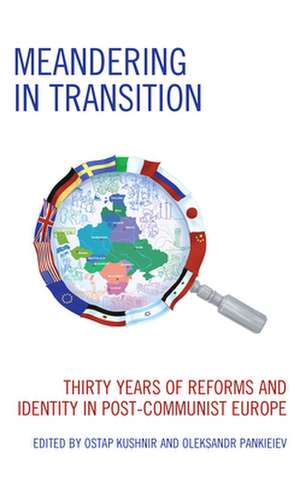
Meandering in Transition: Thirty Years of Reforms and Identity in Post-Communist Europe
Editat de Ostap Kushnir, Oleksandr Pankieiev Contribuţii de Li Bennich-Björkman, Adrian Chojan, Spasimir Domaradski, Serena Giusti, Emilian Kavalski, Margaryta Khvostova, Christopher Lash, Yevhen Mahda, Juraj Marusiak, Mykhailo Minakov, Rasmus Nilsson, Fabio Parola, Bo Petersson, Robert Rajczyk, Mykola Riabchuk, Anna Rudakowska, Eva Schäffler, Manabu Sengoku, Assen Slim, Andriy Tyushka, Nedim Useinowen Limba Engleză Hardback – 19 aug 2021
The contributors outline reasons why some of these states accomplished a decisive break with the Communist past and became members of European and transatlantic structures, while some opted for pseudo-transition and fostered hybrid political regimes, jeopardizing their genuine integration with the West. A group of states which decided to preserve their Communist legacy is also explained.
The collection describes and scrutinizes the formation of geopolitical affiliations and the evolution of discourses of belonging. It also traces the fluctuating dynamics of national decision-making and institution-building, as many of the post-Communist states reconsider and re-elaborate their initial ideas and visions of Europe today.
Finally, the collection brings to light the rapidly changing perceptions of the region by the major global actors-the European Union, People's Republic of China, Russian Federation, and others.
Preț: 694.73 lei
Preț vechi: 1055.92 lei
-34%
Puncte Express: 1042
Carte tipărită la comandă
Livrare economică 23 noiembrie-07 decembrie
Livrare prin curier în România Termenul estimat este afișat lângă disponibilitate.
Transport gratuit pentru acest produs Plată online sau ramburs, în funcție de opțiunile comenzii.
Retur gratuit în 14 zile Comandă securizată și suport în română.
Specificații
ISBN-13: 9781793650740
ISBN-10: 1793650748
Pagini: 410
Ilustrații: 4 tables;
Dimensiuni: 162 x 228 x 31 mm
Greutate: 0.74 kg
Editura: Bloomsbury Publishing
Colecția Lexington Books
Locul publicării:New York, United States
ISBN-10: 1793650748
Pagini: 410
Ilustrații: 4 tables;
Dimensiuni: 162 x 228 x 31 mm
Greutate: 0.74 kg
Editura: Bloomsbury Publishing
Colecția Lexington Books
Locul publicării:New York, United States
Cuprins
Part I: "Ideas of Europe" and the Post-Communist Space
Chapter 1: Shifting the Wall Further East. What Has Left of the "Eastern Europe" Thirty Years Later? by Mykola Riabchuk
Chapter 2: The Transition of "Transition": Assessing the Post-Communist Experience and Its Research by Mikhail Minakov
Chapter 3: Has the Post-Communist Transition Been Completed? Economic Perspective by Assen Slim
Part II: Post-Communist Transition and Identity-Building: View From "Within"
Chapter 4: Societies in Post-Communist Transition: Polish and Hungarian Experience by Adrian Chojan
Chapter 5: Exceptional but Different: Navigating Transition in Estonia, Latvia, and Lithuania by Li Bennich-Björkman
Chapter 6: Czech Republic and Slovakia - Changing Perception of the European Integration Since 1989 by Juraj Marusiak
Chapter 7: Thirty Years of Post-Communist Nation-Building in Belarus, Moldova, and Ukraine by Yevhen Mahda and Margaryta Khvostova
Chapter 8: Thirty Years After Communism - Bulgaria and Romania's Experience by Spa
Chapter 1: Shifting the Wall Further East. What Has Left of the "Eastern Europe" Thirty Years Later? by Mykola Riabchuk
Chapter 2: The Transition of "Transition": Assessing the Post-Communist Experience and Its Research by Mikhail Minakov
Chapter 3: Has the Post-Communist Transition Been Completed? Economic Perspective by Assen Slim
Part II: Post-Communist Transition and Identity-Building: View From "Within"
Chapter 4: Societies in Post-Communist Transition: Polish and Hungarian Experience by Adrian Chojan
Chapter 5: Exceptional but Different: Navigating Transition in Estonia, Latvia, and Lithuania by Li Bennich-Björkman
Chapter 6: Czech Republic and Slovakia - Changing Perception of the European Integration Since 1989 by Juraj Marusiak
Chapter 7: Thirty Years of Post-Communist Nation-Building in Belarus, Moldova, and Ukraine by Yevhen Mahda and Margaryta Khvostova
Chapter 8: Thirty Years After Communism - Bulgaria and Romania's Experience by Spa
Recenzii
A comprehensive, well-structured, and thoughtful approach to the institutional, social, economic, and cultural transformations of Europe in recent times. The contributors realize the amplitude of these changes and help the readers grasp the short and long term implications of the unfinished European project. This collection of intellectually compelling and analytically insightful chapters is both timely and inspiring.
Thirty years after the collapse of communism, can the old 'Eastern Europe' or Central and Eastern Europe (CEE) still be considered a coherent region separate from the cultures and countries that surround it? How far have the societies, cultures, economies and political systems moved away from their communist past? This valuable and innovative volume provides a unique perspective on these important questions. It examines the view from within the region. But it also looks at these questions from the point of view of Western Europe as well as countries further removed - including Japan, China, and the Middle East. The result is a uniquely global perspective that one almost never sees in other volumes.
Meandering in Transition is a collection of articles that helps us understand what has happened in Europe and with Europe after the fall of the Berlin Wall and the disintegration of the Soviet Union. Transformed has been not only the borders, societies, identities and visions of the past and future, but also the scope of the region itself, as the old Eastern Europe has been joined by the republics of the western USSR. Back in the 1990s at the pick of the popularity of the "transitology" studies everyone wanted to know where the transition would eventually lead. Now we have an answer provided by some of the best scholars in the field. Essential read for anyone who wants to understand not only what happened with the region in the last thirty years but also what is happening there today.
Thirty years after the collapse of communism, can the old 'Eastern Europe' or Central and Eastern Europe (CEE) still be considered a coherent region separate from the cultures and countries that surround it? How far have the societies, cultures, economies and political systems moved away from their communist past? This valuable and innovative volume provides a unique perspective on these important questions. It examines the view from within the region. But it also looks at these questions from the point of view of Western Europe as well as countries further removed - including Japan, China, and the Middle East. The result is a uniquely global perspective that one almost never sees in other volumes.
Meandering in Transition is a collection of articles that helps us understand what has happened in Europe and with Europe after the fall of the Berlin Wall and the disintegration of the Soviet Union. Transformed has been not only the borders, societies, identities and visions of the past and future, but also the scope of the region itself, as the old Eastern Europe has been joined by the republics of the western USSR. Back in the 1990s at the pick of the popularity of the "transitology" studies everyone wanted to know where the transition would eventually lead. Now we have an answer provided by some of the best scholars in the field. Essential read for anyone who wants to understand not only what happened with the region in the last thirty years but also what is happening there today.