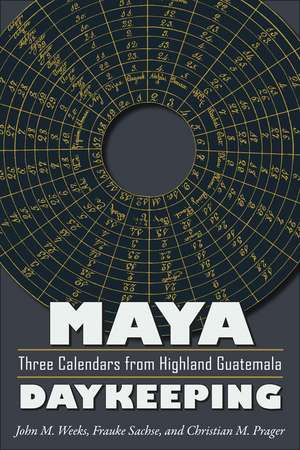
Maya Daykeeping: Three Calendars from Highland Guatemala: Mesoamerican Worlds
Editat de John M. Weeks, Frauke Sachse, Christian M. Prageren Limba Engleză Paperback – 14 mai 2013 – vârsta de la 19 ani
InMaya
Daykeeping,
three
divinatory
calendars
from
highland
Guatemala
-
examples
of
a
Mayan
literary
tradition
that
includes
the
Popul
Vuh,
Annals
of
the
Cakchiquels,
and
the
Titles
of
the
Lords
of
Totonicapan
-
dating
to
1685,
1722,
and
1855,
are
transcribed
in
K'iche
or
Kaqchikel
side-by-side
with
English
translations.
Calendars
such
as
these
continue
to
be
the
basis
for
prognostication,
determining
everything
from
the
time
for
planting
and
harvest
to
foreshadowing
illness
and
death.
Good,
bad,
and
mixed
fates
can
all
be
found
in
these
examples
of
the
solar
calendar
and
the
260-day
divinatory
calendar.
The
use
of
such
calendars
is
mentioned
in
historical
and
ethnographic
works,
but
very
few
examples
are
known
to
exist.
Each
of
the
three
calendars
transcribed
and
translated
by
John
M.
Weeks,
Frauke
Sachse,
and
Christian
M.
Prager
-
and
housed
at
the
University
of
Pennsylvania
Museum
of
Archaeology
and
Anthropology
-
is
unique
in
structure
and
content.
Moreover,
except
for
an
unpublished
study
of
the
1722
calendar
by
Rudolf
Schuller
and
Oliver
La
Farge
(1934),
these
little-known
works
appear
to
have
escaped
the
attention
of
most
scholars.
Introductory
essays
contextualize
each
document
in
time
and
space,
and
a
series
of
appendixes
present
previously
unpublished
calendrical
notes
assembled
in
the
early
twentieth
century.
Providing considerable information on the divinatory use of calendars in colonial highland Maya society previously unavailable without a visit to the University of Pennsylvania's archives,Maya Daykeepingis an invaluable primary resource for Maya scholars.Mesoamerican Worlds Series
Providing considerable information on the divinatory use of calendars in colonial highland Maya society previously unavailable without a visit to the University of Pennsylvania's archives,Maya Daykeepingis an invaluable primary resource for Maya scholars.Mesoamerican Worlds Series




Preț: 198.76 lei
Puncte Express: 298
Preț estimativ în valută:
35.12€ • 40.35$ • 30.42£
35.12€ • 40.35$ • 30.42£
Carte tipărită la comandă
Livrare economică 06-20 mai
Specificații
ISBN-13: 9781607322467
ISBN-10: 1607322463
Pagini: 236
Ilustrații: 8 figures, 1 map, 17 tables
Dimensiuni: 152 x 229 x 18 mm
Greutate: 0.36 kg
Editura: University Press of Colorado
Colecția University Press of Colorado
Seria Mesoamerican Worlds
ISBN-10: 1607322463
Pagini: 236
Ilustrații: 8 figures, 1 map, 17 tables
Dimensiuni: 152 x 229 x 18 mm
Greutate: 0.36 kg
Editura: University Press of Colorado
Colecția University Press of Colorado
Seria Mesoamerican Worlds
V-ar putea interesa
-
 How the Other Half LivesJacob A. RiisPreț: 85.65 lei
 -
 The Old WayElizabeth Marshall ThomasPreț: 139.47 lei
 -
 An Introduction to Theories of Popular CultureDominic StrinatiPreț: 336.23 lei
 -
 Fan CulturesMatthew HillsPreț: 378.88 lei
 -
 Cultural Studies: A Critical IntroductionSimon DuringPreț: 336.27 lei
 -
 The Stars Down to EarthTheodor AdornoPreț: 135.10 lei
 -
 Natural Symbols: Explorations in CosmologyProfessor Mary DouglasPreț: 134.98 lei
 -
 The Subcultures Reader: Second EditionKen Gelder-15%Preț: 462.17 lei543.73 lei
 -
 -15%Preț: 401.18 lei471.97 lei
 -
 The Cultural Studies ReaderSimon During-8%Preț: 435.77 lei473.67 lei
 -
 Cultural Theory: The Key ConceptsAndrew EdgarPreț: 236.76 lei
 -
 The Anthropology of Food and Body: Gender, Meaning and PowerCarole M. Counihan-15%Preț: 454.08 lei534.21 lei
 -
 Preț: 439.34 lei
 -
 StuffDaniel MillerPreț: 134.20 lei
 -
 The Anthropology of Labor UnionsE. Paul DurrenbergerPreț: 176.55 lei
 -
 Cultural Politics in a Global Age: Uncertainty, Solidarity, and InnovationHenrietta L. Moore Prof.-46%Preț: 162.75 lei302.26 lei
Recenzii
"[T]he
authors'
work
is
truly
groundbreaking.
Once
more,
this
kind
of
detailed
investigation
of
hitherto
largely
ignored
materials
.
.
.
should
serve
as
a
fine
example
to
all
historians
of
science."
—Benjamin B. Olshin,Isis
—Benjamin B. Olshin,Isis
"This
volume
makes
available
priceless
documents
about
the
Maya
of
highland
Guatemala.
Their
transcription
and
translation
conserves
vital
legacies
of
Maya
thought,
conservation
even
more
critical
in
light
of
the
especially
brutal
repression
and
violence
against
Maya
peoples
in
recent
decades.
.
.
.
The
three
calendars
are—individually
and
collectively—invaluable
resources
for
scholars."
—Wendy Ashmore, University of California Riverside
—Wendy Ashmore, University of California Riverside
Notă biografică
Dr.
phil.Christian
M.
Prager earned
his
doctoral
degree
at
the
University
of
Bonn
where
he
is
assistant
lecturer
and
holds
a
research
position.
Frauke Sachse received her docotorate in Linguisitcs from Leiden University and is assistant professor at the University of Bonn.
John M. Weeks is the museum librarian and a consulting scholar at the University of Pennsylvania Museum of Archaeology and Anthropology.
Frauke Sachse received her docotorate in Linguisitcs from Leiden University and is assistant professor at the University of Bonn.
John M. Weeks is the museum librarian and a consulting scholar at the University of Pennsylvania Museum of Archaeology and Anthropology.
Descriere
InMaya
Daykeeping,
three
divinatory
calendars
from
highland
Guatemala
-
examples
of
a
Mayan
literary
tradition
that
includes
the
Popul
Vuh,
Annals
of
the
Cakchiquels,
and
the
Titles
of
the
Lords
of
Totonicapan
-
dating
to
1685,
1722,
and
1855,
are
transcribed
in
K'iche
or
Kaqchikel
side-by-side
with
English
translations.
Calendars
such
as
these
continue
to
be
the
basis
for
prognostication,
determining
everything
from
the
time
for
planting
and
harvest
to
foreshadowing
illness
and
death.
Good,
bad,
and
mixed
fates
can
all
be
found
in
these
examples
of
the
solar
calendar
and
the
260-day
divinatory
calendar.