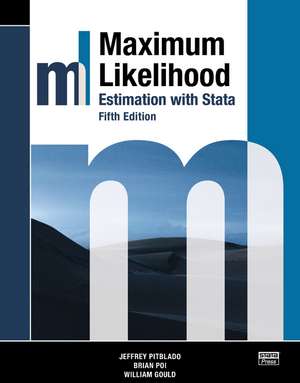
Maximum Likelihood Estimation with Stata, Fifth Edition
Autor Jeffrey Pitblado, Brian Poi, William Goulden Limba Engleză Paperback – 23 noi 2023
The fifth edition includes a new second chapter that demonstrates the easy-to-use mlexp command. This command allows you to directly specify a likelihood function and perform estimation without any programming.
The core of the book focuses on Stata's ml command. It shows you how to take full advantage of ml’s noteworthy features:
- Linear constraints
- Four optimization algorithms (Newton–Raphson, DFP, BFGS, and BHHH)
- Observed information matrix (OIM) variance estimator
- Outer product of gradients (OPG) variance estimator
- Huber/White/sandwich robust variance estimator
- Cluster–robust variance estimator
- Complete and automatic support for survey data analysis
- Direct support of evaluator functions written in Mata
In later chapters, you will learn how to take advantage of Mata, Stata's matrix programming language. For ease of programming and potential speed improvements, you can write your likelihood-evaluator program in Mata and continue to use ml to control the maximization process. A new chapter in the fifth edition shows how you can use the moptimize() suite of Mata functions if you want to implement your maximum likelihood estimator entirely within Mata.
In the final chapter, the authors illustrate the major steps required to get from log-likelihood function to fully operational estimation command. This is done using several different models: logit and probit, linear regression, Weibull regression, the Cox proportional hazards model, random-effects regression, and seemingly unrelated regression. This edition adds a new example of a bivariate Poisson model, a model that is not available otherwise in Stata.
The authors provide extensive advice for developing your own estimation commands. With a little care and the help of this book, users will be able to write their own estimation commands---commands that look and behave just like the official estimation commands in Stata.
Whether you want to fit a special ML estimator for your own research or wish to write a general-purpose ML estimator for others to use, you need this book.
Preț: 480.11 lei
Preț vechi: 521.86 lei
-8%
Puncte Express: 720
Carte disponibilă
Livrare economică 02-16 noiembrie
Livrare express 16-22 octombrie pentru 52.100 lei
Livrare prin curier în România Termenul estimat este afișat lângă disponibilitate.
Transport gratuit pentru acest produs Plată online sau ramburs, în funcție de opțiunile comenzii.
Retur gratuit în 14 zile Comandă securizată și suport în română.
Specificații
ISBN-13: 9781597184113
ISBN-10: 159718411X
Pagini: 472
Dimensiuni: 182 x 235 x 29 mm
Greutate: 0.96 kg
Ediția:5. Auflage
Editura: Stata Press
Colecția Stata Press
ISBN-10: 159718411X
Pagini: 472
Dimensiuni: 182 x 235 x 29 mm
Greutate: 0.96 kg
Ediția:5. Auflage
Editura: Stata Press
Colecția Stata Press
Public țintă
Academic, Postgraduate, and Professional Practice & DevelopmentCuprins
Theory and practice The likelihood-maximization problem Likelihood theory The maximization problem Estimation with mlexp Syntax Normal linear regression Initial values Restricted parameters Robust standard errors The probit model Specifying derivatives Additional estimation features Wrapping up Introduction to ml The probit mode Normal linear regression Robust standard errors Weighted estimation Other features of method-gf0 evaluators Limitations Overview of ml The terminology of ml Equations in ml Likelihood-evaluator methods Tools for the ml programmer Common ml options Maximizing your own likelihood functions Appendix: More about scalar parameters Method lf The linear-form restrictions Examples The importance of generating temporary variables as doubles Problems you can safely ignore Nonlinear specifications The advantages of lf in terms of execution speed Methods lf0, lf1, and lf2 Comparing these methods Outline of evaluators of methods lf0, lf1, and lf2 Summary of methods lf0, lf1, and lf2 Examples Methods d0, d1, and d2 Comparing these methods Outline of method d0, d1, and d2 evaluators Summary of methods d0, d1, and d2 Panel-data likelihoods Other models that do not meet the linear-form restrictions Debugging likelihood evaluators ml check Using the debug methods ml trace Setting initial values ml search ml plot ml init Interactive maximization The iteration log Pressing the Break key Maximizing difficult likelihood functions Final results Graphing convergence Redisplaying output Writing do-files to maximize likelihoods The structure of a do-file Putting the do-file into production Writing ado-files to maximize likelihoods Writing estimation commands The standard estimation-command outline Outline for estimation commands using ml Using ml in noninteractive mode Advice Writing ado-files for survey data analysis Program properties Writing your own predict command Mata-based likelihood evaluators Introductory examples Evaluator function prototypes Utilities Random-effects linear regression Ado-file considerations Mata’s moptimize() function Introductory examples Restricting the estimation sample Estimation preliminaries Estimation Results Estimation commands Regression redux Other examples The logit model The probit model Normal linear regression The Weibull model The Cox proportional hazards model The random-effects regression model The seemingly unrelated regression model A bivariate Poisson regression model Epilogue Syntax of mlexp Syntax of ml Syntax of moptimize() Likelihood-evaluator checklists Method lf Method d0 Method d1 Method d2 Method lf0 Method lf1 Method lf2 Listing of estimation commands The logit model The probit model The normal model The Weibull model The Cox proportional hazards model The random-effects regression model The seemingly unrelated regression model A bivariate Poisson regression model References
Notă biografică
Jeff Pitblado is Executive Director, Statistical Software at StataCorp. Pitblado has played a leading role in the development of ml: he added the ability of ml to work with survey data, and he wrote the current implementation of ml in Mata.
Brian Poi previously worked as a developer at StataCorp and wrote many popular econometric estimators in Stata. Since then, he has applied his knowledge of econometrics and statistical programming in several areas, including macroeconomic forecasting, credit analytics, and bank stress testing.
William Gould is President Emeritus of StataCorp and headed the development of Stata for over 30 years. Gould is also the architect of Mata.
Brian Poi previously worked as a developer at StataCorp and wrote many popular econometric estimators in Stata. Since then, he has applied his knowledge of econometrics and statistical programming in several areas, including macroeconomic forecasting, credit analytics, and bank stress testing.
William Gould is President Emeritus of StataCorp and headed the development of Stata for over 30 years. Gould is also the architect of Mata.
Descriere
Maximum Likelihood Estimation with Stata, Fifth Edition is the essential reference and guide for researchers in all disciplines who wish to write maximum likelihood (ML) estimators in Stata. Learn about ML estimation and how to write Stata code for a special ML estimator for your own research or for a general-purpose ML estimator.