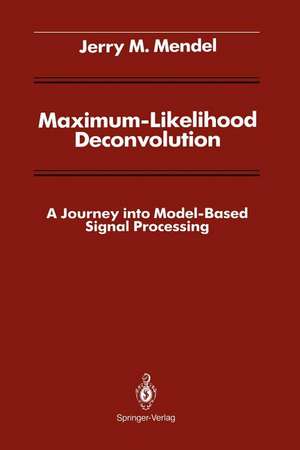
Maximum-Likelihood Deconvolution: Signal Processing and Digital Filtering
Autor Jerry M. Mendelen Limba Engleză Paperback – 17 sep 2011

Preț: 373.16 lei
Puncte Express: 560
Carte tipărită la comandă
Livrare economică 24 noiembrie-08 decembrie
Livrare prin curier în România Termenul estimat este afișat lângă disponibilitate.
Transport gratuit de la 400.00 lei Plată online sau ramburs, în funcție de opțiunile comenzii.
Retur gratuit în 14 zile Comandă securizată și suport în română.
Specificații
ISBN-13: 9781461279853
ISBN-10: 1461279852
Pagini: 244
Ilustrații: XIV, 227 p.
Dimensiuni: 155 x 235 x 14 mm
Greutate: 0.38 kg
Ediția:Softcover reprint of the original 1st ed. 1990
Editura: Springer
Colecția Signal Processing and Digital Filtering
Seria Signal Processing and Digital Filtering
Locul publicării:New York, NY, United States
ISBN-10: 1461279852
Pagini: 244
Ilustrații: XIV, 227 p.
Dimensiuni: 155 x 235 x 14 mm
Greutate: 0.38 kg
Ediția:Softcover reprint of the original 1st ed. 1990
Editura: Springer
Colecția Signal Processing and Digital Filtering
Seria Signal Processing and Digital Filtering
Locul publicării:New York, NY, United States
V-ar putea interesa
-
 WiMAX HandbookFrank Ohrtman-40%Preț: 467.03 lei773.49 lei
 -
 Getting the Message: A History of CommunicationsLaszlo Solymar-28%Preț: 545.38 lei756.66 lei
 -
 Television Technology Demystified: A Non-technical GuideAleksandar Louis Todorovic-15%Preț: 425.36 lei500.42 lei
 -
 Simulation of Communication SystemsMichel C Jeruchim-18%Preț: 1923.66 lei2345.93 lei
 -
 Multi-application Smart CardsMike Hendry-14%Preț: 807.39 lei938.83 lei
 -
 -31%Preț: 409.09 lei590.88 lei
 -
 Satellite CommunicationsJoseph N. PeltonPreț: 366.44 lei
 -
 Trustworthy Execution on Mobile DevicesAmit Vasudevan-20%Preț: 310.41 lei388.01 lei
 -
 -27%Preț: 1274.56 lei1736.58 lei
 -
 Spectacular Television: Exploring Televisual PleasureHelen Wheatley-25%Preț: 175.59 lei234.00 lei
 -
 The Art and Science of Nfc ProgrammingAnne-Marie Lesas-9%Preț: 973.20 lei1069.45 lei
Public țintă
ResearchCuprins
1 - Introduction.- 1.1 Introduction.- 1.2 Our Approach.- 1.3 Likelihood Versus Probability.- 1.4 Maximum-Likelihood Method.- 1.5 Comments.- 2 - Convolutional Model.- 2.1 Introduction.- 2.2 The Seismic Convolutional Model.- 2.3 Input.- 2.4 Channel Model IR (Seismic Wavelet).- 2.5 Measurement Noise.- 2.6 Other Effects.- 2.7 Mathematical Model.- 2.8 Summary.- 3 - Likelihood.- 3.1 Introduction.- 3.2 Loglikelihood.- 3.3 Likelihood Function.- 3.4 Using Given Information.- 3.5 Message for the Reader.- 3.6 Mathematical Likelihood Functions.- 3.7 Mathematical Loglikelihood Functions.- 3.8 Summary.- 4 - Maximizing Likelihood.- 4.1 Introduction.- 4.2 A Rationale.- 4.3 Block Component Search Algorithms.- 4.4 Mathematical Fact.- 4.5 Separation Principle.- 4.6 Update Random Parameters.- 4.7 Binary Detection.- 4.8 Update Wavelet Parameters.- 4.9 Update Statistical Parameters.- 4.10 Message for the Reader.- 4.11 Summary.- 5 - Properties and Performance.- 5.1 Introduction.- 5.2 Minimum-Variance Deconvolution.- 5.3 Detectors.- 5.4 A Modified Likelihood Function.- 5.5 An Objective Function.- 5.6 Marquardt-Levenberg Algorithm.- 5.7 Convergence.- 5.8 Entropy Interpretation.- 5.9 Summary.- 6 - Examples.- 6.1 Introduction.- 6.2 Some Real Data Examples.- 6.3 Minimum-Variance Deconvolution.- 6.4 Detection.- 6.5 Block Component Method.- 6.6 Backscatter.- 6.7 Noncausal Channel Models.- 6.8 Summary.- 7 - Mathematical Details for Chapter 4.- 7.1 Introduction.- 7.2 Mathematical Fact.- 7.3 Separation Principle.- 7.4 Minimum-Variance Deconvolution.- 7.5 Threshold Detector.- 7.6 Single Most-Likely Replacement Detector.- 7.7 Single Spike Shift Detector.- 7.8 SSS-SMLR Detector.- 7.9 Marquardt-Levenberg Algorithm.- 7.10 Calculating Gradients.- 7.11 Calculating Second Derivatives.- 7.12 Why vr Cannot be Estimated: Maximization of L or M is an Ill-Posed Problem.- 7.13 An Algorithm for ?.- 8 - Mathematical Details for Chapter 5.- 8.1 Introduction.- 8.2 MVD Filter Properties.- 8.3 Threshold Detector.- 8.4 Modified Likelihood Function.- 8.5 Separation Principle for P and Derivation of N from P.- 8.6 Why vr Cannot be Estimated: Maximization of P or N is not an Ill-Posed Problem.- 8.7 SMLR1 Detector Based on N.- 8.8 Quadratic Convergence of the Newton-Raphson Algorithm.- 8.9 Wavelet Identifiability.- 8.10 Convergence of Adaptive SMLR Detector.- 9 - Computational Considerations.- 9.1 Introduction.- 9.2 Recursive Processing.- 9.3 Summary.- References.