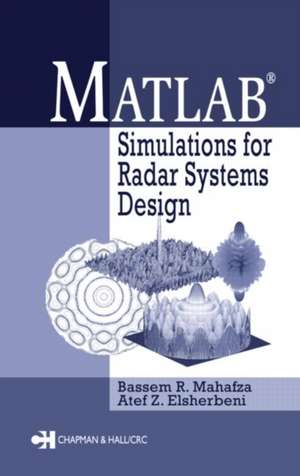
MATLAB Simulations for Radar Systems Design
Autor Bassem R. Mahafza, Atef Elsherbenien Limba Engleză Hardback – 17 dec 2003
ÖUnderstand radar operations and design philosophy
ÖKnow how to select the radar parameters to meet the design requirements
ÖBe able to perform detailed trade-off analysis in the context of radar sizing, modes of operation, frequency selection, waveforms, and signal processing
ÖDevelop loss and error budgets associated with the design
MATLAB Simulations for Radar Systems Design teaches all of this and provides the M-files and hands-on simulation experience needed to design and analyze radar systems. Part I forms a comprehensive description of radar systems, their analysis, and the design process. The authors' unique approach involves a design case study introduced in Chapter 1 and followed throughout the text. As the treatment progresses, the complexity increases and the case study requirements are adjusted accordingly. Part II presents a series of chapters-some authored by other experts in the field-on specialized radar topics important to a full understanding of radar systems design and analysis.
A comprehensive set of MATLAB programs and functions support both parts of the book and are available for download from the CRC Press Web site.
Preț: 1456.33 lei
Preț vechi: 1776.01 lei
-18%
Carte tipărită la comandă
Livrare economică 20 iulie-03 august
Specificații
ISBN-10: 1584883928
Pagini: 704
Ilustrații: 422 b/w images, 80 tables and 1000 equations
Dimensiuni: 156 x 234 x 42 mm
Greutate: 1.46 kg
Ediția:New.
Editura: CRC Press
Colecția Chapman and Hall/CRC
V-ar putea interesa
-
 -20%Preț: 791.32 lei989.15 lei
 -
 -20%Preț: 800.55 lei1000.69 lei
 -
 5G Wireless: A Comprehensive IntroductionWilliam StallingsPreț: 507.47 lei
 -
 Deep LearningIan Goodfellow-20%Preț: 628.38 lei785.48 lei
 -
 -18%Preț: 882.28 lei1075.96 lei
 -
 Preț: 442.55 lei
 -
 -5%Preț: 1131.12 lei1190.65 lei
 -
 -5%Preț: 468.94 lei493.62 lei
 -
 -20%Preț: 659.83 lei824.79 lei
 -
 -15%Preț: 406.97 lei478.79 lei
 -
 -20%Preț: 1202.47 lei1503.10 lei
 -
 Foundations of Electromagnetic CompatibilityBogdan Adamczyk-9%Preț: 800.67 lei879.85 lei
 -
 5G Radio Access Network ArchitectureSasha Sirotkin-9%Preț: 800.30 lei879.45 lei
 -
 LPIC-1 Linux Professional Institute Certification Study GuideChristine Bresnahan-20%Preț: 317.30 lei396.64 lei
 -
 Introduction to Synthetic Aperture Radar: Concepts and PracticeE. David Jansing-30%Preț: 588.53 lei838.80 lei
 -
 Data and Computer CommunicationsWilliam Stallings-11%Preț: 638.48 lei717.39 lei
 -
 Network Security Essentials: Applications and Standards, Global EditionWilliam Stallings-20%Preț: 541.51 lei676.89 lei
 -
 -15%Preț: 648.44 lei762.87 lei
 -
 -18%Preț: 1389.74 lei1694.80 lei
 -
 Applied Signal ProcessingSadasivan Puthusserypady-23%Preț: 788.38 lei1023.86 lei
 -
 Python Data Analysis - Third EditionAvinash Navlani-20%Preț: 221.31 lei276.63 lei
 -
 PRIN ART NEURAL NETWORK (4TH ED)Daniel Graupe-20%Preț: 899.89 lei1124.86 lei
 -
 -15%Preț: 617.77 lei726.79 lei
Public țintă
ProfessionalCuprins
PART I
INTRODUCTION TO RADAR BASICS
Radar Classifications
Range
Range Resolution
Doppler Frequency
The Radar Equation
Search (Surveillance)
Pulse Integration
Radar Losses
My Radar Design Case Study - Visit 1
MATLAB Program and Function Listings
Appendix - Pulsed Radar
Appendix -Noise Figure
RADAR DETECTION
Detection in the Presence of Noise
Probability of False Alarm
Probability of Detection
Pulse Integration
Detection of Fluctuating Targets
Probability of Detection Calculation
The Radar Equation Revisited
Cumulative Probability of Detection
Constant False Alarm Rate (CFAR)
My Radar Design Case Study - Visit 2
MATLAB Program and Function Listings
RADAR WAVEFORMS
Low Pass, Band Pass Signals and Quadrature Components
The Analytic Signal
CW and Pulsed Waveforms
Linear Frequency Modulation Waveforms
High Range Resolution
Stepped Frequency Waveforms
The Matched Filter
The Replica
Matched Filter Response to LFM Waveforms
Waveform Resolution and Ambiguity
My Radar Design Case Study - Visit 3
MATLAB Program and Function Listings
THE RADAR AMBIGUITY FUNCTION
Introduction
Examples of the Ambiguity Function
Ambiguity Diagram Contours
Digital Coded Waveforms
My Radar Design Case Study - Visit 4
MATLAB Program and Function Listings
PULSE COMPRESSION
Time-Bandwidth Product
Radar Equation with Pulse Compression
LFM Pulse Compression
My Radar Design Case Study - Visit 5
MATLAB Program and Function Listings
SURFACE AND VOLUME CLUTTER
Clutter Definition
Surface Clutter
Volume Clutter
Clutter Statistical Models
My Radar Design Case Study - Visit 6
MATLAB Program and Function Listings
MOVING TARGET INDICATOR (MTI) AND CLUTTER MITIGATION
Clutter Spectrum
Moving Target Indicator (MTI)
Single Delay Line Canceler
Double Delay Line Canceler
Delay Lines with Feedback (Recursive Filters)
PRF Staggering
MTI Improvement Factor
My Radar Design Case Study - Visit 7
MATLAB Program and Function Listings
PHASED ARRAYS
Directivity, Power Gain, and Effective Aperture
Near and Far Fields
General Arrays
Linear Arrays
Planar Arrays
Array Scan Loss
My Radar Design Case Study - Visit 8
MATLAB Program and Function Listings
TARGET TRACKING
Single Target Tracking
Angle Tracking
Amplitude Comparison Monopulse
Phase Comparison Monopulse
Range Tracking
Multiple Target Tracking
Track-While-Scan (TWS)
State Variable Representation of an LTI System
The LTI System of Interest
Fixed-Gain Tracking Filters
The Kalman Filter
My Radar Design Case Study - Visit 9
MATLAB Program and Function Listings
PART II
ELECTRONIC COUNTERMEASURES (ECM)
Introduction
Jammers
Range Reduction Factor
Chaff
MATLAB Program and Function Listings
RADAR CROSS SECTION (RCS)
RCS Definition
RCS Prediction Methods
Dependency on Aspect Angle and Frequency
RCS Dependency on Polarization
RCS of Simple Objects
Scattering From a Dielectric-Capped Wedge
RCS of Complex Objects
RCS Fluctuations and Statistical Models
MATLAB Program and Function Listings
HIGH RESOLUTION TACTICAL SYNTHETIC APERTURE RADAR
(TSAR)
Introduction
Side Looking SAR Geometry
SAR Design Considerations
SAR Radar Equation
SAR Signal Processing
Side Looking SAR Doppler Processing
SAR Imaging Using Doppler Processing
Range Walk
A Three-Dimensional SAR Imaging Technique
MATLAB Programs and Functions
SIGNAL PROCESSING
Signal and System Classifications
The Fourier Transform
The Fourier Series
Convolution and Correlation Integrals
Energy and Power Spectrum Densities
Random Variables
Multivariate Gaussian Distribution
Random Processes
Sampling Theorem
The Z-Transform
The Discrete Fourier Transform
Discrete Power Spectrum
Windowing Techniques
MATLAB Programs
APPENDICES
Fourier Transform Table
Some Common Probability Densities
Z - Transform Table
MATLAB PROGRAM AND FUNCTION NAME LIST
BIBLIOGRAPHY
INDEX
Descriere
Simulation is integral to the successful design of modern radar systems, and there is arguably no better software for this purpose than MATLAB. But software and the ability to use it does not guarantee success. One must also:
ÖUnderstand radar operations and design philosophy
ÖKnow how to select the radar parameters to meet the design requirements
ÖBe able to perform detailed trade-off analysis in the context of radar sizing, modes of operation, frequency selection, waveforms, and signal processing
ÖDevelop loss and error budgets associated with the design
MATLAB Simulations for Radar Systems Design teaches all of this and provides the M-files and hands-on simulation experience needed to design and analyze radar systems. Part I forms a comprehensive description of radar systems, their analysis, and the design process. The authors' unique approach involves a design case study introduced in Chapter 1 and followed throughout the text. As the treatment progresses, the complexity increases and the case study requirements are adjusted accordingly. Part II presents a series of chapters-some authored by other experts in the field-on specialized radar topics important to a full understanding of radar systems design and analysis.
A comprehensive set of MATLAB programs and functions support both parts of the book and are available for download from the CRC Press Web site.