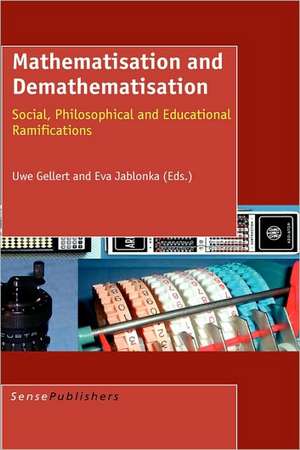
Mathematisation and Demathematisation
Editat de Uwe Gellert, Eva Jablonkaen Limba Engleză Hardback – 19 iun 2008
Preț: 848.88 lei
Preț vechi: 1102.45 lei
-23%
Puncte Express: 1273
Preț estimativ în valută:
150.07€ • 172.16$ • 129.66£
150.07€ • 172.16$ • 129.66£
Carte tipărită la comandă
Livrare economică 28 aprilie-04 mai
Specificații
ISBN-13: 9789087900120
ISBN-10: 9087900120
Pagini: 216
Dimensiuni: 156 x 234 x 14 mm
Greutate: 0.48 kg
Editura: Sense Publishers
Locul publicării:Netherlands
ISBN-10: 9087900120
Pagini: 216
Dimensiuni: 156 x 234 x 14 mm
Greutate: 0.48 kg
Editura: Sense Publishers
Locul publicării:Netherlands
V-ar putea interesa
-
 Teaching Environmental LiteracyHeather L. ReynoldsPreț: 169.82 lei
 -
 The Art Teacher's Book of Lists, Grades K-12Helen D HumePreț: 219.64 lei
 -
 Preț: 211.95 lei
 -
 Inspirational Ideas: PSHE and Citizenship 9-11Molly Potter-43%Preț: 94.91 lei166.23 lei
 -
 Preț: 171.55 lei
 -
 Norse MythologyCharles KovacsPreț: 88.90 lei
 -
 Preț: 92.10 lei
 -
 -42%Preț: 105.96 lei182.77 lei
 -
 Designing and Using Mathematical TasksSue Johnston-WilderPreț: 121.78 lei