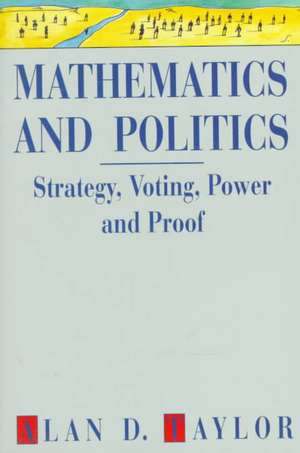
Mathematics and Politics
Autor Alan D. Tayloren Limba Engleză Paperback – 9 mar 1995
Preț: 321.74 lei
Puncte Express: 483
Carte indisponibilă temporar
Specificații
ISBN-13: 9780387943916
ISBN-10: 0387943919
Pagini: 304
Ilustrații: XIV, 284 p.
Dimensiuni: 156 x 234 x 16 mm
Greutate: 0.43 kg
Ediția:New.
Editura: Springer Nature B.V.
Locul publicării:New York, NY, United States
ISBN-10: 0387943919
Pagini: 304
Ilustrații: XIV, 284 p.
Dimensiuni: 156 x 234 x 16 mm
Greutate: 0.43 kg
Ediția:New.
Editura: Springer Nature B.V.
Locul publicării:New York, NY, United States
V-ar putea interesa
-
 Game ChangeJohn HeilemannPreț: 117.76 lei
 -
 Still the Best HopeDennis PragerPreț: 105.93 lei
 -
 The EU's Decision Traps: Comparing PoliciesGerda Falkner-14%Preț: 721.96 lei839.48 lei
 -
 -14%Preț: 858.15 lei997.85 lei
 -
 Government AgenciesK. Verhoest-15%Preț: 684.02 lei804.73 lei
 -
 European Politics: Pasts, presents, futuresKlaus H GoetzPreț: 303.88 lei
 -
 Compliance Ideologies: Rethinking Political CultureRichard W. WilsonPreț: 290.92 lei
 -
 Democratization and Research MethodsMichael CoppedgePreț: 332.72 lei
 -
 Preț: 223.86 lei
 -
 Party Politics and Economic Reform in Africa's DemocraciesM. Anne PitcherPreț: 271.12 lei
 -
 -14%Preț: 767.66 lei892.64 lei
 -
 Constitutional Change and Democracy in IndonesiaDonald L. HorowitzPreț: 253.51 lei
 -
 War, Guilt, and World Politics after World War IIThomas U. BergerPreț: 296.41 lei
 -
 -38%Preț: 234.00 lei378.21 lei
 -
 Reclaiming Public Ownership: Making Space for Economic DemocracyProfessor Andrew Cumbers-26%Preț: 184.79 lei249.22 lei
 -
 The Mathematics of Coordinated Inference: A Study of Generalized Hat ProblemsChristopher S. HardinPreț: 370.84 lei
Public țintă
Lower undergraduateCuprins
1 Escalation.- 1.1. Introduction.- 1.2. Game-Tree Analyses.- 1.3. Limitations and Back-of-the-Envelope Calculations.- 1.4. Statement of O’Neill’s Theorem.- 1.5. Conclusions.- Exercises.- 2 Conflict.- 2.1. Introduction.- 2.2. Dominant Strategies and Nash Equilibria.- 2.3. Prisoner’s Dilemma.- 2.4. A Game-Theoretic Model of the Arms Race.- 2.5. Chicken.- 2.6. Game-Theoretic Models of the Cuban Missile Crisis.- 2.7. Conclusions.- Exercises.- 3 Yes-No Voting.- 3.1. Introduction.- 3.2. Swap Robustness and the Nonweightedness of the Federal System.- 3.3. Trade Robustness and the Nonweightedness of the Procedure to Amend the Canadian Constitution.- 3.4. Statement of the Characterization Theorem.- 3.5. Conclusions.- Exercises.- 4 Political Power.- 4.1. Introduction.- 4.2. The Shapley-Shubik Index of Power.- 4.3. Calculations for the European Economic Community.- 4.4. A Theorem on Voting Blocs.- 4.5. The Banzhaf Index of Power.- 4.6. Two Methods of Computing Banzhaf Power.- 4.7. Ordinal Power: Incomparability.- 4.8. Conclusions.- Exercises.- 5 Social Choice.- 5.1. Introduction.- 5.2. Five Examples of Social Choice Procedures.- 5.3. Four Desirable Properties of Social Choice Procedures.- 5.4. Positive Results—Proofs.- 5.5. Negative Results—Proofs.- 5.6. The Condorcet Voting Paradox.- 5.7. A Glimpse of Impossibility.- 5.8. Conclusions.- Exercises.- 6 More Escalation.- 6.1. Introduction.- 6.2. Statement of the Strong Version of O’Neill’s Theorem.- 6.3. Proof (by Mathematical Induction) of the Strong Version of O’Neill’s Theorem.- 6.4. Vickrey Auctions.- 6.5. Vickrey Auctions as a Generalized Prisoner’s Dilemma.- 6.6. Conclusions.- Exercises.- 7 More Conflict.- 7.1. Introduction.- 7.2. The Yom Kippur War.- 7.3. The Theory of Moves.- 7.4. Models of Deterrence.-7.5. A Probabilistic Model of Deterrence.- 7.6. Two-Person Zero-Sum Games.- 7.7. Conclusions.- Exercises.- 8 More Yes-No Voting.- 8.1. Introduction.- 8.2. A Magic Square Voting System.- 8.3. Dimension Theory and the U.S. Federal System.- 8.4. Vector-Weighted Voting Systems.- 8.5. Conclusions.- Exercises.- 9 More Political Power.- 9.1. Introduction.- 9.2. The Johnston Index of Power.- 9.3. The Deegan-Packel Index of Power.- 9.4. The Power of the President.- 9.5. Ordinal Power: Comparability.- 9.6. The Chair’s Paradox.- 9.7. Conclusions.- Exercises.- 10 More Social Choice.- 10.1. Introduction.- 10.2. Social Welfare Functions.- 10.3. May’s Theorem for Two Alternatives.- 10.4. Arrow’s Impossibility Theorem.- 10.5. Single Peakedness—Theorems of Black and Sen.- 10.6. Conclusions.- Exercises.- Attributions.- References.