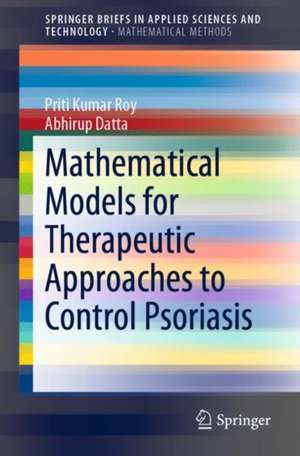
Mathematical Models for Therapeutic Approaches to Control Psoriasis: SpringerBriefs in Applied Sciences and Technology
Autor Priti Kumar Roy, Abhirup Dattaen Limba Engleză Paperback – 30 iul 2019
Recomandăm acest volum ca referință de specialitate pentru nivelul de master și doctorat, fiind o incursiune riguroasă în biomatematică. Lucrarea Mathematical Models for Therapeutic Approaches to Control Psoriasis se concentrează pe utilizarea aparatului matematic complex pentru a înțelege și controla patogeneza psoriazisului, o boală autoimună cu o dinamică celulară complexă. Autorii, Priti Kumar Roy și Abhirup Datta, structurează materialul în zece capitole care evoluează de la modelele de bază ale plăcii imunopatogene către abordări avansate de ordin fracționar.
Considerăm că punctul forte al cărții rezidă în analiza detaliată a mecanismelor de control, precum feedback-ul negativ cu efect de întârziere în creșterea keratinocitelor. Spre deosebire de Applications of Dynamical Systems in Biology and Medicine, care oferă o panoramă largă asupra diverselor patologii (cancer, malarie), volumul de față este o monografie nișată pe interacțiunea specifică dintre celulele dendritice și celulele CD8+ T. Această abordare completează perspectiva oferită de Fractional Calculus in Medical and Health Science, adăugând studii de caz concrete despre eficacitatea medicamentelor Ciclosporină și FK506 în reglarea sistemului psoriazic.
Structura este logică și progresivă, debutând cu modele bazate pe ecuații diferențiale ordinare și culminând cu ultimele trei capitole dedicate abordărilor fracționare. Autorul Priti Kumar Roy își continuă aici direcția de cercetare stabilită în lucrarea anterioară, Mathematical Models for Therapeutic Approaches to Control HIV Disease Transmission, aplicând expertiza sa în modelarea bolilor infecțioase și autoimune pentru a propune strategii de optimizare a tratamentului. Textul este dens, matematic, dar extrem de bine ancorat în realitatea clinică a bolii.
Din seria SpringerBriefs in Applied Sciences and Technology
-
 Preț: 301.01 lei
 -
 Preț: 364.77 lei
 - 20%
 Preț: 314.65 lei
 -
 Preț: 364.51 lei
 -
 Preț: 459.50 lei
 -
 Preț: 367.72 lei
 -
 Preț: 416.14 lei
 -
 Preț: 368.30 lei
 -
 Preț: 365.97 lei
 - 20%
 Preț: 309.31 lei
 -
 Preț: 336.26 lei
 -
 Preț: 375.56 lei
 -
 Preț: 334.91 lei
 -
 Preț: 251.64 lei
 -
 Preț: 334.09 lei
 -
 Preț: 254.42 lei
 -
 Preț: 365.06 lei
 -
 Preț: 368.30 lei
 -
 Preț: 365.31 lei
 -
 Preț: 461.36 lei
 - 20%
 Preț: 216.46 lei
 -
 Preț: 369.60 lei
 -
 Preț: 365.75 lei
 -
 Preț: 396.35 lei
 -
 Preț: 332.21 lei
 -
 Preț: 365.59 lei
 -
 Preț: 251.49 lei
 -
 Preț: 330.32 lei
 - 5%
 Preț: 348.31 lei
 -
 Preț: 398.15 lei
 -
 Preț: 334.09 lei
 -
 Preț: 366.64 lei
 - 20%
 Preț: 286.05 lei
 -
 Preț: 333.81 lei
 -
 Preț: 364.24 lei
 -
 Preț: 367.72 lei
 -
 Preț: 369.31 lei
 -
 Preț: 333.28 lei
 -
 Preț: 367.19 lei
 -
 Preț: 400.85 lei
 -
 Preț: 365.59 lei
 -
 Preț: 364.24 lei
 -
 Preț: 365.06 lei
 - 20%
 Preț: 314.65 lei
 - 20%
 Preț: 313.75 lei
 -
 Preț: 397.86 lei
 -
 Preț: 365.97 lei
 - 15%
 Preț: 476.02 lei
 -
 Preț: 362.68 lei
Preț: 363.26 lei
Carte disponibilă
Livrare economică 16-30 mai
Specificații
ISBN-10: 9811390193
Pagini: 83
Ilustrații: XVII, 89 p. 33 illus., 29 illus. in color.
Dimensiuni: 155 x 235 mm
Greutate: 0.17 kg
Ediția:1st ed. 2019
Editura: Springer Nature Singapore
Colecția Springer
Seriile SpringerBriefs in Applied Sciences and Technology, SpringerBriefs in Mathematical Methods
Locul publicării:Singapore, Singapore
De ce să citești această carte
Această lucrare este esențială pentru cercetătorii din matematica aplicată și bioinformatică dornici să înțeleagă patologiile autoimune prin prisma ecuațiilor diferențiale. Cititorul câștigă o metodologie clară pentru modelarea proliferării keratinocitelor și evaluarea teoretică a tratamentelor farmacologice. Este un instrument valoros pentru cei care doresc să aplice calculul fracționar în sănătatea publică și epidemiologie.
Despre autor
Priti Kumar Roy este un cercetător recunoscut în domeniul matematicii aplicate, cu un interes profund pentru modelarea matematică a sistemelor biologice și medicale. Opera sa se concentrează pe dinamica bolilor complexe, de la HIV/SIDA la afecțiuni autoimune precum psoriazisul. A editat volume de referință, precum Mathematical Analysis and Applications in Modeling, și contribuie activ la literatura academică prin studii ce utilizează ecuații diferențiale și strategii de control optimal pentru a îmbunătăți protocoalele terapeutice globale.
Descriere scurtă
Cuprins
Notă biografică
Professor Roy received the Best Paper Award at the World Congress on Engineering 2010, held in London, UK, as well as the Shiksha Ratan Award from the Government of West Bengal in 2012. He was the principal investigator for seven research projects sponsored by the Government of India. His DST-RFBR project with the Moscow State University was selected in 2018. He was the recipient of a Royal Society Fellowship and a Poland Academy of Science Fellowship, and was sponsored by The Royal Society of Edinburgh under the INSA-Royal Society Bilateral Exchange Program at the University of Strathclyde, Scotland, UK, and the Poland Academy of Science under the INSA-PAS Bilateral Exchange Program at the University of Warsaw, Poland. He received the Open Arms award at the International Congress of Mathematics (ICM) 2018, Brazil. He is a permanent Visiting Professor at Beijing Technology and Business University, China. Professor Roy has delivered invited lectures at over 45 overseas universities and institutes across Europe, Asia, and America and numerous lectures at several Indian universities.
ABHIRUP DATTA is Assistant Professor at the Department of Mathematics, Netaji Satabarshiki Mahavidyalaya, West Bengal, India. He was awarded a Junior Research Fellow by the CSIR, India, and completed his Ph.D. under the guidance of Professor Priti Kumar Roy at the Department of Mathematics, Jadavpur University, in 2016. Dr Datta is the first researcher in India to be awarded a Ph.D. degree on the topic of mathematical modeling of psoriasis. He has published more than 20 research articles in various leading international journals, and he has attended and delivered lectures at more than 20 national and international conferences and at prestigious universities and institutes in India.