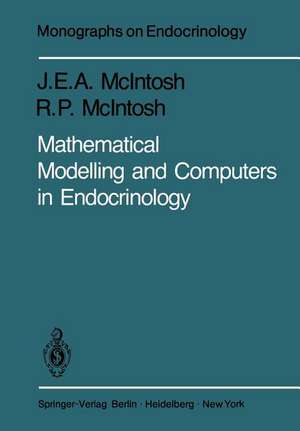
Mathematical Modelling and Computers in Endocrinology
Autor Rosalind McIntoshen Limba Engleză Paperback – 16 dec 2011
Preț: 726.54 lei
Preț vechi: 764.78 lei
-5%
Puncte Express: 1090
Carte tipărită la comandă
Livrare economică 03-17 decembrie
Livrare prin curier în România Termenul estimat este afișat lângă disponibilitate.
Transport gratuit pentru acest produs Plată online sau ramburs, în funcție de opțiunile comenzii.
Retur gratuit în 14 zile Comandă securizată și suport în română.
Specificații
ISBN-13: 9783642814037
ISBN-10: 3642814034
Pagini: 356
Ilustrații: XII, 340 p.
Dimensiuni: 170 x 244 x 20 mm
Greutate: 0.62 kg
Ediția:Softcover reprint of the original 1st ed. 1980
Editura: Springer
Locul publicării:Berlin, Heidelberg, Germany
ISBN-10: 3642814034
Pagini: 356
Ilustrații: XII, 340 p.
Dimensiuni: 170 x 244 x 20 mm
Greutate: 0.62 kg
Ediția:Softcover reprint of the original 1st ed. 1980
Editura: Springer
Locul publicării:Berlin, Heidelberg, Germany
V-ar putea interesa
-
 Testosterone Deficiency in MenHugh Jones-18%Preț: 301.13 lei368.88 lei
 -
 Hormones: A Very Short IntroductionMartin Luck-5%Preț: 64.72 lei68.13 lei
 -
 Endocrinology Adult and Pediatric: The Thyroid GlandLeslie J. De Groot-5%Preț: 779.00 lei820.00 lei
 -
 Painful Diabetic Neuropathy in Clinical PracticeAndrew J. M. Boulton-5%Preț: 356.75 lei375.54 lei
 -
 -5%Preț: 284.27 lei299.23 lei
 -
 Endocrine Diseases: Risk Factors, Diagnosis & ManagementKenneth Hines-23%Preț: 1043.01 lei1362.14 lei
 -
 -24%Preț: 755.36 lei987.62 lei
 -
 Gestational Diabetes During and After PregnancyCatherine Kim-5%Preț: 758.90 lei798.83 lei
 -
 Managing Diabetic Eye Disease in Clinical PracticeRishi P Singh-5%Preț: 347.72 lei366.02 lei
 -
 LeptinMd Dagogo-Jack-5%Preț: 748.74 lei788.14 lei
 -
 Surgery of the Thyroid and Parathyroid GlandsDaniel Oertli-5%Preț: 1100.60 lei1158.53 lei
 -
 HypoparathyroidismMaria Luisa Brandi-5%Preț: 759.07 lei799.02 lei
Public țintă
ResearchCuprins
1 Modelling in Biology.- 1.1 The Nature of Scientific Models.- 1.2 Clarity from Complexity.- 1.3 Experimental Data.- 1.4 Predictions from Models — Simulation.- 1.5 A Model of Complexity Producing Organized Simplicity.- 1.6 Subjectivity in Modelling.- 1.7 Mathematics in Modelling.- 1.8 Computers and Models.- 1.9 Description of Models.- 1.10 Modelling in Perspective.- 1.11 Advantages in Modelling.- 2 Mathematical Descriptions of Biological Models.- 2.1 Theoretical Modelling — Analysis of Mechanism.- 2.2 Linearity and Non-Linearity.- 2.3 Empirical Modelling — a Description of System Response.- 2.4 Point Stability in Models.- 2.5 Concepts of Feedback.- 2.6 Biological Development and Mathematics Beyond Instability.- 2.7 Finite Level Modelling.- 2.8 The Need for Statistics.- 3 Comparing Models with Experimental Results.- 3.1 Analogue Simulation.- 3.2 Approximate Simulation by Digital Computer.- 3.3 Suitable Digital Computers.- 3.4 Estimation of Parameters.- 3.5 Practical Details of Fitting Non-Linear Models to Data.- 3.6 Models Containing Differential Equations.- 3.7 Using the Computer to Fit Models to Data.- 4 Design of Analytical Experiments.- 4.1 Principles of Design.- 4.2 Sequential Design.- 5 Dynamic Systems: Clearance and Compartmental Analysis.- 5.1 Clearance.- 5.2 Compartmental Analysis.- 6 Ligand—Protein Interaction and Competitive Displacement Assays.- 6.1 Interactions Between Ligands and Macromolecules.- 6.2 Competitive Protein-Binding Assays.- 7 Mathematical Modelling of Biological Rhythms.- 7.1 Biological Rhythms: Experimental Evidence.- 7.2 The Contribution of Mathematics.- 7.3 Response of Rhythms to Stimuli — Rhythm Coupling.- 7.4 Rhythms, Endocrinology and Biological Control.- 7.5 Empirical Characterization of Rhythms from Data.- 8 Large Systems:Modelling Ovulatory Cycles.- 8.1 Modelling the Ovulatory Cycle.- 8.2 A Description of the Ovulatory Cycle.- 8.3 Use of Differential Equations with Cyclic Solutions.- 8.4 Use of a Threshold Discontinuity to Produce Cyclicity.- 8.5 A Physiologically Based Model of the Rat Oestrous Cycle.- 8.6 An Empirical Model of the Rat Oestrous Cycle Controlled by Time.- 8.7 An Attempt to Include More Variables.- 8.8 Eliminating the Differential Equations: A Finite Level Model.- 8.9 A “Complete” Description.- 8.10 Conclusions.- 9 Stochastic Models.- 9.1 Non-Parametric Statistical Models.- 9.2 Multivariate Analysis.- 10 Appendix A: A Summary of Relevant Statistics.- 10.1 Variance, Standard Deviation and Weight.- 10.2 The Propagation of Variance.- 10.3 Covariance and Correlation.- 10.4 z-Scores, or Standardized Measures.- 10.5 Testing Hypotheses.- 10.6 Runs-Test.- 10.7 Chi-Square Test.- 10.8 Tests of Normality of Distribution.- 10.9 Comparing Two Parameters: The r-Test.- 10.10 Comparing Any Number of Parameters: Analysis of Variance.- 10.11 The Variance Ratio or F-Test.- 10.12 Confidence Intervals.- 10.13 Control Charts.- 11 Appendix B: Computer Programs.- 11.1 MODFIT: A General Model-Fitting Program.- 11.2 SIMUL: A Program for Monte Carlo Simulation.- 11.3 FUNCTN Subprogram RESERVR: Exponential Decay.- 11.4 FUNCTN Subprogram EXPCUBE: Growth of Organisms.- 11.5 FUNCTN Subprogram POLYNOM: General Polynomial.- 11.6 FUNCTN Subprogram FOLL: Growth of Ovarian Follicles.- 11.7 DESIGN: A Program for Efficient Experimental Design.- 11.8 FUNCTN Subprogram CAI: Compartmental Analysis.- 11.9 FUNCTN Subprogram CA2: Compartmental Analysis.- 11.10 FUNCTN Subprogram CA2A: Compartmental Analysis.- 11.11 FUNCTN Subprogram CA3: Compartmental Analysis.- 11.12 FUNCTN Subprogram MASSACT: LigandBinding.- 11.13 FUNCTN Subprogram GENBIND: Ligand Binding.- 11.14 FUNCTN Subprogram RIA: Competitive Protein-Binding.- 11.15 FUNCTN Subprogram RIAH: Competitive Protein-Binding.- 11.16 FUNCTN Subprogram SIN: Rhythmical Data.- 11.17 FUNCTN Subprogram LIMIT: Limit Cycles.- 11.18 Other Programs for Fitting Non-Linear Models to Data.- 12 Appendix C: Analytical Integration by Laplace Transform.- References.