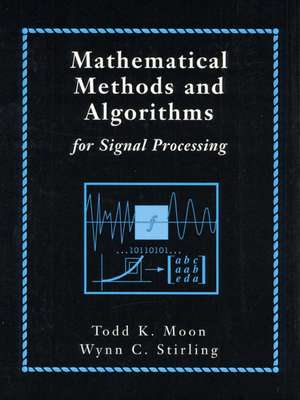
Mathematical Methods and Algorithms for Signal Processing
Autor Todd K. Moon, Wynn C. Stirlingen Limba Engleză Mixed media product – 3 aug 1999
"Mathematical Methods and Algorithms for Signal Processing" tackles the challenge of providing readers and practitioners with the broad tools of mathematics employed in modern signal processing. Building from an assumed background in signals and stochastic processes, the book provides a solid foundation in analysis, linear algebra, optimization, and statistical signal processing. Interesting modern topics not available in many other signal processing books; such as the EM algorithm, blind source operation, projection on convex sets, etc., in addition to many more conventional topics such as spectrum estimation, adaptive filtering, etc. For those interested in signal processing.
Preț: 1405.89 lei
Preț vechi: 1825.84 lei
-23%
Carte tipărită la comandă
Livrare economică 05-19 noiembrie
Specificații
ISBN-10: 0201361868
Pagini: 937
Dimensiuni: 202 x 252 x 48 mm
Greutate: 1.7 kg
Ediția:1
Editura: Pearson Education
Colecția Prentice Hall
Locul publicării:Upper Saddle River, United States
V-ar putea interesa
-
 Cybersecurity and Applied MathematicsLeigh Metcalf-29%Preț: 332.50 lei471.55 lei
 -
 Satisficing Games and Decision MakingWynn C. Stirling-20%Preț: 431.20 lei539.00 lei
 -
 Theory of Social Choice on NetworksWynn C. Stirling-14%Preț: 753.36 lei876.00 lei
 -
 Theory of Conditional GamesWynn C. Stirling-20%Preț: 378.02 lei472.53 lei
 -
 -23%Preț: 464.09 lei602.72 lei
 -
 Preț: 419.59 lei
 -
 Algebra for CryptologistsAlko R. MeijerPreț: 526.70 lei
 -
 Mathematical Software - ICMS 2016Gert-Martin Greuel-20%Preț: 348.66 lei435.83 lei
 -
 -5%Preț: 1545.05 lei1626.37 lei
 -
 -5%Preț: 1055.44 lei1110.99 lei
 -
 Soft Methods for Data ScienceMaria Brigida Ferraro-20%Preț: 1250.59 lei1563.24 lei
 -
 -20%Preț: 330.21 lei412.76 lei
 -
 Information SecurityMatt Bishop-20%Preț: 330.96 lei413.70 lei
 -
 -20%Preț: 312.30 lei390.38 lei
 -
 Arithmetic of Finite FieldsSylvain Duquesne-20%Preț: 321.74 lei402.18 lei
Descriere
Mathematical Methods and Algorithms for Signal Processing tackles the challenge of providing students and practitioners with the broad tools of mathematics employed in modern signal processing. Building from an assumed background in signals and stochastic processes, the book provides a solid foundation in analysis, linear algebra, optimization, and statistical signal processing.
Cuprins
1. Introduction and Foundations.
II. VECTOR SPACES AND LINEAR ALGEBRA.
2. Signal Spaces.
3. Representation and Approximation in Vector Spaces.
4. Linear Operators and Matrix Inverses.
5. Some Important Matrix Factorizations.
6. Eigenvalues and Eigenvectors.
7. The Singular Value Decomposition.
8. Some Special Matrices and Their Applications.
9. Kronecker Products and the Vec Operator.
III. DETECTION, ESTIMATION, AND OPTIMAL FILTERING.
10. Introduction to Detection and Estimation, and Mathematical Notation.
11. Detection Theory.
12. Estimation Theory.
13. The Kalman Filter.
IV. ITERATIVE AND RECURSIVE METHODS IN SIGNAL PROCESSING.
14. Basic Concepts and Methods of Iterative Algorithms.
15. Iteration by Composition of Mappings.
16. Other Iterative Algorithms.
17. The EM Algorithm in Signal Processing.
V. METHODS OF OPTIMIZATION.
18. Theory of Constrained Optimization.
19. Shortest-Path Algorithms and Dynamic Programming.
20. Linear Programming.
APPENDIXES.
A. Basic Concepts and Definitions.
B. Completing the Square.
C. Basic Matrix Concepts.
D. Random Processes.
E. Derivatives and Gradients.
F. Conditional Expectations of Multinomial and Poisson r.v.s.
Notă biografică
WYNN C. STIRLING is a professor of electrical engineering at Brigham Young University, where he has served on the faculty since 1984. He received his Ph.D. in electrical engineering from Stanford University, and has worked as a research engineer for Rockwell International Corporation, ESL, Inc. (now TRW), and Autonetics. His research interests include decision theory, control theory, estimation theory, and stochastic processes. Dr. Stirling has contributed numerous articles to professional journals, and is a member of IEEE and Phi Beta Kappa.
Caracteristici
- Many MATLAB algorithms and examples.
- Allow the reader to understand more deeply by seeing the implementation and to learn by doing. Ex.___
- Allow the reader to understand more deeply by seeing the implementation and to learn by doing. Ex.___
- A strong foundation which motivates the development of advanced concepts, removing the “mysteries” frequently encountered by students—Geometric insight is presented wherever possible.
- Students develop maturity to read literature, and develop confidence in their abilities. Ex. Ch. 2, 3
- Students develop maturity to read literature, and develop confidence in their abilities. Ex. Ch. 2, 3
- Solid introduction to wavelets in the context of vector spaces—Including transform algorithms and basic theory.
- Presents this important and modern topic in a context that should help students' understanding. Ex. Ch. 3
- Presents this important and modern topic in a context that should help students' understanding. Ex. Ch. 3
- Interesting modern topics not available in many other signal processing texts—Such as the EM algorithm, blind source separation, projection on convex sets, etc., in addition to many more conventional topics such as spectrum estimation, adaptive filtering, etc.
- Motivate student interest by presenting the field as dynamic, with an enormous number of useful applications. Ex.___
- Motivate student interest by presenting the field as dynamic, with an enormous number of useful applications. Ex.___
- Broad treatment of eigen-spaced signal processing methods—Including eigenfilters, MUSIC, ESPRIT, and others. Also extensive applications of SVD to signal processing.
- Applications in these areas continue to grow, and students should be informed. Ex. Ch. 6, 7
- Applications in these areas continue to grow, and students should be informed. Ex. Ch. 6, 7
- Several extended exercises—Which engage the student in step-by-step development of important topics, such as linear prediction, Kalmanfiltering, conjugate gradients, etc.
- Students are shown the outline of the approach and, by filling in the details, come to greater understanding. Ex.___
- Students are shown the outline of the approach and, by filling in the details, come to greater understanding. Ex.___
- Extensive discussion of optimization—With a variety of exercises throughout the book on constrained optimization problems of the sort that students might face.
- Students learn to recognize how to formulate criteria for optimization, then how to find useful solutions. Ex.___
- Students learn to recognize how to formulate criteria for optimization, then how to find useful solutions. Ex.___
- Textboxes—Present useful information for easy reference or for background material.
- Readers can find the material quickly for reference, but won't be pulled aside by detail unless need is there. Ex.___
- Readers can find the material quickly for reference, but won't be pulled aside by detail unless need is there. Ex.___
- Review of many signal models, in time domain, frequency domain, and state space domain, showing relationships between them, and issues related to their applications.
- Students can learn to move among the various forms, and understand how they relate. Also, come to understand the importance of a good signal model in approaching new problems. Ex. Ch. 1
- Students can learn to move among the various forms, and understand how they relate. Also, come to understand the importance of a good signal model in approaching new problems. Ex. Ch. 1
- Presents path algorithms (dynamic programming and Viterbi) with many applications.
- By seeing many examples, students will develop the ability to recognize path algorithms in new problems they may face. Ex. Ch. 19
- By seeing many examples, students will develop the ability to recognize path algorithms in new problems they may face. Ex. Ch. 19
- Coverage of detection and estimation theory.
- Students can employ the tools they have gained in the first part, overcoming some of the algebraic difficulties frequently encountered in this area. Ex. Ch. 10
- Students can employ the tools they have gained in the first part, overcoming some of the algebraic difficulties frequently encountered in this area. Ex. Ch. 10
- More than one approach to some problems.
- In QR factorization and the Kalman filter, for example, multiple approaches are presented so students can gain insight and approach the realization that there is more than one way to solve the most interesting problems. Ex. Ch. 5, 14
- In QR factorization and the Kalman filter, for example, multiple approaches are presented so students can gain insight and approach the realization that there is more than one way to solve the most interesting problems. Ex. Ch. 5, 14
- Introduction to proofs.
- Students frequently resist doing proofs, viewing it as not part of engineering practice. We motivate the rationale, then provide a few suggestions on how to proceed. Ex. Ch. 1
- Students frequently resist doing proofs, viewing it as not part of engineering practice. We motivate the rationale, then provide a few suggestions on how to proceed. Ex. Ch. 1