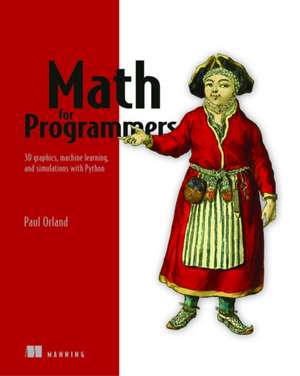
Math for Programmers
Autor Paul Orlanden Limba Engleză Paperback – 12 ian 2021
ABORDAREA PRACTICĂ: Raportul dintre teorie și cod în Math for Programmers este net în favoarea aplicabilității imediate. În loc să livreze teoreme abstracte, Paul Orland transformă conceptele matematice în funcții Python, oferind peste 200 de exerciții și proiecte care ancorează matematica direct în fluxul de lucru al unui dezvoltator software. Descoperim aici o metodologie care elimină barierele academice rigide, făcând algebra liniară și calculul diferențial accesibile prin vizualizare și implementare algoritmică. Abordarea diferă de Doing Math with Python prin complexitatea și finalitatea subiectelor abordate — dacă lucrarea lui Amit Saha se concentrează pe nivelul de liceu și fundamentele limbajului, volumul de față este mult mai aplicabil în industrii de vârf precum machine learning, criptografie și dezvoltarea motoarelor de jocuri. Structura cărții reflectă o progresie logică: pornim de la vectori și transformări geometrice în primele capitole, avansăm către simularea sistemelor fizice și forțelor, pentru a culmina cu aplicații complexe de inteligență artificială, inclusiv clasificarea datelor și antrenarea rețelelor neuronale. Față de cealaltă lucrare a autorului, The Algebra of Code Volume, care explorează conexiunile dintre programarea funcțională și structurile matematice, Math for Programmers este un ghid mult mai orientat către rezultate numerice și simulări. Reținem că această carte publicată de Manning Publications nu este un simplu manual de referință, ci un instrument de recalificare pentru programatorii care vor să stăpânească matematica din spatele bibliotecilor de data science pe care le folosesc zilnic.
Preț: 349.58 lei
Preț vechi: 436.98 lei
-20%
Carte disponibilă
Livrare economică 01-15 octombrie
Livrare express 17-23 septembrie pentru 79.25 lei
Specificații
ISBN-10: 1617295353
Pagini: 688
Ilustrații: Illustrations, unspecified
Dimensiuni: 186 x 232 x 31 mm
Greutate: 1.12 kg
Editura: Manning Publications
V-ar putea interesa
-
 -19%Preț: 598.38 lei738.74 lei
 -
 -19%Preț: 498.61 lei615.57 lei
 -
 -19%Preț: 491.40 lei606.66 lei
 -
 Lazy EvaluationJoachim Breitner-19%Preț: 575.56 lei710.57 lei
 -
 -19%Preț: 517.17 lei638.48 lei
 -
 Modeling and Prediction of I/O Performance in Virtualized EnvironmentsOmar-Qais Noorshams-19%Preț: 625.27 lei771.94 lei
 -
 Design and Analysis of a Content-based Image Retrieval SystemPilar Hernández Mesa-19%Preț: 582.32 lei718.91 lei
 -
 -19%Preț: 582.32 lei718.91 lei
 -
 An Access Definition and Query LanguageAndreas Sonnenbichler-19%Preț: 555.24 lei685.49 lei
 -
 Realtime Analysis of Large-Scale DataDaniel Becker-19%Preț: 458.07 lei565.52 lei
 -
 Helmholtz Portfolio Theme Large-Scale Data Management and Analysis (LSDMA)Christopher [Hrsg]Meyer Jörg [Hr Jung-19%Preț: 588.17 lei726.13 lei
 -
 Immersion Into NoiseJoseph NechvatalPreț: 465.09 lei
 -
 Deep Learning with PyTorchEli Stevens-20%Preț: 283.83 lei354.78 lei
 -
 Deep Learning: A Visual ApproachAndrew Glassner-35%Preț: 492.67 lei763.81 lei
 -
 Python Machine LearningSebastian Raschka-20%Preț: 323.65 lei404.56 lei
 -
 E-LEARNER¿S ASSESSMENTS with FUZZY LOGICMousumi Mitra-20%Preț: 544.90 lei681.13 lei
 -
 Técnicas de Soft Computing para la localización de instalacionesVirgilio Cruz Guzmán-20%Preț: 387.80 lei484.75 lei
 -
 Basics of PowerpointZainab Talib-20%Preț: 118.28 lei147.85 lei
 -
 Microsoft Outlook A beginner guideZainab Talib-20%Preț: 118.91 lei148.64 lei
 -
 Niveles de Colaboración en las Aulas VirtualesJosé Simón Chacón Dávila-20%Preț: 368.65 lei460.82 lei
 -
 -20%Preț: 260.06 lei325.07 lei
De ce să citești această carte
Recomandăm această carte programatorilor care doresc să treacă de la simpla utilizare a unor biblioteci software la înțelegerea și optimizarea algoritmilor de bază. Prin parcurgerea celor 688 de pagini, câștigați competențele matematice necesare pentru cariere în machine learning sau computer graphics, fără a trece prin demonstrații teoretice aride, ci prin proiecte Python concrete și vizuale.
Descriere scurtă
To score a job in data science, machine learning, computer graphics, and cryptography, you need to bring strong math skills to the party. Math for Programmers teaches the math you need for these hot careers, concentrating on what you need to know as a developer. Filled with lots of helpful graphics and more than 200 exercises and mini-projects, this book unlocks the door to interesting-and lucrative -careers in some of today's hottest programming fields. Purchase of the print book includes a free eBook in PDF, Kindle, and ePub formats from Manning Publications. About the technology
Skip the mathematical jargon: This one-of-a-kind book uses Python to teach the math you need to build games, simulations, 3D graphics, and machine learning algorithms. Discover how algebra and calculus come alive when you see them in code About the book
In Math for Programmers you'll explore important mathematical concepts through hands-on coding. Filled with graphics and more than 300 exercises and mini-projects, this book unlocks the door to interesting-and lucrative -careers in some of today's hottest fields. As you tackle the basics of linear algebra, calculus, and machine learning, you'll master the key Python libraries used to turn them into real-world software applications. What's inside Vector geometry for computer graphics
Matrices and linear transformations
Core concepts from calculus
Simulation and optimization
Image and audio processing
Machine learning algorithms for regression and classification About the reader
For programmers with basic skills in algebra. About the author
Paul Orland is a programmer, software entrepreneur, and math enthusiast. He is co-founder of Tachyus, a start-up building predictive analytics software for the energy industry. You can find him online at www.paulor.land. Table of Contents 1 Learning math with code PART I - VECTORS AND GRAPHICS 2 Drawing with 2D vectors 3 Ascending to the 3D world 4 Transforming vectors and graphics 5 Computing transformations with matrices 6 Generalizing to higher dimensions 7 Solving systems of linear equations PART 2 - CALCULUS AND PHYSICAL SIMULATION 8 Understanding rates of change 9 Simulating moving objects 10 Working with symbolic expressions 11 Simulating force fields 12 Optimizing a physical system 13 Analyzing sound waves with a Fourier series PART 3 - MACHINE LEARNING APPLICATIONS 14 Fitting functions to data 15 Classifying data with logistic regression 16 Training neural networks