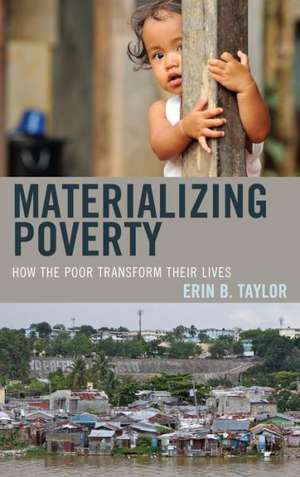
Materializing Poverty: How the Poor Transform Their Lives: Anthropology of Daily Life
Autor Erin B. Tayloren Limba Engleză Hardback – 10 oct 2013
Preț: 588.70 lei
Preț vechi: 684.54 lei
-14%
Puncte Express: 883
Carte tipărită la comandă
Livrare economică 25 noiembrie-09 decembrie
Livrare prin curier în România Termenul estimat este afișat lângă disponibilitate.
Transport gratuit pentru acest produs Plată online sau ramburs, în funcție de opțiunile comenzii.
Retur gratuit în 14 zile Comandă securizată și suport în română.
Specificații
ISBN-13: 9780759124219
ISBN-10: 0759124213
Pagini: 192
Ilustrații: 11 b/w photos
Dimensiuni: 158 x 237 x 20 mm
Greutate: 0.42 kg
Ediția:New.
Editura: Bloomsbury Publishing
Colecția Rowman & Littlefield
Seria Anthropology of Daily Life
Locul publicării:New York, United States
ISBN-10: 0759124213
Pagini: 192
Ilustrații: 11 b/w photos
Dimensiuni: 158 x 237 x 20 mm
Greutate: 0.42 kg
Ediția:New.
Editura: Bloomsbury Publishing
Colecția Rowman & Littlefield
Seria Anthropology of Daily Life
Locul publicării:New York, United States
Cuprins
Contents
Acknowledgments
Introduction: The Wealth of Poverty
Chapter One. More than Artifacts: The Materiality of Poverty
Chapter Two. Building Futures: Squatting as an Enabling Constraint
Chapter Three. Too Big to Ignore: The State and the Persistence of Squatting
Chapter Four. ¡Crisis is Coming! Material Manifestations of Immaterial Ends
Chapter Five. Moving Places: Barrios as Barometers of National Progress
Chapter Six. Flexible Identities: Negotiating Values Through Material Forms
Coda
Glossary
Bibliography
Acknowledgments
Introduction: The Wealth of Poverty
Chapter One. More than Artifacts: The Materiality of Poverty
Chapter Two. Building Futures: Squatting as an Enabling Constraint
Chapter Three. Too Big to Ignore: The State and the Persistence of Squatting
Chapter Four. ¡Crisis is Coming! Material Manifestations of Immaterial Ends
Chapter Five. Moving Places: Barrios as Barometers of National Progress
Chapter Six. Flexible Identities: Negotiating Values Through Material Forms
Coda
Glossary
Bibliography
Recenzii
What is poverty? In answer, we need more than statistics, we need to understand what is experienced as poverty. Through scholarly and incredibly rich ethnography Taylor shows the consequence of appreciating that it is the poor rather than the rich whose experience is dominated by materiality. Materializing Poverty is an account that respects both the creativity and the constraints that may accompany poverty. People from all disciplines would be better educated in this essential issue by reading this empathetic engagement which goes beyond the meaning of poverty to how the poor create meaning.
From its brilliant introduction to its final word, Materializing Poverty evokes the struggle and also the triumph of La Ciénaga where the intimate materialities of life are used to interpret the experience of being poor. Its account of the polyvalent way in which material forms are deployed in an urban barrio provides a new and provocative understanding of inequality in both a national and an international perspective. I feel confident that in the years to come this landmark ethnography will become a standard reference on poverty both within and beyond the Caribbean.
From its brilliant introduction to its final word, Materializing Poverty evokes the struggle and also the triumph of La Ciénaga where the intimate materialities of life are used to interpret the experience of being poor. Its account of the polyvalent way in which material forms are deployed in an urban barrio provides a new and provocative understanding of inequality in both a national and an international perspective. I feel confident that in the years to come this landmark ethnography will become a standard reference on poverty both within and beyond the Caribbean.