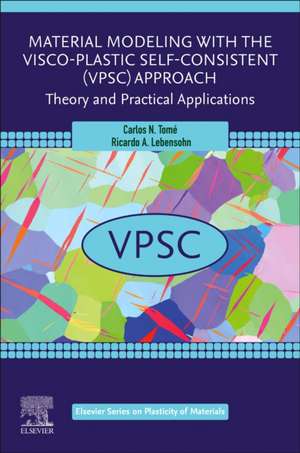
Material Modeling with the Visco-Plastic Self-Consistent (VPSC) Approach: Theory and Practical Applications: Elsevier Series on Plasticity of Materials
Autor Carlos N. Tome, Ricardo A. Lebensohnen Limba Engleză Paperback – 26 mai 2023
Ne-a atras atenția această lucrare fundamentală prin modul în care integrează ecosistemul modelării numerice, oferind nu doar teorie, ci și acces direct la codul computerizat VPSC (Visco-Plastic Self-Consistent). Considerăm că volumul semnat de Carlos N. Tome și Ricardo A. Lebensohn reprezintă un instrument tehnic esențial pentru prezicerea răspunsului tensiune-deformare și a evoluției texturii în agregatele cristaline. Structura cărții urmărește o progresie logică, pornind de la fundamentarea teoretică a mediilor efective termo-elastice și viscoplastice, până la implementarea practică a modelelor de alunecare și înfrățire (twinning).
În contextul operei autorului, Material Modeling with the Visco-Plastic Self-Consistent (VPSC) Approach rafinează conceptele explorate în Fundamentals & Engineering of Severe Plastic Deformation, trecând de la analiza experimentală a procesării materialelor la o metodologie computațională riguroasă. Complementar lucrării Large Plastic Deformation of Crystalline Aggregates de Cristian Teodosiu, care oferă o perspectivă vastă asupra microstructurii, volumul de față se concentrează pe aplicabilitatea regimului auto-consistent pentru simularea stărilor de tensiune internă din interiorul grăunților, fiind mult mai focalizat pe utilizarea practică a codului software dedicat.
Apreciem în mod deosebit versatilitatea abordării, care poate fi aplicată unor simetrii materiale arbitrare, de la cele cubice la cele triclinice. Cele 80 de ilustrații, dintre care majoritatea color, facilitează înțelegerea reorientării și schimbării formei grăunților individuali. Față de Texture and Anisotropy, care se concentrează pe măsurarea și analiza texturilor, lucrarea de față pune accentul pe predicția evolutivă a acestora în timpul deformării prin intermediul simulării numerice, oferind cititorului capacitatea de a modifica input-urile sau de a adăuga subrutine specifice pentru nevoile proprii de cercetare.



Preț: 1279.19 lei
Preț vechi: 1765.93 lei
-28%
Carte tipărită la comandă
Livrare economică 21 noiembrie-05 decembrie
Specificații
ISBN-10: 0128207132
Pagini: 380
Ilustrații: 80 illustrations (60 in full color)
Dimensiuni: 152 x 229 x 20 mm
Greutate: 0.61 kg
Editura: ELSEVIER SCIENCE
Seria Elsevier Series on Plasticity of Materials
V-ar putea interesa
-
 -24%Preț: 364.38 lei479.88 lei
 -
 Mechanical Behavior of Materials: Deformation and DesignRajiv S. Mishra-32%Preț: 529.24 lei777.61 lei
 -
 Introduction to Coupled Theories in Solid MechanicsLallit Anand-23%Preț: 582.72 lei751.97 lei
 -
 Multiscale Modelling of PolymersDoros N. Theodorou-23%Preț: 580.56 lei749.36 lei
 -
 Thermoforming Modeling and SimulationFouad Erchiqui-9%Preț: 1153.39 lei1267.46 lei
 -
 Computational Methods for Plasticity - Theory and ApplicationsDavid R. J. Owen-23%Preț: 961.42 lei1248.59 lei
 -
 Applied Mechanics of SolidsAllan F. Bower-14%Preț: 792.43 lei921.43 lei
 -
 Thermomechanics of ViscoplasticityMilan Micunovic-24%Preț: 877.70 lei1154.87 lei
 -
 Fundamentals & Engineering of Severe Plastic DeformationVladimir M Segal-26%Preț: 1940.90 lei2640.47 lei
 -
 Foundations of the Theory of Elasticity, Plasticity, and ViscoelasticityEduard Starovoitov-15%Preț: 573.22 lei674.37 lei
 -
 Fundamentals of StrengthPaul FollansbeePreț: 538.53 lei
 -
 Basic Modeling and Theory of Creep of Metallic MaterialsRolf SandströmPreț: 342.50 lei
 -
 New Achievements in MechanicsWolfgang H. Müller-18%Preț: 802.31 lei978.42 lei
 -
 Preț: 418.50 lei
 -
 Continuum Models and Discrete SystemsFrançois Willot-18%Preț: 1158.11 lei1412.32 lei
 -
 Plasticity TheoryAndreas ÖchsnerPreț: 379.88 lei
 -
 A Concise Introduction to Polymer PhysicsReinhard Hentschke-11%Preț: 428.27 lei481.21 lei
 -
 Multiscale Modelling in Sheet Metal FormingDorel Banabic-20%Preț: 665.63 lei832.04 lei
 -
 Computer Simulation of Polymeric MaterialsJapan Association For Chemical Innovation-18%Preț: 993.67 lei1211.80 lei
 -
 -18%Preț: 1073.93 lei1309.67 lei
Public țintă
Academic researchers in mechanical engineering, materials science; Professional engineers and material scientists Professors and students in these fieldsDe ce să citești această carte
Această carte este indispensabilă cercetătorilor și inginerilor din domeniul științei materialelor care utilizează modelarea numerică. Cititorul câștigă acces la metodologia VPSC, un standard în simularea deformărilor plastice, primind totodată resursele software necesare pentru a implementa modelele teoretice în proiecte reale de inginerie mecanică sau geologie.
Cuprins
1. Introduction
2. Theory and Models for Thermo-Elastic Effective Media
3. Theories and Models for Visco-Plastic Effective Media
4. Constitutive Models for Slip and Twinning
5. Description of Visco-Plastic Self-Consistent Code
6. Examples and Applications of Visco-Plastic Self-Consistent Code
Descriere
Material Modeling with the Visco-Plastic Self-Consistent (VPSC) Approach: Theory and Practical Applications provides readers with knowledge of material viscoplasticity and robust modeling approaches for predicting plastic deformation of crystal aggregates. Visco-Plastic Self-Consistent (VPSC) is the identifier of a computer code developed for the specific mechanical regime addressed (visco-plastic: VP) and the approach used (self-consistent: SC) meant to simulate large plastic deformation of aggregates, thermo-elastic material deformation, as well as predict stress-strain response, texture evolution of aggregates and stress-strain state inside grains. This approach is very versatile and able to tackle arbitrary material symmetry (cubic, hexagonal, trigonal, orthorhombic, triclinic), twinning, and multiphase aggregates.
It accounts for hardening, reorientation and shape change of individual grains, and can be applied to the deformation of metals, inter-metallics and geologic aggregates. Readers will have access to a companion website where they can download code and modify its input/output or add subroutines covering specific simulation research needs.
- Highlights a modeling approach that allows readers to accurately predict stress-strain response, texture evolution of aggregates, and internal stress states inside grains while also accounting for hardening, reorientation and shape change of individual grains
- Features modeling techniques that can be applied to the deformation of metals, inter-metallics and geologic aggregates
- Covers the theoretical aspects of homogeneous effective medium models as they apply to the simulation of plasticity and elasticity
- Provides several practical examples and applications of materials of different symmetry subjected to different deformation conditions