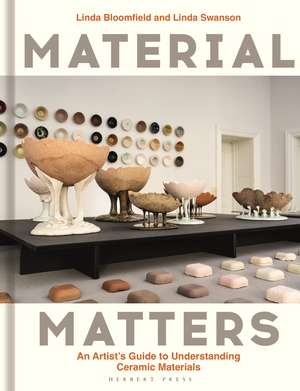
Material Matters: An Artist’s Guide to Understanding Ceramic Materials
Autor Linda Bloomfield, Linda Swansonen Limba Engleză Hardback – 30 iul 2026
Understanding how and why clay and glazes work (or don't) is a fundamental skill needed by all potters and ceramicists. Material Matters reveals the science and technology involved in making and firing ceramics, explaining the property and behaviour of various raw materials based on their underlying chemistry. Suitable for both amateur and experienced potters, the topics explored include clay types, slips, glaze development, colourants and firing techniques - as well as the safety and sustainability tips you'll need along the way.
Supported by full colour illustrations, photographs, charts and graphs, and written by ceramic arts professor Linda Swanson and glaze expert Linda Bloomfield, Material Matters is the essential guide to working confidently with ceramics.
Preț: 202.67 lei
Preț vechi: 338.97 lei
-40% Nou
Puncte Express: 304
Carte disponibilă
Livrare economică 02-16 noiembrie
Livrare express 17-23 octombrie pentru 196.04 lei
Livrare prin curier în România Termenul estimat este afișat lângă disponibilitate.
Transport gratuit de la 400.00 lei Plată online sau ramburs, în funcție de opțiunile comenzii.
Retur gratuit în 14 zile Comandă securizată și suport în română.
Specificații
ISBN-13: 9781789942309
ISBN-10: 1789942306
Pagini: 224
Ilustrații: Full colour illustrations and photographs throughout
Dimensiuni: 194 x 250 x 26 mm
Greutate: 0.89 kg
Editura: Bloomsbury Publishing
Colecția Herbert Press
Locul publicării:London, United Kingdom
ISBN-10: 1789942306
Pagini: 224
Ilustrații: Full colour illustrations and photographs throughout
Dimensiuni: 194 x 250 x 26 mm
Greutate: 0.89 kg
Editura: Bloomsbury Publishing
Colecția Herbert Press
Locul publicării:London, United Kingdom
V-ar putea interesa
-
 Pottery Analysis, Second Edition: A SourcebookPrudence M. Rice-8%Preț: 436.23 lei474.16 lei
 -
 Ceramic GlazesBrian Taylor-21%Preț: 158.36 lei199.54 lei
 -
 The Glaze BookStephen Murfitt-22%Preț: 151.67 lei195.29 lei
 -
 The Workshop Guide to CeramicsAnthony Quinn-21%Preț: 188.29 lei236.96 lei
 -
 Glazes for the Contemporary MakerLouisa TaylorPreț: 157.29 lei
 -
 -16%Preț: 134.08 lei160.53 lei
 -
 Amazing Glaze Food-Safe RecipesBill Collins-17%Preț: 135.29 lei162.23 lei
 -
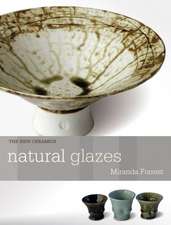 Natural GlazesMiranda ForrestPreț: 226.34 lei
 -
 Earth & FireKylie Johnson-16%Preț: 265.96 lei317.38 lei
 -
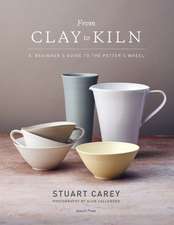 From Clay to KilnStuart CareyPreț: 110.22 lei
 -
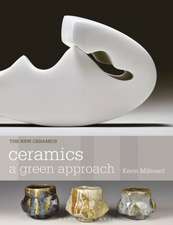 Ceramics: A Green ApproachKevin Millward-43%Preț: 137.05 lei239.01 lei
 -
 The Potter's DictionaryFrank Hamer-39%Preț: 469.09 lei767.84 lei
 -
 Crystalline GlazesDiane Creber-26%Preț: 84.52 lei114.05 lei
 -
 -43%Preț: 134.81 lei237.57 lei
 -
 Exploring Crystalline GlazesDiane Creber-43%Preț: 134.81 lei237.57 lei
 -
 Stoneware Glazes: 1001 Recipes for PottersAndrea Vinkovic-38%Preț: 243.37 lei390.28 leiNou
 -
 The Handbook of Glaze RecipesLinda Bloomfield-41%Preț: 224.36 lei379.02 lei
 -
 Natural Glazes: Collecting and MakingMiranda Forrest-41%Preț: 104.90 lei176.65 lei
 -
 The Potter's Book of Glaze RecipesEmmanuel Cooper-43%Preț: 134.08 lei235.79 lei
Cuprins
Introduction
Chapter 1: Geology and the origins of clay
Rocks, Clay minerals, Residual and sedimentary clay, Sedimentary and metamorphic processes, Rocks and chemistry, Collecting natural materials
Chapter 2: Clay
Understanding clay, Kaolin, Ball clay, Stoneware clay, Fire clay, Earthenware clay, Bentonite, Additional terms for clay
Chapter 3: Clay bodies
Clay in clay bodies, Flux in clay bodies, Glass former in clay bodies, Filler in clay bodies, Colour, Clay body types, Clay body applications, Testing, faults and remedies, Glaze fit and thermal expansion
Chapter 4: Clay as liquid
Slip, Deflocculation, Terra sigillata, Casting slip, Slip density, Slip - engobe, Local clay, Egyptian paste and solubility
Chapter 5: Glaze
Clay versus glaze, Glaze oxides, Alumina, Silica, Boron, Phosphorus, Sodium, Potassium, Lithium, Calcium, Magnesium, Barium, Strontium, Zinc, Lead
Chapter 6: Glaze materials
Materials and the oxides they supply, Using local and recycled materials
Chapter 7: Glaze chemistry and calculation
Composition of a glaze, Unity molecular formula
Chapter 8: Colourants and opacifiers
Colourants and their effects, carbonates, oxides and sulphates, Opacifiers, Stains
Chapter 9: Firing
Important stages during firing, Measuring temperature and heat work, Oxidation and reduction, Wood firing, soda firing, Adjusting firing temperature, Glaze faults, Special effect glazes
Chapter 10: Health and Safety
Soluble materials, Toxic materials, Studio practice, Firing safely
Conclusion
References
Resources on sustainability
Glossary
Appendices
Periodic Table, Natural Sources of Ceramic Materials, Directions for processing local clay, and more
Index
Acknowledgements
Chapter 1: Geology and the origins of clay
Rocks, Clay minerals, Residual and sedimentary clay, Sedimentary and metamorphic processes, Rocks and chemistry, Collecting natural materials
Chapter 2: Clay
Understanding clay, Kaolin, Ball clay, Stoneware clay, Fire clay, Earthenware clay, Bentonite, Additional terms for clay
Chapter 3: Clay bodies
Clay in clay bodies, Flux in clay bodies, Glass former in clay bodies, Filler in clay bodies, Colour, Clay body types, Clay body applications, Testing, faults and remedies, Glaze fit and thermal expansion
Chapter 4: Clay as liquid
Slip, Deflocculation, Terra sigillata, Casting slip, Slip density, Slip - engobe, Local clay, Egyptian paste and solubility
Chapter 5: Glaze
Clay versus glaze, Glaze oxides, Alumina, Silica, Boron, Phosphorus, Sodium, Potassium, Lithium, Calcium, Magnesium, Barium, Strontium, Zinc, Lead
Chapter 6: Glaze materials
Materials and the oxides they supply, Using local and recycled materials
Chapter 7: Glaze chemistry and calculation
Composition of a glaze, Unity molecular formula
Chapter 8: Colourants and opacifiers
Colourants and their effects, carbonates, oxides and sulphates, Opacifiers, Stains
Chapter 9: Firing
Important stages during firing, Measuring temperature and heat work, Oxidation and reduction, Wood firing, soda firing, Adjusting firing temperature, Glaze faults, Special effect glazes
Chapter 10: Health and Safety
Soluble materials, Toxic materials, Studio practice, Firing safely
Conclusion
References
Resources on sustainability
Glossary
Appendices
Periodic Table, Natural Sources of Ceramic Materials, Directions for processing local clay, and more
Index
Acknowledgements
Recenzii
A gem for a chemically inclined potter, a geologist or a glaze nerd. Packed full of info, formulae, recipes, molecular weights, graphs, firing guidance and some incredible illustrations, this is a one off reference bible.
What sets this book apart is its ability to bridge two worlds that often feel separate: the tactile, intuitive world of the studio, and the precise, analytical world of materials science.
What sets this book apart is its ability to bridge two worlds that often feel separate: the tactile, intuitive world of the studio, and the precise, analytical world of materials science.
Notă biografică
Linda Bloomfield trained as a materials scientist before becoming a potter. She has made porcelain in her West London studio since 2003, with past work sold through Liberty, Harrods and Michelin-starred restaurants, alongside ongoing commissions and gallery exhibitions. A regular Ceramic Review contributor, she has authored best-selling glaze books such as The Handbook of Glaze Recipes and Colour in Glazes, leading to a global reputation and extensive teaching of glaze workshops across Europe.