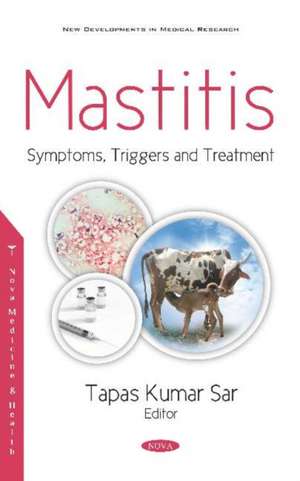
Mastitis: Symptoms, Triggers and Treatment
Editat de Tapas Kumar Saren Limba Engleză Hardback – 10 oct 2019
Preț: 1332.33 lei
Preț vechi: 1737.69 lei
-23%
Puncte Express: 1998
Carte disponibilă
Livrare economică 16-30 noiembrie
Livrare prin curier în România Termenul estimat este afișat lângă disponibilitate.
Transport gratuit pentru acest produs Plată online sau ramburs, în funcție de opțiunile comenzii.
Retur gratuit în 14 zile Comandă securizată și suport în română.
Specificații
ISBN-13: 9781536161243
ISBN-10: 1536161241
Pagini: 376
Dimensiuni: 178 x 254 x 26 mm
Greutate: 0.63 kg
Editura: Nova Science Publishers Inc
Colecția Nova Science Publishers Inc
Locul publicării:United States
ISBN-10: 1536161241
Pagini: 376
Dimensiuni: 178 x 254 x 26 mm
Greutate: 0.63 kg
Editura: Nova Science Publishers Inc
Colecția Nova Science Publishers Inc
Locul publicării:United States
V-ar putea interesa
-
 Your Guide to Lowering Your Cholesterol with TLCU. S. Department of Heal Human Services-5%Preț: 91.80 lei96.63 lei
 -
 What I Need to Know about My Child's BedwettingU. S. Department of Heal Human Services-5%Preț: 61.34 lei64.57 lei
 -
 What I Need to Know about Urinary Tract InfectionsU. S. Department of Heal Human Services-5%Preț: 66.97 lei70.49 lei
 -
 The Pocket Dictionary for Dialysis Technicians and NursesOscar M. Cairoli-5%Preț: 67.77 lei71.33 lei
 -
 Whole-Body Vibration Therapy for OsteoporosisU. S. Department of Heal Human Services-5%Preț: 92.39 lei97.25 lei
 -
 Enabling Health Care Decisionmaking Through Clinical Decision Support and Knowledge ManagementU. S. Department of Heal Human Services-5%Preț: 398.83 lei419.82 lei
 -
 Therapies for Children with Autism Spectrum DisordersU. S. Department of Heal Human Services-5%Preț: 164.10 lei172.74 lei
 -
 A Critical Review of the Literature Regarding Homelessness Among VeteransU. S. Department of Veterans Affairs-5%Preț: 104.87 lei110.39 lei
 -
 Diagnosis and Management of Ductal Carcinoma in Situ (Dcis)U. S. Department of Heal Human Services-5%Preț: 286.88 lei301.98 lei
 -
 Rural vs. Urban Ambulatory Health CareU. S. Department of Veterans Affairs-5%Preț: 124.51 lei131.06 lei
 -
 Dental Caries PreventionU. S. Department of Heal Human Services-5%Preț: 107.15 lei112.79 lei
 -
 Pharmacological Treatment of DementiaU. S. Department of Heal Human Services-5%Preț: 351.25 lei369.73 lei
 -
 Manual for the Surveillance of Vaccine-Preventable Diseases 6th Edition, 2013Sandra W. Roush Mph-5%Preț: 312.95 lei329.43 lei
 -
 -5%Preț: 69.43 lei73.08 lei
 -
 Post-Concussion SyndromeWilliam D. Boyd-5%Preț: 248.73 lei261.82 lei
 -
 Medical Kirundi Phrasebook and GlossaryA. H. Zemback-5%Preț: 80.83 lei85.08 lei
 -
 Therapies for Children with Autism Spectrum DisorderAgency for Healthcare Resea And Quality-5%Preț: 260.74 lei274.46 lei
 -
 Learning More about Autism - Dealing with Autism in the FamilyDueep Jyot Singh-5%Preț: 41.24 lei43.40 lei
 -
 New Developments in Sickle Cell Disease ResearchP D O'Malley-23%Preț: 1508.29 lei1967.16 lei
 -
 New Breast Cancer ResearchAndrew P Yao-23%Preț: 985.49 lei1271.79 lei
 -
 New Research on AtherosclerosisLeon V Clark-23%Preț: 1502.88 lei1963.76 lei
Cuprins
- Preface
- Basic Understandings of Mastitis
- Physiology of Milk Secretion and Its Alteration during Mastitis with Related Biomarkers
- Immune Responses of Mammary Gland
- Bovine Mastitis: Etiology & Epidemiology, Current Trends and Future Perspectives in Monitoring, Detection, and Treatments
- The Commonly Used Drugs for Conventional Therapy of Mastitis
- The Use of Propolis for Mastitis Control
- Supportive Herbal Preparations with Antimicrobial Drugs for Treatment of Mastitis
- About the Editor and Authors
- Index.