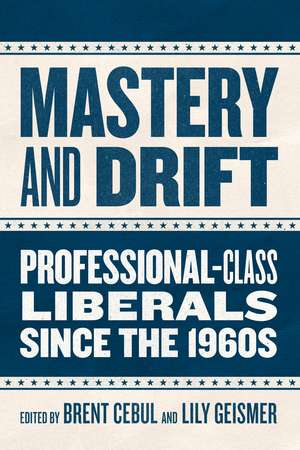
Mastery and Drift: Professional-Class Liberals since the 1960s
Editat de Brent Cebul, Lily Geismeren Limba Engleză Paperback – 11 feb 2025
Descoperim în Mastery and Drift o analiză riguroasă a modului în care liberalismul american și Partidul Democrat au fost reconfigurate pe criterii de clasă profesională începând cu deceniul al șaptelea al secolului trecut. Interdisciplinaritatea este pilonul central al acestui volum, editorii Brent Cebul și Lily Geismer reunind perspective din istorie politică, economie, sociologia mass-media și studii juridice pentru a explica de ce aspirațiile egalitare ale liberalilor au fost adesea subminate de mecanismele complexe ale guvernării moderne.
Remarcăm o structură tematică ambițioasă, organizată pentru a ilustra tranziția de la politicile axate pe clasa muncitoare la un model dominat de experți, consultanți și filantropi. Prima parte a cărții investighează continuitatea și schimbarea generațională, abordând subiecte precum rolul fundațiilor filantropice în modelarea politicilor publice sau impactul „statului contractual” în politica externă. Cititorii familiarizați cu Don't Blame Us de Lily Geismer vor aprecia modul în care acest nou volum extinde analiza de la mediul suburban de înaltă tehnologie către o sferă mai largă a instituțiilor americane, de la redacțiile ziarelor până la organizațiile comunitare precum ACORN.
Notăm cu interes continuitatea tematică în opera lui Brent Cebul. Dacă în Illusions of Progress – Business, Poverty, and Liberalism in the American Century acesta explora „liberalismul ofertei” și legăturile dintre afaceri și planificarea economică, în volumul de față, perspectiva se lărgește pentru a include tensiunile dintre autonomie, rasă și structurile corporative. Tonul volumului rămâne academic și analitic, oferind o progresie logică de la baze ideologice la aplicații practice în politici de sănătate și dezvoltare globală.
Preț: 246.99 lei
Carte disponibilă
Livrare economică 16-30 noiembrie
Livrare express 31 octombrie-06 noiembrie pentru 35.86 lei
Specificații
ISBN-10: 0226838137
Pagini: 416
Ilustrații: 3 halftones, 1 tables
Dimensiuni: 152 x 229 x 25 mm
Greutate: 0.59 kg
Ediția:First Edition
Editura: University of Chicago Press
Colecția University of Chicago Press
De ce să citești această carte
Recomandăm această carte cercetătorilor și studenților la științe politice sau istorie care doresc să înțeleagă rădăcinile fracturilor politice actuale din SUA. Cititorul câștigă o perspectivă critică asupra modului în care expertiza profesională a influențat guvernarea democrată, oferind un context istoric esențial pentru dezbaterile contemporane despre populism și elitele intelectuale. Este o resursă fundamentală pentru înțelegerea limitărilor interne ale liberalismului modern în fața ascensiunii dreptei.
Despre autor
Brent Cebul este istoric și autor, cunoscut pentru cercetările sale privind relația dintre stat, economie și inegalitate în America secolului XX. Lucrarea sa anterioară, Illusions of Progress – Business, Poverty, and Liberalism in the American Century, a analizat critic politicile de dezvoltare economică. Lily Geismer este profesor asociat de istorie, specializată în istoria politică a Statelor Unite postbelice, fiind autoarea apreciatului volum Don't Blame Us. Împreună, cei doi editori coordonează în Mastery and Drift o echipă de cercetători tineri care aduc o perspectivă proaspătă asupra instituțiilor liberale și a transformărilor de clasă din cadrul Partidului Democrat.
Descriere scurtă
Since the 1960s, American liberalism and the Democratic Party have been remade along professional class lines, widening liberalism’s impact but narrowing its social and political vision. In Mastery and Drift, historians Brent Cebul and Lily Geismer have assembled a group of scholars to address the formation of “professional-class liberalism” and its central role in remaking electoral politics and the practice of governance. Across subjects as varied as philanthropy, consulting, health care, welfare, race, immigration, economics, and foreign conflicts, the authors examine not only the gaps between liberals’ egalitarian aspirations and their approaches to policymaking but also how the intricacies of contemporary governance have tended to bolster professional-class liberals’ power.
The contributors to Mastery and Drift all came of age amid the development of professional-class liberalism, giving them distinctive and important perspectives in understanding its internal limitations and its relationship to neoliberalism and the Right. With never-ending disputes over the meaning of liberalism, the content of its governance, and its relationship to a resurgent Left, now is the time to consider modern liberalism’s place in contemporary American life.
Notă biografică
Extras
To many on the right, these figures were high-flying examples of the “liberal elite”: cosmopolitan, coastal, and contemptuous of the “Heartland” and its working-class (white) people— the so-called deplorables in Hillary Clinton’s self-defeating formulation. On the left, when Clinton vanquished the social democrat Bernie Sanders in the 2016 Democratic Party presidential primary, many Sanders supporters dusted off an old concept to make sense of what had happened. By the 1970s, the “professional-managerial class,” in Barbara Ehrenreich and John Ehrenreich’s analysis, formed a novel managerial, bureaucratic, legal, and professional stratum that operated between working people and the highest echelons of corporate and finance capitalism. With its ranks exploding in the 1970s, “the PMC” absorbed and moderated the era’s radical politics, deflecting serious critiques of capitalist democracy. After Clinton and the liberal establishment rallied to defeat Sanders, “PMC” quickly became an epithet for a privileged political class’s credulous commitments to capitalism and centrist moderation in the face of unfolding global economic, political, and ecological catastrophes.
Rather than relitigate the PMC debates of the last decade, we conceived of this volume to better understand the significant transformations that remade liberalism and the Democratic Party after the 1960s, and which, we maintain, propels much of the recent frustration with liberal governance and electoral politics. Coming of age politically amidst these developments led us to wonder less about how momentary, strategic miscalculations by Democratic administrations or the cunning maneuverings of Republicans dashed potential moments of progressive opportunity. These episodes instead caused us to turn our attention to the limitations internal to liberalism, to examine its fraught relationship with the Left, and to clarify its relationship to neoliberalism.
The essays that follow examine what we term “professional-class liberalism” and explore important conjunctures between professional-class formation, electoral politics, and liberal ideologies of governance. We employ the terms “professional class” and “liberal” to explain how emergent class formations and governing ideologies relate to a set of broader historical political, economic, and demographic transformations as well as to the deeper liberal political tradition.
Their attitudes about governance were shaped not only by their professional training but also by their particular generational relationship to capitalism and the vast and necessarily complex bureaucratic state.
This focus shifts attention to different sorts of developments that are the focus of most traditional histories of twentieth-century American politics. In particular, we emphasize the political effects of the expansion of graduate and professional training in the United States beginning in the 1960s and accelerating in the decades that followed. Some figures illustrate these remarkable demographic, educational, and professional developments. Between 1963 and 1979, the annual number of first-year law students doubled to more than forty thousand. Other professional schools and MA programs saw similarly explosive growth: between 1959 and 1980, the figure more than quadrupled to nearly three hundred thousand new students annually. During the 1970s and 1980s, formal training in public policy also grew substantially. By the mid-1970s, more than one hundred universities offered advanced degrees in public policy, and by 1990, these schools together graduated around a thousand new masters students annually. The growth and diversification of professional and graduate training was particularly striking among women, whose enrollment in law school, for instance—which had accounted for just 9 percent of the total students in 1970—reached parity with that of men circa 2000 and eclipsed it two decades later. The combination of civil rights legislation and the wide implementation of affirmative-action programs also expanded professional training opportunities for African Americans. In 1970, there were around four thousand African American lawyers in the United States; by 2005 there were more than forty thousand.
As the essays suggest, from within the broader ranks of these professionally trained managers, lawyers, and expert bureaucrats of the 1960s and 1970s, there emerged a rising and increasingly diverse generation of political liberals. Their attitudes about governance were shaped not only by their professional training but also by their particular generational relationship to capitalism and the vast and necessarily complex bureaucratic state. These increasingly career-oriented political and policy-development professionals came to exert profound influence over the Democratic Party and the democratic process—as arbiters of political narratives, moderators of party politics, and essential actors in policy development and implementation.
Rather than mark a decisive break with New Deal and mid-century liberalism, however, professional-class liberals’ ideas about capitalism and democracy were in many ways adapted from mid-century and Cold War liberals, even as these younger liberals strove to define themselves as against their forebears’ methods of state and market making. This volume, then, charts the causes and components of professional-class liberalisms’ distinctive governing logics, which emerged in the economically and politically tumultuous 1970s and were theorized and formalized in the 1980s during liberalism’s sojourn in the Reagan-era wilderness.
Cuprins
Brent Cebul and Lily Geismer
Part I: Generational Change and Continuity
1. How Philanthropy Made and Unmade American Liberalism
Lila Corwin Berman
2. Managing Global Development: Robert Nathan and the Liberal Roots of the Contract State in US Foreign Policy
Stephen Macekura
3. Creating “Initiatory Democracy”: Ralph Nader, the Center for the Study of Responsive Law, and the Shaping of Liberalism in the 1970s
Sarah Milov and Reuel Schiller
4. “What Is a Populist Approach to This Crisis?”: ACORN’s Liberalism and the 1980s Savings and Loan Crisis
Marisa Chappell
5. Survival Pending Corporate Sponsorship: The “Crisis” of the Black Family, Black State Skepticism, and the Evolution of Black Liberalism in the Post–Civil Rights Era
Danielle Wiggins
6. Queer Autonomy and the Afterlife of the Family Wage
B. Alex Beasley
7. Making the Liberal Media: Journalism’s Class Transformation since the 1960s
Dylan Gottlieb
8. Seeing Like a Strategist
Timothy Shenk
Part II: New Governance
9. The Preservation of Conditional Citizenship after the 1965 Voting Rights Act
Julilly Kohler-Hausmann
10. Liberalism’s Last Rights: Disability Inclusion and the Rise of the Cost-Benefit State
Karen M. Tani
11. Computerizing a Covenant: Contract Liberalism and the Nationalization of Welfare Administration
Marc Aidinoff
12. Left in Limbo: The Fight for Temporary Protected Status and the Illiberal Effects of Liberal Policymaking
Adam Goodman
13. The Austerity Imperative: Democratic Deficit Hawks and the Crisis of Keynesianism
David Stein
14. The Professional-Class Presidency of Barack Obama
Nicole Hemmer
15. State Agency: Social History with and beyond Institutionalism
Gabriel Winant
Acknowledgments
Notes
List of Contributors
Index