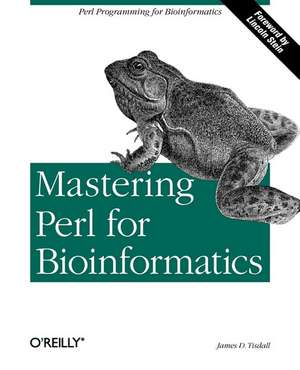
Mastering Perl for Bioinformatics
Autor James Tisdallen Limba Engleză Paperback – 4 noi 2003
Preț: 254.06 lei
Preț vechi: 317.57 lei
-20%
Puncte Express: 381
Carte disponibilă
Livrare economică 31 octombrie-14 noiembrie
Livrare prin curier în România Termenul estimat este afișat lângă disponibilitate.
Transport gratuit de la 400.00 lei Plată online sau ramburs, în funcție de opțiunile comenzii.
Retur gratuit în 14 zile Comandă securizată și suport în română.
Specificații
ISBN-13: 9780596003074
ISBN-10: 0596003072
Pagini: 396
Dimensiuni: 177 x 233 x 27 mm
Greutate: 0.62 kg
Editura: O'Reilly
Locul publicării:United States
ISBN-10: 0596003072
Pagini: 396
Dimensiuni: 177 x 233 x 27 mm
Greutate: 0.62 kg
Editura: O'Reilly
Locul publicării:United States
V-ar putea interesa
-
 -20%Preț: 318.09 lei397.61 lei
 -
 Apple Macintosh EncyclopediaGary Phillips-20%Preț: 324.48 lei405.59 lei
 -
 50 Tips and Tricks for MongoDB DevelopersKristina Chodorow-20%Preț: 155.69 lei194.62 lei
 -
 Jenkins: The Definitive GuideJohn Ferguson Smart-20%Preț: 272.32 lei340.39 lei
 -
 Programming RazorJess Chadwick-20%Preț: 115.32 lei144.14 lei
 -
 Building Mobile Applications with JavaJoshua Marinacci-20%Preț: 113.41 lei141.76 lei
 -
 Getting Started with RstudioJohn Verzani-20%Preț: 96.63 lei120.78 lei
 -
 Introduction to TornadoMichael Dory-20%Preț: 138.95 lei173.69 lei
 -
 R in a NutshellJoseph Adler-20%Preț: 378.63 lei473.29 lei
 -
 HTML5 CookbookChristopher Schmitt-20%Preț: 169.62 lei212.02 lei
 -
 Algorithm Design for Computer System DesignGiorgio Ausiello-20%Preț: 334.19 lei417.74 lei
 -
 MBASIC-Wegweiser für Mikrocomputer unter CP/M und MS-DOSEkkehard Kaier-20%Preț: 401.15 lei501.44 lei
 -
 -20%Preț: 339.50 lei424.39 lei
 -
 BASIC-Wegweiser für IBM PC, PC XT, Portable PC und PCjrEkkehard Kaier-20%Preț: 407.34 lei509.17 lei
 -
 Wie arbeite ich mit dem IBM PCWolfgang Schneider-20%Preț: 397.19 lei496.49 lei
 -
 -20%Preț: 405.26 lei506.58 lei
 -
 -20%Preț: 339.02 lei423.76 lei
 -
 -20%Preț: 404.15 lei505.18 lei
 -
 Bildschirmarbeit: Konfliktfelder und LösungenA. E. Cakir-20%Preț: 402.41 lei503.01 lei
 -
 -20%Preț: 415.57 lei519.47 lei
 -
 -20%Preț: 317.39 lei396.74 lei
 -
 -20%Preț: 408.14 lei510.17 lei
 -
 EUROSAM 84J. Fitch-20%Preț: 341.01 lei426.26 lei
 -
 Mathematical Foundations of Computer Science 1984M. P. Chytil-20%Preț: 337.51 lei421.89 lei
 -
 -20%Preț: 372.14 lei465.18 lei
 -
 -20%Preț: 358.33 lei447.91 lei
 -
 -20%Preț: 411.14 lei513.93 lei
Cuprins
Foreword; Preface; About This Book; What You Need to Know to Use This Book; Organization of This Book; Conventions Used in This Book; Comments and Questions; Acknowledgments; Object-Oriented Programming in Perl; Chapter 1: Modular Programming with Perl; 1.1 What Is a Module?; 1.2 Why Perl Modules?; 1.3 Namespaces; 1.4 Packages; 1.5 Defining Modules; 1.6 Storing Modules; 1.7 Writing Your First Perl Module; 1.8 Using Modules; 1.9 CPAN Modules; 1.10 Exercises; Chapter 2: Data Structures and String Algorithms; 2.1 Basic Perl Data Types; 2.2 References; 2.3 Matrices; 2.4 Complex Data Structures; 2.5 Printing Complex Data Structures; 2.6 Data Structures in Action; 2.7 Dynamic Programming; 2.8 Approximate String Matching; 2.9 Resources; 2.10 Exercises; Chapter 3: Object-Oriented Programming in Perl; 3.1 What Is Object-Oriented Programming?; 3.2 Using Perl Classes (Without Writing Them); 3.3 Objects, Methods, and Classes in Perl; 3.4 Arrow Notation (->); 3.5 Gene1: An Example of a Perl Class; 3.6 Details of the Gene1 Class; 3.7 Gene2.pm: A Second Example of a Perl Class; 3.8 Gene3.pm: A Third Example of a Perl Class; 3.9 How AUTOLOAD Works; 3.10 Cleaning Up Unused Objects with DESTROY; 3.11 Gene.pm: A Fourth Example of a Perl Class; 3.12 How to Document a Perl Class with POD; 3.13 Additional Topics; 3.14 Resources; 3.15 Exercises; Chapter 4: Sequence Formats and Inheritance; 4.1 Inheritance; 4.2 FileIO.pm: A Class to Read and Write Files; 4.3 SeqFileIO.pm: Sequence File Formats; 4.4 Resources; 4.5 Exercises; Chapter 5: A Class for Restriction Enzymes; 5.1 Envisioning an Object; 5.2 Rebase.pm: A Class Module; 5.3 Restriction.pm: Finding Recognition Sites; 5.4 Drawing Restriction Maps; 5.5 Resources; 5.6 Exercises; Perl and Bioinformatics; Chapter 6: Perl and Relational Databases; 6.1 One Perl, Many Databases; 6.2 Popular Relational Databases; 6.3 Relational Database Definitions; 6.4 Structured Query Language; 6.5 Administering Your Database; 6.6 Relational Database Design; 6.7 Perl DBI and DBD Interface Modules; 6.8 A Rebase Database Implementation; 6.9 Additional Topics; 6.10 Resources; 6.11 Exercises; Chapter 7: Perl and the Web; 7.1 How the Web Works; 7.2 Web Servers and Browsers; 7.3 The Common Gateway Interface; 7.4 Rebase: Building Dynamic Web Pages; 7.5 Exercises; Chapter 8: Perl and Graphics; 8.1 Computer Graphics; 8.2 GD; 8.3 Adding GD Graphics to Restrictionmap.pm; 8.4 Making Graphs; 8.5 Resources; 8.6 Exercises; Chapter 9: Introduction to Bioperl; 9.1 The Growth of Bioperl; 9.2 Installing Bioperl; 9.3 Testing Bioperl; 9.4 Bioperl Problems; 9.5 Overview of Objects; 9.6 bptutorial.pl; 9.7 bptutorial.pl: sequence_manipulation Demo; 9.8 Using Bioperl Modules; Appendixes; Perl Summary; Command Interpretation; Comments; Scalar Values and Scalar Variables; Assignment; Statements and Blocks; Arrays; Hashes; Complex Data Structures; Operators; Operator Precedence; Basic Operators; Conditionals and Logical Operators; Binding Operators; Loops; Input/Output; Regular Expressions; Scalar and List Context; Subroutines; Modules and Packages; Object-Oriented Programming; Built-in Functions; Installing Perl; Installing Perl on Your Computer; Versions of Perl; Internet Access; Downloading; How to Run Perl Programs; Finding Help; Colophon;