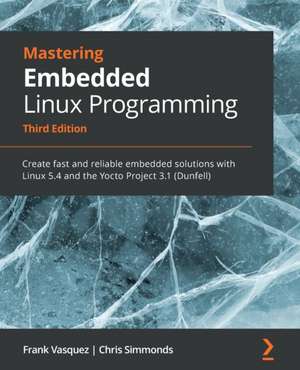
Mastering Embedded Linux Programming - Third Edition
Autor Frank Vasquez, Chris Simmondsen Limba Engleză Paperback – 14 mai 2021
În cadrul ecosistemului sistemelor integrate, descoperim în Mastering Embedded Linux Programming - Third Edition o resursă tehnică ce integrează nucleul Linux 5.4 și Yocto Project 3.1 (Dunfell). Remarcăm o abordare riguroasă a celor patru piloni fundamentali: lanțul de instrumente (toolchain), încărcătorul de boot, nucleul și sistemul de fișiere rădăcină. Autorii, Frank Vasquez și Chris Simmonds, ghidează cititorul prin procesul de construire a acestor elemente de la zero, punând un accent deosebit pe automatizarea fluxurilor de lucru prin Buildroot. Observăm că textul nu se rezumă la teorie, ci explorează specificații practice pentru scenarii reale de producție. Sunt analizate strategii de stocare pentru memorii flash și mecanisme de securitate pentru actualizările over-the-air (OTA) utilizând soluții precum Mender sau balena. Dacă Linux for Embedded and Real-time Applications de Doug Abbott v-a oferit cadrul teoretic și conceptele de bază ale mediului de dezvoltare cross-platform, această carte oferă instrumentele practice necesare pentru a scala proiectele către dispozitive robuste și securizate. În comparație cu Embedded Linux Development Using Yocto Project Cookbook, care se concentrează pe soluții punctuale sub formă de rețete, volumul de față oferă o viziune sistemică asupra întregului ciclu de viață al unui produs. Structura narativă a cărții evoluează logic spre optimizare și depanare. Suntem introduși în tehnici avansate de accesare a hardware-ului prin manipularea arborilor de dispozitive (device trees), fără a recurge neapărat la scrierea de drivere complexe. Finalul lucrării este dedicat profilării performanței, utilizând un arsenal de instrumente precum eBPF și ftrace pentru a identifica blocajele din sistem. Este o resursă densă, de peste 700 de pagini, esențială pentru inginerii care doresc să stăpânească arhitectura internă a Linux-ului în context industrial.
Preț: 424.10 lei
Preț vechi: 530.12 lei
-20%
Carte tipărită la comandă
Livrare economică 28 noiembrie-12 decembrie
Specificații
ISBN-10: 1789530385
Pagini: 758
Dimensiuni: 191 x 235 x 41 mm
Greutate: 1.39 kg
Ediția:Third
Editura: Packt Publishing
V-ar putea interesa
-
 Embedded Systems: ARM Programming and OptimizationJason D. Bakos-34%Preț: 412.11 lei624.90 lei
 -
 BPF Performance ToolsBrendan Gregg-20%Preț: 398.39 lei497.99 lei
 -
 Comptia Linux+ Xk0-005 Cert GuideRoss Brunson-20%Preț: 398.31 lei497.89 lei
 -
 -40%Preț: 458.81 lei768.90 lei
 -
 -31%Preț: 441.34 lei639.30 lei
 -
 -20%Preț: 204.34 lei255.42 lei
 -
 Raspberry Pi For Dummies 4eMike Cook-20%Preț: 138.55 lei173.19 lei
 -
 Linux Command Line and Shell Scripting BibleRichard Blum-20%Preț: 410.86 lei513.56 lei
 -
 Making Embedded SystemsElecia White-38%Preț: 200.48 lei324.68 lei
 -
 Linux Pocket Guide 3eDaniel J. Barrett-32%Preț: 119.54 lei175.60 lei
 -
 Modern C, Third EditionJens Gustedt-20%Preț: 350.34 lei437.92 lei
 -
 -20%Preț: 264.28 lei330.35 lei
 -
 -36%Preț: 295.82 lei462.12 lei
 -
 System Programming in Linux: A Hands-On IntroductionStewart Weiss-35%Preț: 481.65 lei739.15 lei
 -
 Building a DebuggerSy Brand-35%Preț: 337.38 lei518.40 lei
 -
 -36%Preț: 284.35 lei440.95 lei
 -
 Mastering Linux Device Driver DevelopmentJohn Madieu-20%Preț: 338.95 lei423.69 lei
 -
 Learning eBPFMichael Kehoe-20%Preț: 205.87 lei257.34 lei
De ce să citești această carte
Recomandăm această carte inginerilor de sistem și dezvoltatorilor software care au nevoie de o metodologie clară pentru construirea dispozitivelor bazate pe Linux. Cititorul câștigă expertiză în automatizarea build-urilor cu Yocto și Buildroot, dar și competențe critice în depanarea la nivel de kernel. Este un ghid practic pentru trecerea de la prototipuri simple la sisteme integrate securizate și gata de implementare în teren.
Descriere
Harness the power of Linux to create versatile and robust embedded solutions
Key Features
- Learn how to develop and configure robust embedded Linux devices
- Explore the new features of Linux 5.4 and the Yocto Project 3.1 (Dunfell)
- Discover different ways to debug and profile your code in both user space and the Linux kernel
Book Description
If you're looking for a book that will demystify embedded Linux, then you've come to the right place. Mastering Embedded Linux Programming is a fully comprehensive guide that can serve both as means to learn new things or as a handy reference.
The first few chapters of this book will break down the fundamental elements that underpin all embedded Linux projects: the toolchain, the bootloader, the kernel, and the root filesystem. After that, you will learn how to create each of these elements from scratch and automate the process using Buildroot and the Yocto Project. As you progress, the book will show you how to implement an effective storage strategy for flash memory chips and install updates to a device remotely once it's deployed.
You'll also learn about the key aspects of writing code for embedded Linux, such as how to access hardware from apps, the implications of writing multi-threaded code, and techniques to manage memory in an efficient way. The final chapters demonstrate how to debug your code, whether it resides in apps or in the Linux kernel itself.
You'll also cover the different tracers and profilers that are available for Linux so that you can quickly pinpoint any performance bottlenecks in your system.
By the end of this Linux book, you'll be able to create efficient and secure embedded devices using Linux.
What you will learn
- Use Buildroot and the Yocto Project to create embedded Linux systems
- Troubleshoot BitBake build failures and streamline your Yocto development workflow
- Update IoT devices securely in the field using Mender or balena
- Prototype peripheral additions by reading schematics, modifying device trees, soldering breakout boards, and probing pins with a logic analyzer
- Interact with hardware without having to write kernel device drivers
- Divide your system up into services supervised by BusyBox runit
- Debug devices remotely using GDB and measure the performance of systems using tools such as perf, ftrace, eBPF, and Callgrind