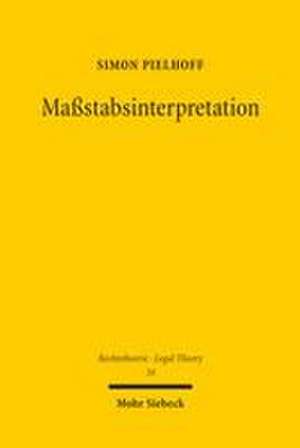
Maßstabsinterpretation: Rechtstheorie - Legal Theory
Autor Simon Pielhoffde Limba Germană Paperback – 16 sep 2026



Preț: 596.96 lei
Preț vechi: 648.86 lei
-8% Nou
Puncte Express: 895
Carte disponibilă
Livrare economică 07-13 noiembrie
Livrare express 28 octombrie-03 noiembrie pentru 70.05 lei
Livrare prin curier în România Termenul estimat este afișat lângă disponibilitate.
Transport gratuit pentru acest produs Plată online sau ramburs, în funcție de opțiunile comenzii.
Retur gratuit în 14 zile Comandă securizată și suport în română.
Specificații
ISBN-13: 9783162005113
ISBN-10: 3162005116
Pagini: 358
Dimensiuni: 154 x 230 x 21 mm
Greutate: 0.53 kg
Ediția:1. Auflage
Editura: Mohr Siebeck GmbH & Co. K
Seria Rechtstheorie - Legal Theory
ISBN-10: 3162005116
Pagini: 358
Dimensiuni: 154 x 230 x 21 mm
Greutate: 0.53 kg
Ediția:1. Auflage
Editura: Mohr Siebeck GmbH & Co. K
Seria Rechtstheorie - Legal Theory
Notă biografică
Geboren 1996; Studium der Rechtswissenschaften in Münster; 2020 Erste Juristische Prüfung; 2025 Promotion (Münster); Rechtsreferendariat am Kammergericht Berlin; 2026 Zweite Juristische Prüfung.
Cuprins
Einführung
1. Teil - Streit ohne Gegenstand: Die Methodendebatte über die Interpretation verfassungsgerichtlicher Maßstäbe und Bedingungen von Methodenvorschlägen
I. Die Methodendebatte über die Interpretation verfassungsgerichtlicher Maßstäbe - II. Bedingungen für das Gelingen eines Methodenvorschlags
2. Teil - Gegenstand ohne Streit: Das teleologische Argument zur Methodenwahl
I. Einführung des Arguments: Methodenwahl als pragmatische Teleologie - II. Eignung des teleologischen Arguments zu den Gelingensbedingungen eines Methodenvorschlags: taugt es als Incompletely Theorized Agreement?
3. Teil - Pragmatistischer, historisierender und dogmatischer Umgang mit Maßstäben: Beurteilung verschiedener Interpretationsmethoden nach ihren Funktionen
I. Gedanken und Zeit in Maßstäben gefasst - Die Ausstiegsmethode - II. Gedanken in Zeit gefasst - Vergleich mit der Kontextualisierungsmethode - III. Zeit in Gedanken gefasst - Vergleich mit der Abstrahierungsmethode
Schluss: Pragmatische Teleologie der Methodenwahl
1. Teil - Streit ohne Gegenstand: Die Methodendebatte über die Interpretation verfassungsgerichtlicher Maßstäbe und Bedingungen von Methodenvorschlägen
I. Die Methodendebatte über die Interpretation verfassungsgerichtlicher Maßstäbe - II. Bedingungen für das Gelingen eines Methodenvorschlags
2. Teil - Gegenstand ohne Streit: Das teleologische Argument zur Methodenwahl
I. Einführung des Arguments: Methodenwahl als pragmatische Teleologie - II. Eignung des teleologischen Arguments zu den Gelingensbedingungen eines Methodenvorschlags: taugt es als Incompletely Theorized Agreement?
3. Teil - Pragmatistischer, historisierender und dogmatischer Umgang mit Maßstäben: Beurteilung verschiedener Interpretationsmethoden nach ihren Funktionen
I. Gedanken und Zeit in Maßstäben gefasst - Die Ausstiegsmethode - II. Gedanken in Zeit gefasst - Vergleich mit der Kontextualisierungsmethode - III. Zeit in Gedanken gefasst - Vergleich mit der Abstrahierungsmethode
Schluss: Pragmatische Teleologie der Methodenwahl