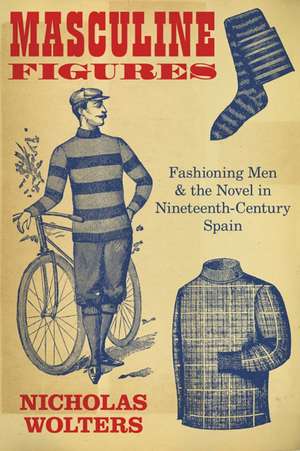
Masculine Figures: Fashioning Men and the Novel in Nineteenth-Century Spain
Autor Nicholas Woltersen Limba Engleză Paperback – 25 ian 2023
Fictional masculinity performs a symbolic role in representing and negotiating the contradictions male novelists often encountered in their attempts to professionalize not only as writers, but also as businessmen, professors, lawyers, and politicians. Through specific and recurring figures like the student, the priest, the businessman, and the heir, male novelists portray and represent an increasingly middle-class world at odds with the values and virtues it inherited from an imperial Spanish past, and those it imported from more industrialized nations like England and France. The visual culture of the time and place marks the material turn in middle-class masculinity and sets the stage for discussions of race and sexuality.
Preț: 297.29 lei
Carte tipărită la comandă
Livrare economică 07-21 decembrie
Specificații
ISBN-10: 0826505171
Pagini: 312
Ilustrații: 48 b&w images
Dimensiuni: 152 x 229 x 18 mm
Greutate: 0.36 kg
Editura: Vanderbilt University Press
Colecția Vanderbilt University Press
Recenzii
—Collin McKinney, author of Mapping the Social Body: Urbanisation, the Gaze and the Novels of Galdós
"The project is very well researched, and the arguments are well contextualized. Challenging conventional ways of thinking of the relation between nineteenth-century bourgeois masculinities and the consumer culture, the book is a valuable contribution to nineteenth-century Spanish literature and gender studies."
—Dorota Heneghan, author of Striking Their Modern Pose: Fashion, Gender, and Modernity in Galdós, Pardo Bazán, and Picón
Notă biografică
Cuprins
Chapter 1: The Student
Chapter 2: The Priest
Chapter 3: The Businessman
Chapter 4: The Heir
Coda
Notes
Bibliography
Index
Descriere
Based on years of archival research in Madrid and Barcelona, this interdisciplinary study offers a fresh approach to understanding how men visualized themselves and their place in a nation that struggled to modernize after nearly a century of civil war, colonial entanglement, and imperial loss. Masculine Figures is the first study to provide a comprehensive overview of competing models of masculinity in nineteenth-century Spain, and is particularly novel in its treatment of Catalan texts and previously unstudied evidence (e.g., department store catalogs, commercial advertisements, fashion plates, and men’s tailoring journals).
Fictional masculinity performs a symbolic role in representing and negotiating the contradictions male novelists often encountered in their attempts to professionalize not only as writers, but also as businessmen, professors, lawyers, and politicians. Through specific and recurring figures like the student, the priest, the businessman, and the heir, male novelists represent an increasingly middle-class world at odds with the values and virtues it inherited from an imperial Spanish past, and those it imported from more industrialized nations like England and France. The visual culture of the time and place marks the material turn in middle-class masculinity and sets the stage for discussions of race and sexuality.
Significant chapter sections on the used clothing trade (in the Rastro flea market in Madrid, also called “Las AmÉricas” during the nineteenth century) and the "indiano businessman" (the colonial returnee) discuss the racial implications of fashion of the period—in the first example, through the racialized discourse of contagion that hygienists used to frame the market. In the second example, the book discusses the ways the Catalan indiano “accessorizes” himself with racialized commodities like pocket watches and tobacco and objectified/infantilized figures like Black house servants and footmen.