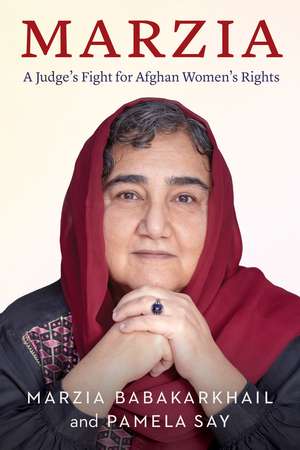
Marzia: A Judge’s Fight for Afghan Women’s Rights
Autor Marzia Babakarkhail, Pamela Sayen Limba Engleză Hardback – mai 2026
As a former judge and advocate, Marzia’s commitment to justice never wavered, even in the face of threats, exile, and unimaginable pressure. Her story is not merely one of survival, but also of determination and strength. It reflects the broader struggle faced by women throughout Afghanistan, particularly those in the legal system who risked everything to uphold the rule of law and protect others’ rights.
Through Marzia’s journey, this book stands as a tribute to the International Association of Women Judges, honoring countries, governments, organizations, and individuals who refused to stay silent. It is a call to remember, to act, and to stand in solidarity with Afghanistan—especially with its women of justice, whose bravery and unwavering spirit continue to inspire the world.
This is not just Marzia’s story—it is the story of a movement, of resistance, and of hope in the darkest of times.
Preț: 168.94 lei
Puncte Express: 253
Carte disponibilă
Livrare economică 05-19 noiembrie
Livrare express 22-28 octombrie pentru 74.84 lei
Livrare prin curier în România Termenul estimat este afișat lângă disponibilitate.
Transport gratuit de la 400.00 lei Plată online sau ramburs, în funcție de opțiunile comenzii.
Retur gratuit în 14 zile Comandă securizată și suport în română.
Specificații
ISBN-13: 9781640126770
ISBN-10: 1640126775
Pagini: 200
Ilustrații: 28 photographs
Dimensiuni: 152 x 229 x 23 mm
Greutate: 0.46 kg
Editura: Potomac Books Inc
Colecția Potomac Books
Locul publicării:United States
ISBN-10: 1640126775
Pagini: 200
Ilustrații: 28 photographs
Dimensiuni: 152 x 229 x 23 mm
Greutate: 0.46 kg
Editura: Potomac Books Inc
Colecția Potomac Books
Locul publicării:United States
Notă biografică
Marzia Babakarkhail was a judge in Afghanistan for seven years before becoming a member of the board and chair of the Women’s Committee of the Afghan NGO’s Coordination Bureau. Now living in the UK, she is a caseworker for a member of Parliament and is a lifelong women’s rights activist and advocate. Babakarkhail appears on the BBC and other news outlets as a spokesperson for Afghan women. Pamela Say is a nonprofit consultant and serves as a book coach, writer, and editor for emerging authors through her consulting firm. She is the author of five books and spent more than six months interviewing and collaborating with Marzia Babakarkhail to tell her story.
Extras
1
The Reign of Afghanistan’s Last King: 1970s
I don’t think that the country can govern itself well without the
participation and the free will of the people of that land, and
therefore, democracy is essential to society.
—Afghanistan’s last king, Mohammad Zahir Shah, 2002 CNN interview
As a child growing up in Puli Khumrī, the capitol of the Baghlan Province
of northern Afghanistan, I saw a city bursting with color and happiness.
The lush green valley juxtaposed against the stark brown edges of the
Afghan mountains looked like a wonderland. As a working-class
people, the citizens of Puli Khumrī labored in factories, served in government
and education, and worked the land. As the economic hub of northern
Afghanistan, Puli Khumrī thrived under the reign of the nation’s last
king, Mohammad Zahir Shah, who brought forty years of peace. The king
expanded diplomatic relations throughout the world, remaining neutral
through the Cold War. He built international relationships, receiving
aid from both the United States and the Soviet Union, expanding infrastructure,
and developing the country’s first modern university. King
Shah introduced free elections, a new constitution, and a parliament.
He expanded civil, political, and women’s rights.
Just five and a half hours from Kabul, roads weaved their way from
Puli Khumrī to all the other provinces, and industry expanded. In that
golden era of Afghanistan, I was born to an educated family. I lived in a
big, beautiful house with my mom, dad, four sisters, and two brothers.
Trees and grass accented our landscape, and inside, a charming atrium
featured a verdant garden that could be seen through huge glass windowpanes.
Every year of my childhood, on March 21, the residents of
Puli Khumrī gathered at the big park in the city to celebrate Nowruz,
the traditional spring festival. My imagination soared alongside the
hundreds of kites floating in the sky. On Thursdays, we walked to the
base of the mountain where water rolled gently down the hillside, gathering
in a warm, natural pool. A communal space, we bathed playfully
in the water as the warm sun danced on our skin. During those years,
those good years, northern Afghanistan remained diverse. Not a strictly
Islamic state, we enjoyed many freedoms. My mother, who served as
a teacher and later a principal, kept order in the house. A beautiful
woman, she had short hair and perfectly polished fingernails. My father,
on the other hand, was both successfully self-employed and a modern,
hopeless romantic. He grew up in Ghorband, also known as Syagird, in
the province of Parwan—a wonderful place in the southern foothills of
the Hindu Kush, forming the western boundary of the ancient valley
of Koh Daman. Our home’s atrium, which we called the flower room,
perfectly captured his essence. Dotted with chairs and tables, we watched
the birds flutter about in the summer when the temperatures soared.
In the winter, the snowflakes could be seen falling through the picture
windows. My father could often be found there, drinking his tea.
Our family expanded outside the walls of that beautiful house as well.
In our culture, it remained common for a man to take multiple wives. My
father married three times. While I never met his first wife, his second
wife and her children became an integral part of our lives. Though they
lived a city away, we remained closely connected. I shared my father’s
blood with his second wife’s children, and I loved them deeply. Every
summer for three long months, my parents, siblings, and I made our
way to Kabul for holiday. My dad purchased a home in Kārte Parwān, a
famous neighborhood on the northwestern side of the city, before he and
my mother married. That home became our summer gathering place.
Kārte Parwān brought great joy into my life. It remained home to the
famous Hotel Inter-Continental Kabul—the nation’s first international
luxury hotel—and the regal Bagh-e Bala Palace. It also served as the
center for the Hindu and Sikh communities in Afghanistan. Even more
meaningful, those summers brought my immediate family together
with my father’s other wife and all my half-siblings. Together for three
months, we lived a perfect life. They came to our house, and we went to
theirs. We traveled to the cinema and made food together. The sharing
of love and closeness during those summer months lit up my days and
nights. In our homes, we learned to care for one another. Elderly family
members often lived with their children and grandchildren. We enjoyed
freedom and togetherness.
In this setting, I grew into a playfully mischievous little girl, competing
with my brother constantly. My naturally naughty nature led me to
constantly act on what I wanted, rather than what the adults expected
of me. For years, when I was little, I snuck my childhood pacifier to
school, shifting my body weight down low behind the other students’
backs to suck on it without being detected. When the family gathered
around the table in our spacious dining room, everyone finished their
meal while I stayed long after, sitting at the table, savoring every bite.
Each of the seven children in my home had their own room and a
sense of independence. Though I attended a government school, my
dad hired a teacher to come to the house and help us with our studies.
My brother used the time very wisely, but I often dodged my lessons.
The teacher eventually complained to my father, and I knew, intuitively,
mistakes would be part of my life. As I got older, I wandered off to walk
through the streets of Puli Khumrī. I stashed away money without telling
anyone and found a thrift market full of secondhand clothes from
America and England. Though my mother hated me going there, a sense
of freedom and wonder filled me as I navigated the tables dotted with
wares from a world away.
The Reign of Afghanistan’s Last King: 1970s
I don’t think that the country can govern itself well without the
participation and the free will of the people of that land, and
therefore, democracy is essential to society.
—Afghanistan’s last king, Mohammad Zahir Shah, 2002 CNN interview
As a child growing up in Puli Khumrī, the capitol of the Baghlan Province
of northern Afghanistan, I saw a city bursting with color and happiness.
The lush green valley juxtaposed against the stark brown edges of the
Afghan mountains looked like a wonderland. As a working-class
people, the citizens of Puli Khumrī labored in factories, served in government
and education, and worked the land. As the economic hub of northern
Afghanistan, Puli Khumrī thrived under the reign of the nation’s last
king, Mohammad Zahir Shah, who brought forty years of peace. The king
expanded diplomatic relations throughout the world, remaining neutral
through the Cold War. He built international relationships, receiving
aid from both the United States and the Soviet Union, expanding infrastructure,
and developing the country’s first modern university. King
Shah introduced free elections, a new constitution, and a parliament.
He expanded civil, political, and women’s rights.
Just five and a half hours from Kabul, roads weaved their way from
Puli Khumrī to all the other provinces, and industry expanded. In that
golden era of Afghanistan, I was born to an educated family. I lived in a
big, beautiful house with my mom, dad, four sisters, and two brothers.
Trees and grass accented our landscape, and inside, a charming atrium
featured a verdant garden that could be seen through huge glass windowpanes.
Every year of my childhood, on March 21, the residents of
Puli Khumrī gathered at the big park in the city to celebrate Nowruz,
the traditional spring festival. My imagination soared alongside the
hundreds of kites floating in the sky. On Thursdays, we walked to the
base of the mountain where water rolled gently down the hillside, gathering
in a warm, natural pool. A communal space, we bathed playfully
in the water as the warm sun danced on our skin. During those years,
those good years, northern Afghanistan remained diverse. Not a strictly
Islamic state, we enjoyed many freedoms. My mother, who served as
a teacher and later a principal, kept order in the house. A beautiful
woman, she had short hair and perfectly polished fingernails. My father,
on the other hand, was both successfully self-employed and a modern,
hopeless romantic. He grew up in Ghorband, also known as Syagird, in
the province of Parwan—a wonderful place in the southern foothills of
the Hindu Kush, forming the western boundary of the ancient valley
of Koh Daman. Our home’s atrium, which we called the flower room,
perfectly captured his essence. Dotted with chairs and tables, we watched
the birds flutter about in the summer when the temperatures soared.
In the winter, the snowflakes could be seen falling through the picture
windows. My father could often be found there, drinking his tea.
Our family expanded outside the walls of that beautiful house as well.
In our culture, it remained common for a man to take multiple wives. My
father married three times. While I never met his first wife, his second
wife and her children became an integral part of our lives. Though they
lived a city away, we remained closely connected. I shared my father’s
blood with his second wife’s children, and I loved them deeply. Every
summer for three long months, my parents, siblings, and I made our
way to Kabul for holiday. My dad purchased a home in Kārte Parwān, a
famous neighborhood on the northwestern side of the city, before he and
my mother married. That home became our summer gathering place.
Kārte Parwān brought great joy into my life. It remained home to the
famous Hotel Inter-Continental Kabul—the nation’s first international
luxury hotel—and the regal Bagh-e Bala Palace. It also served as the
center for the Hindu and Sikh communities in Afghanistan. Even more
meaningful, those summers brought my immediate family together
with my father’s other wife and all my half-siblings. Together for three
months, we lived a perfect life. They came to our house, and we went to
theirs. We traveled to the cinema and made food together. The sharing
of love and closeness during those summer months lit up my days and
nights. In our homes, we learned to care for one another. Elderly family
members often lived with their children and grandchildren. We enjoyed
freedom and togetherness.
In this setting, I grew into a playfully mischievous little girl, competing
with my brother constantly. My naturally naughty nature led me to
constantly act on what I wanted, rather than what the adults expected
of me. For years, when I was little, I snuck my childhood pacifier to
school, shifting my body weight down low behind the other students’
backs to suck on it without being detected. When the family gathered
around the table in our spacious dining room, everyone finished their
meal while I stayed long after, sitting at the table, savoring every bite.
Each of the seven children in my home had their own room and a
sense of independence. Though I attended a government school, my
dad hired a teacher to come to the house and help us with our studies.
My brother used the time very wisely, but I often dodged my lessons.
The teacher eventually complained to my father, and I knew, intuitively,
mistakes would be part of my life. As I got older, I wandered off to walk
through the streets of Puli Khumrī. I stashed away money without telling
anyone and found a thrift market full of secondhand clothes from
America and England. Though my mother hated me going there, a sense
of freedom and wonder filled me as I navigated the tables dotted with
wares from a world away.
Cuprins
List of Illustrations
1. The Reign of Afghanistan’s Last King: 1970s
2. Kabul University, Faculty of Sharia; 1985–88
3. Family Court Judge, Sharia Law, Puli Khumrī: Early 1990s
4. The Afghan Women Social and Cultural Organization: 1994
5. Attack on Puli Khumrī: June 1997
6. A Refugee in Pakistan: 1997–2001
7. A Trip to America: 2005
8. Assassination Attempt and Asylum: 2007
9. Rise of an International Activist: The 2000s
10. The Fall of Kabul: August 15, 2021
11. The Campaign to Be a Voice for the Voiceless: 2021–24
12. Judges Update and the State of Women in Afghanistan: 2024
Epilogue: A Letter to Eva
Bibliography
1. The Reign of Afghanistan’s Last King: 1970s
2. Kabul University, Faculty of Sharia; 1985–88
3. Family Court Judge, Sharia Law, Puli Khumrī: Early 1990s
4. The Afghan Women Social and Cultural Organization: 1994
5. Attack on Puli Khumrī: June 1997
6. A Refugee in Pakistan: 1997–2001
7. A Trip to America: 2005
8. Assassination Attempt and Asylum: 2007
9. Rise of an International Activist: The 2000s
10. The Fall of Kabul: August 15, 2021
11. The Campaign to Be a Voice for the Voiceless: 2021–24
12. Judges Update and the State of Women in Afghanistan: 2024
Epilogue: A Letter to Eva
Bibliography
Recenzii
“Marzia Babakarkhail’s life story is one of tenacity, integrity, and hope. . . . She is a true hero of Afghanistan. Reading her story will make you think, What would I have done in the same circumstances? It will challenge your values and whether you’d be prepared to give up everything to live those values.”—Debbie Abrahams, member of the UK Parliament
“Marzia is more than a story of survival. It is a story of a woman whose bravery, kindness, and unshakable belief in justice changed countless lives.”—Deeyah Kahn, Emmy and Peabody Award–winning documentary filmmaker
“Judge Marzia Babakarkhail is a hero to so many women, including me. No one should miss a chance to learn more about her story. Marzia conveys the triumph and tragedy a whole nation of Afghan women and girls has experienced in recent decades, all through the lens of her extraordinary life.”—Heather Barr, associate director of the Women’s Rights Division at Human Rights Watch
“Liaising with governments all over the world, being available 24/7 in different time zones and under great pressure, Marzia Babakarkhail is an ardent advocate working tirelessly on behalf of her colleagues, fueled by the fire in her bones to see justice done.”—Marijke Hoek, theologian
“This powerful memoir chronicles the extraordinary journey of Marzia Babakarkhail, a pioneering Afghan family court judge who stood defiantly at the crossroads of law, activism, and resistance. . . . More than a memoir, this is a call for justice and a testament to the indomitable strength of Afghan women who refuse to be erased.”—Rina Amiri, former U.S. special envoy for Afghan women, girls, and human rights; cofounder and principle for the Alliance of Diplomacy and Justice
“This compelling story sheds light on Marzia Babakarkhail’s fight for justice, her enduring connection to her roots, and her remarkable ability to turn adversity into triumph. A tale of grit and perseverance, her life is a testament to the enduring strength of the human spirit. A thoroughly gripping read!”—Nerissa Roberts, head of faculty for English for Speakers of Other Languages at Oldham College
“This is a story not just of one brave judge’s plight but that of millions of Afghan women whose rights and voices continue to be eroded by the Taliban. Marzia is about the tireless activism, fight for justice, and Afghan spirit that persist even in the darkest of times, and which continue to hold the international community and those in power to account.”—Ruth Green, journalist who has worked for the International Bar Association’s Global Insight and freelanced for The Guardian
“Whilst it will take more than a generation to undo the harm and depravity perpetrated on all Afghans by the Taliban, Marzia Babakarkhail offers hope. She reminds us we can play a part.”—Karen Badcock, neuropsychologist
“Marzia Babakarkhail’s life story is one of formidable strength and courage in the face of incredible adversity and the worst sort of misogyny. It will inspire those who campaign for women’s rights across the world and all those who ‘campaign to be a voice for the voiceless,’ particularly refugees and asylum seekers.”—Joanna Cherry, lawyer and former member of Parliament for Edinburgh South West and former chair of the Joint Committee on Human Rights
“Beautifully written, this memoir paints a vivid picture of the women in Afghanistan during the past fifty years, through the remarkable life of one woman who refused to give in or give up. . . . It is also a testimony to the power of friendship and the love of family even in the most difficult of circumstances, and the strength and determination of a woman who, despite assassination attempts, refuses to give up her dream of women’s equality.”—Nikki van der Gaag, independent gender consultant and senior fellow at Equimundo: Center for Masculinities and Social Justice
“Marzia is more than a story of survival. It is a story of a woman whose bravery, kindness, and unshakable belief in justice changed countless lives.”—Deeyah Kahn, Emmy and Peabody Award–winning documentary filmmaker
“Judge Marzia Babakarkhail is a hero to so many women, including me. No one should miss a chance to learn more about her story. Marzia conveys the triumph and tragedy a whole nation of Afghan women and girls has experienced in recent decades, all through the lens of her extraordinary life.”—Heather Barr, associate director of the Women’s Rights Division at Human Rights Watch
“Liaising with governments all over the world, being available 24/7 in different time zones and under great pressure, Marzia Babakarkhail is an ardent advocate working tirelessly on behalf of her colleagues, fueled by the fire in her bones to see justice done.”—Marijke Hoek, theologian
“This powerful memoir chronicles the extraordinary journey of Marzia Babakarkhail, a pioneering Afghan family court judge who stood defiantly at the crossroads of law, activism, and resistance. . . . More than a memoir, this is a call for justice and a testament to the indomitable strength of Afghan women who refuse to be erased.”—Rina Amiri, former U.S. special envoy for Afghan women, girls, and human rights; cofounder and principle for the Alliance of Diplomacy and Justice
“This compelling story sheds light on Marzia Babakarkhail’s fight for justice, her enduring connection to her roots, and her remarkable ability to turn adversity into triumph. A tale of grit and perseverance, her life is a testament to the enduring strength of the human spirit. A thoroughly gripping read!”—Nerissa Roberts, head of faculty for English for Speakers of Other Languages at Oldham College
“This is a story not just of one brave judge’s plight but that of millions of Afghan women whose rights and voices continue to be eroded by the Taliban. Marzia is about the tireless activism, fight for justice, and Afghan spirit that persist even in the darkest of times, and which continue to hold the international community and those in power to account.”—Ruth Green, journalist who has worked for the International Bar Association’s Global Insight and freelanced for The Guardian
“Whilst it will take more than a generation to undo the harm and depravity perpetrated on all Afghans by the Taliban, Marzia Babakarkhail offers hope. She reminds us we can play a part.”—Karen Badcock, neuropsychologist
“Marzia Babakarkhail’s life story is one of formidable strength and courage in the face of incredible adversity and the worst sort of misogyny. It will inspire those who campaign for women’s rights across the world and all those who ‘campaign to be a voice for the voiceless,’ particularly refugees and asylum seekers.”—Joanna Cherry, lawyer and former member of Parliament for Edinburgh South West and former chair of the Joint Committee on Human Rights
“Beautifully written, this memoir paints a vivid picture of the women in Afghanistan during the past fifty years, through the remarkable life of one woman who refused to give in or give up. . . . It is also a testimony to the power of friendship and the love of family even in the most difficult of circumstances, and the strength and determination of a woman who, despite assassination attempts, refuses to give up her dream of women’s equality.”—Nikki van der Gaag, independent gender consultant and senior fellow at Equimundo: Center for Masculinities and Social Justice
Descriere
This harrowing narrative reveals Judge Marzia Babakarkhail’s efforts as a voice and advocate for the women of Afghanistan, including hundreds who worked in the legal system, whose lives were endangered following the rise of terrorism and the Taliban’s takeover.