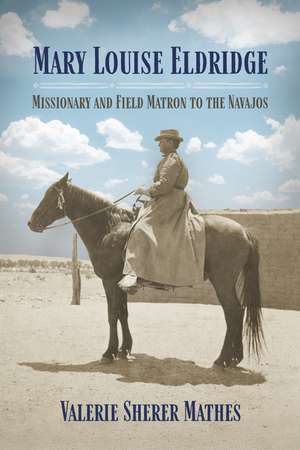
Mary Louise Eldridge: Missionary and Field Matron to the Navajos
Autor Valerie Sherer Mathesen Limba Engleză Hardback – iun 2026
This biography with selected letters is the first history of Eldridge’s WNIA-funded missionary work. It opens a critical window into social reform efforts among Native peoples in the American Southwest, the predicament of the Navajo Nation after their return from incarceration at Bosque Redondo, and the coercive assimilationist policies enacted against resistant Native peoples in the Dawes Act era.
Preț: 499.76 lei
Puncte Express: 750
Carte tipărită la comandă
Livrare economică 23 noiembrie-07 decembrie
Livrare prin curier în România Termenul estimat este afișat lângă disponibilitate.
Transport gratuit pentru acest produs Plată online sau ramburs, în funcție de opțiunile comenzii.
Retur gratuit în 14 zile Comandă securizată și suport în română.
Specificații
ISBN-13: 9781496246684
ISBN-10: 1496246683
Pagini: 336
Ilustrații: 28 photographs, 2 maps, index
Dimensiuni: 152 x 229 x 22 mm
Greutate: 0.62 kg
Editura: Nebraska
Colecția University of Nebraska Press
Locul publicării:United States
ISBN-10: 1496246683
Pagini: 336
Ilustrații: 28 photographs, 2 maps, index
Dimensiuni: 152 x 229 x 22 mm
Greutate: 0.62 kg
Editura: Nebraska
Colecția University of Nebraska Press
Locul publicării:United States
Notă biografică
Valerie Sherer Mathes is professor emerita of history at City College of San Francisco. She is the author of numerous books, including Divinely Guided Revisited: The Women’s National Indian Association Beyond California, Amelia Stone Quinton and the Women’s National Indian Association: A Legacy of Indian Reform, and Charles C. Painter: The Life of an Indian Reform Advocate.
Cuprins
List of Illustrations
Preface
Part 1. Biographical Sketch
Introduction
1. The Navajo Mission and Field Matron Duties, 1891–95
2. Field Matron Work, a Visit to Lake Mohonk, and a Station at Two Grey Hills, 1896–98
3. The Rebecca Collins Hospital, 1899–1902
4. Closiah, the Mary G. Fisk Home, and Waro’s Camp, 1902–6
5. Huerfano and Blanco Canyon, 1906–9
6. Return to the Mary G. Fisk Home, 1909–33
Conclusion
Part 2. Letters and Extracts
Notes
Bibliography
Index
Preface
Part 1. Biographical Sketch
Introduction
1. The Navajo Mission and Field Matron Duties, 1891–95
2. Field Matron Work, a Visit to Lake Mohonk, and a Station at Two Grey Hills, 1896–98
3. The Rebecca Collins Hospital, 1899–1902
4. Closiah, the Mary G. Fisk Home, and Waro’s Camp, 1902–6
5. Huerfano and Blanco Canyon, 1906–9
6. Return to the Mary G. Fisk Home, 1909–33
Conclusion
Part 2. Letters and Extracts
Notes
Bibliography
Index
Recenzii
“This enlightening biography of Mary Louise Eldridge added to Valerie Sherer Mathes’s previous books makes Mathes the leading scholar on the Indian reform era of the late nineteenth century. With lively prose, the author illuminates the devoted missionary work of Eldridge among the Navajos during hard times. Everyone interested in Native history needs to read this book.”—Donald L. Fixico (Shawnee, Sac and Fox, Muscogee, and Seminole), Regents’ and Distinguished Foundation Professor of History, Arizona State University
“This work enlarges our understanding of Diné–Euro-American interactions in northeastern Navajo lands during the post–Long Walk era, after the Navajo Treaty of 1868 provided for the Diné’s return to their homeland.”—Margaret Connell Szasz, author of Indian Education in the American Colonies, 1607–1783
“This work enlarges our understanding of Diné–Euro-American interactions in northeastern Navajo lands during the post–Long Walk era, after the Navajo Treaty of 1868 provided for the Diné’s return to their homeland.”—Margaret Connell Szasz, author of Indian Education in the American Colonies, 1607–1783
Descriere
Valerie Sherer Mathes presents the biography and selected letters of missionary and federal field matron Mary Louise Eldridge about her tenure within the Navajo Nation in New Mexico Territory, revealing the predicament of Diné peoples in the late nineteenth and early twentieth centuries.