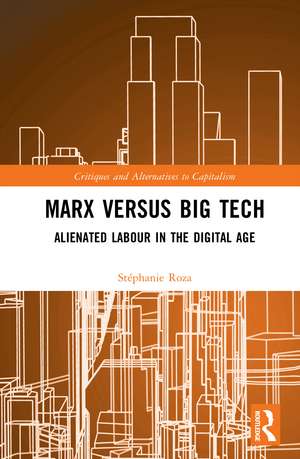
Marx versus Big Tech: Alienated Labour in the Digital Age: Critiques and Alternatives to Capitalism
Autor Stéphanie Rozaen Limba Engleză Hardback – 12 iun 2026
Humanist Marxism, as advocated by Georg Lukács and Henri Lefebvre, among others, provides invaluable tools for analysing the transformations and shortcomings of contemporary society. It puts forward the hypothesis that a universal human essence evolves over time thanks to the efforts of individuals in their work, gradually humanising the world and increasing the wealth and power of societies. However, with this progress comes a "dark side" caused by advances in technology and digital platforms, bringing new forms of alienation and dramatically altering our relationships with work and others. Drawing on analysis of platforms such as Uber and positing that labour plays a key role in human bondage or emancipation, the book shows how platformisation is a new strategy of exploitation.
Drawing on the contributions and debates within Humanist Marxism, this book offers a clear and philosophically rich reading of our world that can provide a serious basis for a theory of liberation relevant to our times. It will be vital reading for researchers and post-graduate students with interests in Marxism, social and political thought, alternatives to capitalism and political philosophy.
Din seria Critiques and Alternatives to Capitalism
- 9%
 Preț: 1352.10 lei
 -
 Preț: 413.06 lei
 - 19%
 Preț: 469.20 lei
 - 19%
 Preț: 467.96 lei
 -
 Preț: 354.40 lei
 - 18%
 Preț: 1125.98 lei
 -
 Preț: 212.39 lei
 -
 Preț: 480.92 lei
 - 18%
 Preț: 1140.58 lei
 -
 Preț: 394.02 lei
 -
 Preț: 398.68 lei
 -
 Preț: 212.62 lei
 -
 Preț: 407.04 lei
 - nou
 Preț: 1342.01 lei
 -
 Preț: 418.09 lei
 -
 Preț: 415.54 lei
 -
 Preț: 378.70 lei
 -
 Preț: 470.58 lei
 - 18%
 Preț: 1133.73 lei
 -
 Preț: 378.47 lei
 - 19%
 Preț: 474.04 lei
 -
 Preț: 403.78 lei
 - 18%
 Preț: 1120.74 lei
 - 18%
 Preț: 1158.34 lei
 -
 Preț: 437.93 lei
 - 18%
 Preț: 1113.77 lei
 -
 Preț: 405.33 lei
 -
 Preț: 434.52 lei
 - 18%
 Preț: 1116.90 lei
Preț: 1340.54 lei
Preț vechi: 1634.80 lei
-18%
Puncte Express: 2011
Carte tipărită la comandă
Livrare economică 27 noiembrie-11 decembrie
Livrare prin curier în România Termenul estimat este afișat lângă disponibilitate.
Transport gratuit pentru acest produs Plată online sau ramburs, în funcție de opțiunile comenzii.
Retur gratuit în 14 zile Comandă securizată și suport în română.
Specificații
ISBN-13: 9781041215486
ISBN-10: 1041215487
Pagini: 156
Dimensiuni: 156 x 234 mm
Greutate: 0.4 kg
Ediția:1
Editura: Taylor & Francis
Colecția Routledge
Seria Critiques and Alternatives to Capitalism
Locul publicării:Oxford, United Kingdom
ISBN-10: 1041215487
Pagini: 156
Dimensiuni: 156 x 234 mm
Greutate: 0.4 kg
Ediția:1
Editura: Taylor & Francis
Colecția Routledge
Seria Critiques and Alternatives to Capitalism
Locul publicării:Oxford, United Kingdom
Public țintă
Academic and PostgraduateRecenzii
‘This latest installment by one of the most prominent French thinkers is an exhilarating attempt to rethink Marxist humanism in light of the profound transformations of capitalism. It offers an original reading of neo-liberalism, financialization of the economy, post-Fordist organization of the workplace, alienation and technology. It is a must-read for anyone interested in understanding which aspects of Marxist thought are still relevant to the meandering complexities of contemporary societies.’
Eva Illouz, Director of Studies at European Center of Sociology and Political Science (CSE-EHESS), Paris, France.
Eva Illouz, Director of Studies at European Center of Sociology and Political Science (CSE-EHESS), Paris, France.
Cuprins
Introduction: The great contradiction of our time Part I: A toolmaking animal 1. A materialist anthropology of labour 2. “[C]apitalist society is a vast cemetery for integrity and human capacity”: The contribution of Lukácsian humanist marxism Part II: The metamorphoses of labour in the age of neoliberalism 3. The new neoliberal order and the post-Fordist organisation of labour 4. Labour in the era of platform capitalism Part III: Everyday life 5. Capitalism's assault on free time 6. The self as a commodity Conclusion: Neo-romanticism or critical progressivism
Notă biografică
Stéphanie Roza is a researcher at the CNRS's SND laboratory (Sorbonne University). Initially, her research focused on the "collectivist" utopias of the Enlightenment and the French Revolution, from Morelly to Babeuf. She then turned her attention to the legacy of 18th-century France in the communist, socialist, and anarchist left-wing movements of the last two centuries. Her recent publications include: La gauche contre les Lumières? (2020), Lumières de la gauche (2022), Le Marxisme est un humanisme (2024) and Utopia: From the Novel to Revolution (2025).
Descriere
This book asks whether Marx's concepts can still be useful in seeking emancipation in the time of platform capitalism. With a discussion of what emancipation in the workplace would mean, it explores the potential of Humanist Marxism to address this possibility, offering vital reading for researchers and post-graduates interested in Marxism.