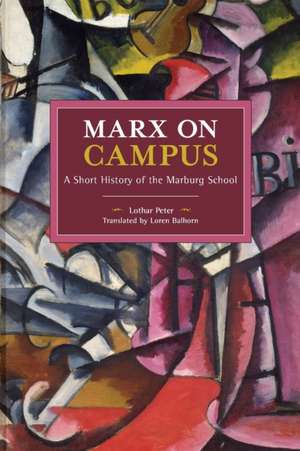
Marx on Campus
Autor Lothar Peteren Limba Engleză Paperback – 20 oct 2020
Preț: 187.30 lei
Puncte Express: 281
Carte tipărită la comandă
Livrare economică 13-27 octombrie
Livrare prin curier în România Termenul estimat este afișat lângă disponibilitate.
Transport gratuit de la 400.00 lei Plată online sau ramburs, în funcție de opțiunile comenzii.
Retur gratuit în 14 zile Comandă securizată și suport în română.
Specificații
ISBN-13: 9781642593365
ISBN-10: 1642593362
Pagini: 184
Dimensiuni: 152 x 229 x 11 mm
Greutate: 0.27 kg
Editura: Haymarket Books
ISBN-10: 1642593362
Pagini: 184
Dimensiuni: 152 x 229 x 11 mm
Greutate: 0.27 kg
Editura: Haymarket Books
Cuprins
Preface
Abbreviations
Introduction
Ingar Solty
1 Abendroth School or Marburg School?
1What Constitutes a School of Thought?
2Why the ‘Marburg School’?
2 First Phase: Gradual Formation, 1950 to the Mid-1960s
1Social and Political Context
2Wolfgang Abendroth (1906–85)
3Students, Doctoral Candidates, Staff
3 Second Phase: Emergence of an ‘Epistemic Community’, Mid-1960s to Early 1970s
1Social and Political Context
2Werner Hofmann (1922–69)
3Heinz Maus (1911–78)
4Abendroth, Hofmann, and Maus’s Understanding of Marx and Marxism
5The Marburg and Frankfurt Schools: ‘Social Critique’ or ‘Artistic Critique’?
6Dominance of the Marxist Paradigm
4 Third Phase: Continuity and New Challenges. Abendroth’s Retirement to the Early 1980s
1Social and Political Context
2The Political Sociology of Worker Consciousness and the Trade Unions (Frank Deppe)
3The History of German Social Democracy (Georg Fülberth and Jürgen Harrer)
4Studying Fascism (Reinhard Kühnl)
5The Political Sociology of Latin America (Dieter Boris)
6External Pressure, Administrative Interference, Difficult Encounters
7A Controversial History of the Trade Unions
8Theoretical Conflict: The Identity of Marxism
5 The Marburg School since the 1980s
1A Premature Farewell
2A Contribution to Constitutional Law (Peter Römer)
3Marburg in the Historikerstreit (Reinhard Kühnl)
4Activities and Interactions in the Academic Sphere
6 Fourth Phase: From the ‘Epochal Rupture’ of 1989–90 to the Early 2000s
1Social and Political Context
2Confronting the ‘Epochal Rupture’ (Georg Fülberth)
3Reacting to a Changed Situation
4Excursus: A Conversation between Ulrich Beck and Frank Deppe on the State of Political Opposition in Germany
7 Scholarly Focuses since the 1990s
1Research Activity and a New Conflict
2Social Movements in Latin America (Dieter Boris)
3Capitalism and Kapitalistik (Georg Fülberth)
4Political Thought from the Late Nineteenth to the Early Twenty-First Century (Frank Deppe)
8 Conclusion
Bibliography
Index
Abbreviations
Introduction
Ingar Solty
1 Abendroth School or Marburg School?
1What Constitutes a School of Thought?
2Why the ‘Marburg School’?
2 First Phase: Gradual Formation, 1950 to the Mid-1960s
1Social and Political Context
2Wolfgang Abendroth (1906–85)
3Students, Doctoral Candidates, Staff
3 Second Phase: Emergence of an ‘Epistemic Community’, Mid-1960s to Early 1970s
1Social and Political Context
2Werner Hofmann (1922–69)
3Heinz Maus (1911–78)
4Abendroth, Hofmann, and Maus’s Understanding of Marx and Marxism
5The Marburg and Frankfurt Schools: ‘Social Critique’ or ‘Artistic Critique’?
6Dominance of the Marxist Paradigm
4 Third Phase: Continuity and New Challenges. Abendroth’s Retirement to the Early 1980s
1Social and Political Context
2The Political Sociology of Worker Consciousness and the Trade Unions (Frank Deppe)
3The History of German Social Democracy (Georg Fülberth and Jürgen Harrer)
4Studying Fascism (Reinhard Kühnl)
5The Political Sociology of Latin America (Dieter Boris)
6External Pressure, Administrative Interference, Difficult Encounters
7A Controversial History of the Trade Unions
8Theoretical Conflict: The Identity of Marxism
5 The Marburg School since the 1980s
1A Premature Farewell
2A Contribution to Constitutional Law (Peter Römer)
3Marburg in the Historikerstreit (Reinhard Kühnl)
4Activities and Interactions in the Academic Sphere
6 Fourth Phase: From the ‘Epochal Rupture’ of 1989–90 to the Early 2000s
1Social and Political Context
2Confronting the ‘Epochal Rupture’ (Georg Fülberth)
3Reacting to a Changed Situation
4Excursus: A Conversation between Ulrich Beck and Frank Deppe on the State of Political Opposition in Germany
7 Scholarly Focuses since the 1990s
1Research Activity and a New Conflict
2Social Movements in Latin America (Dieter Boris)
3Capitalism and Kapitalistik (Georg Fülberth)
4Political Thought from the Late Nineteenth to the Early Twenty-First Century (Frank Deppe)
8 Conclusion
Bibliography
Index
Notă biografică
Lothar Peter, Prof. Dr. phil. (1942), completed his Ph.D. at the University of Marburg under Wolfgang Abendroth and Heinz Maus. He taught sociology at the University of Bremen until 2005, and has published numerous articles and books on the subject.