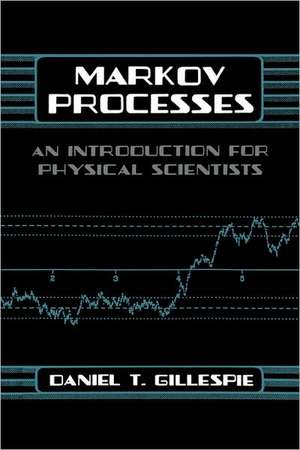
Markov Processes: An Introduction for Physical Scientists
Autor Daniel T. Gillespieen Limba Engleză Hardback – 2 dec 1991
- A self-contained, prgamatic exposition of the needed elements of random variable theory
- Logically integrated derviations of the Chapman-Kolmogorov equation, the Kramers-Moyal equations, the Fokker-Planck equations, the Langevin equation, the master equations, and the moment equations
- Detailed exposition of Monte Carlo simulation methods, with plots of many numerical examples
- Clear treatments of first passages, first exits, and stable state fluctuations and transitions
- Carefully drawn applications to Brownian motion, molecular diffusion, and chemical kinetics
Preț: 366.67 lei
Preț vechi: 448.67 lei
-18%
Puncte Express: 550
Carte tipărită la comandă
Livrare economică 28 noiembrie-12 decembrie
Livrare prin curier în România Termenul estimat este afișat lângă disponibilitate.
Transport gratuit de la 400.00 lei Plată online sau ramburs, în funcție de opțiunile comenzii.
Retur gratuit în 14 zile Comandă securizată și suport în română.
Specificații
ISBN-13: 9780122839559
ISBN-10: 0122839552
Pagini: 592
Dimensiuni: 152 x 229 x 34 mm
Greutate: 1.08 kg
Editura: ELSEVIER SCIENCE
ISBN-10: 0122839552
Pagini: 592
Dimensiuni: 152 x 229 x 34 mm
Greutate: 1.08 kg
Editura: ELSEVIER SCIENCE
V-ar putea interesa
-
 The Bayesian ChoiceChristian Robert-15%Preț: 653.70 lei769.06 lei
 -
 Model Selection and Model AveragingGerda Claeskens-11%Preț: 671.52 lei754.51 lei
 -
 -11%Preț: 678.77 lei762.66 lei
 -
 -15%Preț: 522.29 lei614.46 lei
 -
 First (and Second) Steps in StatisticsDaniel B. WrightPreț: 381.02 lei
 -
 Time Series AnalysisHenrik Madsen-18%Preț: 968.96 lei1181.66 lei
 -
 -18%Preț: 796.24 lei971.02 lei
 -
 -20%Preț: 751.63 lei939.53 lei
 -
 Applied Nonparametric Statistical MethodsPeter Sprent-18%Preț: 827.55 lei1009.20 lei
 -
 Handbook of Statistical Analyses Using StataBrian S. Everitt-15%Preț: 656.48 lei772.33 lei
Public țintă
Professionals/scientists without training in probability and statistics (using books as a "self-help" guide), senior undergraduate and graduate level students in physics and chemistry and mathematicians specializing in game theory, and finite math.Cuprins
Random Variable Theory
General Features of a Markov Process
Continuous Markov Processes
Jump Markov Processes with Continuum States
Jump Markov Processes with Discrete States
Temporally Homogeneous Birth-Death Markov Processes
Appendixes: Some Useful Integral Identities
Integral Representations of the Delta Functions
An Approximate Solution Procedure for "Open" Moment Evolution Equations
Estimating the Width and Area of a Function Peak
Can the Accuracy of the Continuous Process Simulation Formula Be Improved?
Proof of the Birth-Death Stability Theorem
Solution of the Matrix Differential Equation
General Features of a Markov Process
Continuous Markov Processes
Jump Markov Processes with Continuum States
Jump Markov Processes with Discrete States
Temporally Homogeneous Birth-Death Markov Processes
Appendixes: Some Useful Integral Identities
Integral Representations of the Delta Functions
An Approximate Solution Procedure for "Open" Moment Evolution Equations
Estimating the Width and Area of a Function Peak
Can the Accuracy of the Continuous Process Simulation Formula Be Improved?
Proof of the Birth-Death Stability Theorem
Solution of the Matrix Differential Equation