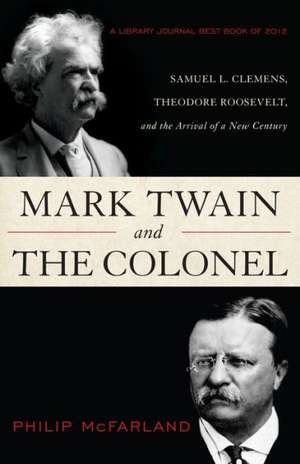
Mark Twain and the Colonel: Samuel L. Clemens, Theodore Roosevelt, and the Arrival of a New Century
Autor Philip McFarlanden Limba Engleză Paperback – 16 ian 2014
The narrative unfolds in six sections, each focusing on a different aspect of the United States of the early twentieth century that continues to matter to this day: America as an imperialist nation, America as a continental nation, America as a racial nation, America as a corporate nation, America at home, and America striving for peace.
In this short span of years, the America of the late nineteenth century will move substantially closer to the America we know today, thanks in part to the influence and actions of Mark Twain and Theodore Roosevelt, two of the most influential figures of the age.
Preț: 117.03 lei
Preț vechi: 135.00 lei
-13%
Puncte Express: 176
Carte tipărită la comandă
Livrare economică 07-21 decembrie
Livrare prin curier în România Termenul estimat este afișat lângă disponibilitate.
Transport gratuit de la 400.00 lei Plată online sau ramburs, în funcție de opțiunile comenzii.
Retur gratuit în 14 zile Comandă securizată și suport în română.
Specificații
ISBN-13: 9781442212275
ISBN-10: 1442212276
Pagini: 499
Dimensiuni: 144 x 225 x 27 mm
Greutate: 0.65 kg
Editura: Bloomsbury Publishing
Colecția Rowman & Littlefield
Locul publicării:New York, United States
ISBN-10: 1442212276
Pagini: 499
Dimensiuni: 144 x 225 x 27 mm
Greutate: 0.65 kg
Editura: Bloomsbury Publishing
Colecția Rowman & Littlefield
Locul publicării:New York, United States
Cuprins
Part I: War
Chapter 1: Return to America
Chapter 2: Celebrity
Chapter 3: Vice-Presidential Candidate
Chapter 4: Warfare
Chapter 5: Imperialist America
Chapter 6: Anti-Imperialist
Chapter 7: Election Results
Chapter 8: The Strenuous Life
Part II: West
Chapter 9: Rural Upbringing
Chapter 10: Urban Upbringing
Chapter 11: Clemens Goes West
Chapter 12: Grand Tours
Chapter 13: Western Writings
Chapter 14: Continental America
Chapter 15: The Philippines
Chapter 16: Pan-American Exposition
Part III: Race
Chapter 17: Yale Bicentennial
Chapter 18: Racial America
Chapter 19: Back to Hannibal
Chapter 20: Roosevelt and Race
Chapter 21: Livy
Chapter 22: Huckleberry Finn
Chapter 23: Roosevelt and the Philippines
Chapter 24: Placating the South
Part IV: Oil
Chapter 25: The Kanawha
Chapter 26: Corporate America
Chapter 27: Roosevelt as Reformer
Chapter 28: The Gilded Age
Chapter 29: Bankruptcy
Chapter 30: In the White House
Chapter 31: Trustbusting
Chapter 32: Our Life Is Wrecked
Part V: Children
Chapter 33: A Seventieth Birthday
Chapter 34: Susy
Chapter 35: America at Home
Chapter 36: Bully Father
Chapter 37: President in His Own Right
Chapter 38: Global Visions
Chapter 39: Bereft and Adrift
Chapter 40: Young People
Part VI: Peace
Chapter 41: Carnegie
Chapter 42: America at Peace
Chapter 43: Late Pleasures
Chapter 44: TR Steps Down
Chapter 45: Jean
Chapter 46: Funerals
Chapter 47: Bull Moose
Chapter 48: Afterward
Chronology
Chapter 1: Return to America
Chapter 2: Celebrity
Chapter 3: Vice-Presidential Candidate
Chapter 4: Warfare
Chapter 5: Imperialist America
Chapter 6: Anti-Imperialist
Chapter 7: Election Results
Chapter 8: The Strenuous Life
Part II: West
Chapter 9: Rural Upbringing
Chapter 10: Urban Upbringing
Chapter 11: Clemens Goes West
Chapter 12: Grand Tours
Chapter 13: Western Writings
Chapter 14: Continental America
Chapter 15: The Philippines
Chapter 16: Pan-American Exposition
Part III: Race
Chapter 17: Yale Bicentennial
Chapter 18: Racial America
Chapter 19: Back to Hannibal
Chapter 20: Roosevelt and Race
Chapter 21: Livy
Chapter 22: Huckleberry Finn
Chapter 23: Roosevelt and the Philippines
Chapter 24: Placating the South
Part IV: Oil
Chapter 25: The Kanawha
Chapter 26: Corporate America
Chapter 27: Roosevelt as Reformer
Chapter 28: The Gilded Age
Chapter 29: Bankruptcy
Chapter 30: In the White House
Chapter 31: Trustbusting
Chapter 32: Our Life Is Wrecked
Part V: Children
Chapter 33: A Seventieth Birthday
Chapter 34: Susy
Chapter 35: America at Home
Chapter 36: Bully Father
Chapter 37: President in His Own Right
Chapter 38: Global Visions
Chapter 39: Bereft and Adrift
Chapter 40: Young People
Part VI: Peace
Chapter 41: Carnegie
Chapter 42: America at Peace
Chapter 43: Late Pleasures
Chapter 44: TR Steps Down
Chapter 45: Jean
Chapter 46: Funerals
Chapter 47: Bull Moose
Chapter 48: Afterward
Chronology
Recenzii
Philip McFarland delivers hundreds of pages of solid anecdotes with quotes and details of life at the turn of the century....By the final page, the reader will know a lot about Twain as writer and man and much about Roosevelt's key policies, and will have toured a vanished America. One of his subjects wanted life to be "strenuous" and "dutiful"; the other wanted to mock those exhortations and light up another stogie and rack up some more billiard balls.
The interplay between the two gargantuan lives leads biographer Philip McFarland to some fascinating trivia and unexpected role-reversals.
What did two of the most famous Americans of the early 20th century have in common? In this interesting if overlong dual biography of President Theodore Roosevelt (1858-1919) and Mark Twain (1835-1910), McFarland (Loves of Harriet Beecher Stowe, 2007, etc.) seems bent on challenging the conventional wisdom as to which of these two Gilded Age giants had the better progressive credentials. In one corner stands Roosevelt, the war hero and manly man who busted the Standard Oil monopoly, protected national lands, and worked to improve labor conditions. He was also a defiant imperialist who thought it was the duty of America to spread civilization to backward, pagan countries, whether they wanted it or not. In the other corner stands the genius writer and humorist Twain, who helped expose the moral evil of slavery and thought the United States had no business helping "liberate" the Philippines from Spain. He was also a wealthy venture capitalist whose best friends were oil barons and thought government had no business telling John Rockefeller what to do. Roosevelt and Twain were alike in many ways: voluminous writers, beloved celebrities, wealthy men who enjoyed great success and suffered terrible personal tragedy and who opposed slavery but not white supremacy. McFarland's story is both personal and political, focusing on the lives and philosophies of both subjects....The still-relevant contrast between these two American powerhouses is well told. Both men were consumed by domestic and international problems that continue to reverberate.
Author McFarland (Hawthorne in Concord) succeeds in his purpose of portraying the similarities and differences between two iconic American personages as they responded to the issues of their day-imperialism, racism, corporations, and the end of America's westward movement-during the period from 1890 until Mark Twain's death in 1910. Lyrically written and unobtrusively annotated, this book of musings on episodes in the lives of two lovers of language, both proficient in several European tongues, who embodied much of their country's culture at the dawn of the 20th century, also includes several other individuals of note. Among them are Booker T. Washington, Andrew Carnegie, and H.H. Rogers of Standard Oil, whose business acumen Twain greatly admired. Based largely on secondary rather than primary sources, the book may surprise some with the comment that the skeptical Twain and the optimistic Roosevelt privately disliked each other. Both were noted travelers, often touring the lecture circuit. Twain spent nearly all of the 1890s (and some time thereafter) residing in Europe where, after business mishaps, he claimed he could live more cheaply.
Verdict Recommended for aficionados of turn-of-the-20th-century American literature and history, especially the general reader....This sweeping, engrossing narrative explores Twain's and TR's relationship, and how they became heroes of the "Gilded Age" and icons of American history and culture.
Though America's most famous satirist and the 26th president seldom came into direct contact, here McFarland (Loves of Harriet Beecher Stowe) posits the duo as dynamic foils, indicative of the social and political growing pains of the country. Differences in background and beliefs abounded: Roosevelt was an expansionist; Twain was a staunch anti-imperialist. The politician "spurn[ed] idleness, to an extent that amazed those who knew him;" the humorist embraced "the gypsy-like leaving behind of responsibilities." Perhaps most telling of their disparate social roles is their handling of racial issues-while Twain grew vocally outraged at "The United States of Lyncherdom," Roosevelt fretted about losing the Southern vote. McFarland doesn't shy away from the complex notions each man had of the other-Twain called Roosevelt "one of the most likeable men that I am acquainted with," and also "far and away the worst president we have ever had." In addition to being a compelling duel biography, McFarland makes full use of Twain and Roosevelt's specific moment in time, using their opinions, vitriol, and praises to explore varying sides of issues that belabored the United States at the turn of the 20th century.
In Mark Twain and the Colonel, Philip McFarland tells the story of the rich years of American history between 1890 and 1910 through the fully engaged involvement of two of its most vital participants.
No two men captured the zeitgeist of Gilded Age America more than Mark Twain, the cultural icon, and Theodore Roosevelt, the political one, claims the author in this dual biography and narrative history of 1890-1910....McFarland, the author of two novels and five nonfiction works,offers here a captivating investigation of the similarities and differences between Twain and Roosevelt presented against a backdrop of politics, imperialism, commercialism, and racism of these decades....General readers already familiar with Twain and Roosevelt or those who know little about either man will be fascinated by this illuminating, comparative biography/history that displays their significance to this tumultuous era.
Philip McFarland's book "Mark Twain and the Colonel" is a hybrid biography of two of the most colorful figures of their era and a fascinating look at America at the beginning of the 20th century....Readers of Mr. McFarland's very well-written book, filled with wonderful anecdotes, can judge for themselves who is the better man.
A magnificent storyteller, Philip McFarland has told the story of late nineteenth- and early twentieth-century America through the intertwined lives of two of its most memorable and colorful figures: Mark Twain and Theodore Roosevelt. Impeccably researched, beautifully written, Mark Twain and the Colonel will delight anyone interested in American history, literature, or culture.
Philip McFarland's new book, the latest in his distinguished series of American biographies and histories, fuses two vivid stories set around the first decade of the twentieth century. One touches on the astonishing career of President Theodore Roosevelt, an eastern patrician sometimes derided as a "cowboy" and saber-rattler. He speeded the emergence of modern America from a frontier nation to a world power with far-flung interests. The second of McFarland's stories follows the comparably astonishing career of the democrat and westerner Mark Twain, who came east from the closing western frontier and became famous as author, humorist, and universal sage. More than a century later, these two flamboyant personalities, each a distinctly native production and neither at a loss for words on every issue of their time, continue to occupy a formative place in the American style and imagination.
Independent historian McFarland (The Brave Bostonians: Hutchinson, Quincy, Franklin, and the Coming of the American Revolution, CH, Oct'98, 36-1163) has pieced together the lives of two 19th- and early-20th-century icons, both of whom contributed greatly but differently to the nation's history. Most are aware of Roosevelt's accomplishments in the Spanish-American War, how he came to the presidency upon the assassination of William McKinley in the fall of 1901, and his subsequent accomplishments during his administration. McFarland describes Roosevelt as a man whose "name [is] shining among the brightest in our presidential firmament." Not all would agree. To the author's credit, however, he adorns Roosevelt with virtues (progressivism) and flaws (racism and imperialism). Clemens, the satirist and novelist, did not take to politicians. He was critical of Roosevelt's quest for empire. As McFarland suggests, Clemens, as a product of pastoral America, found it difficult to accept imperialism and industrialism and what both portended for the nation's future. In short, this book contributes to two different perspectives of the Gilded and Progressive eras. Summing Up: Recommended. All levels/libraries.
"McFarland's story is both personal and political, focusing on the lives and philosophies of both subjects."
The interplay between the two gargantuan lives leads biographer Philip McFarland to some fascinating trivia and unexpected role-reversals.
What did two of the most famous Americans of the early 20th century have in common? In this interesting if overlong dual biography of President Theodore Roosevelt (1858-1919) and Mark Twain (1835-1910), McFarland (Loves of Harriet Beecher Stowe, 2007, etc.) seems bent on challenging the conventional wisdom as to which of these two Gilded Age giants had the better progressive credentials. In one corner stands Roosevelt, the war hero and manly man who busted the Standard Oil monopoly, protected national lands, and worked to improve labor conditions. He was also a defiant imperialist who thought it was the duty of America to spread civilization to backward, pagan countries, whether they wanted it or not. In the other corner stands the genius writer and humorist Twain, who helped expose the moral evil of slavery and thought the United States had no business helping "liberate" the Philippines from Spain. He was also a wealthy venture capitalist whose best friends were oil barons and thought government had no business telling John Rockefeller what to do. Roosevelt and Twain were alike in many ways: voluminous writers, beloved celebrities, wealthy men who enjoyed great success and suffered terrible personal tragedy and who opposed slavery but not white supremacy. McFarland's story is both personal and political, focusing on the lives and philosophies of both subjects....The still-relevant contrast between these two American powerhouses is well told. Both men were consumed by domestic and international problems that continue to reverberate.
Author McFarland (Hawthorne in Concord) succeeds in his purpose of portraying the similarities and differences between two iconic American personages as they responded to the issues of their day-imperialism, racism, corporations, and the end of America's westward movement-during the period from 1890 until Mark Twain's death in 1910. Lyrically written and unobtrusively annotated, this book of musings on episodes in the lives of two lovers of language, both proficient in several European tongues, who embodied much of their country's culture at the dawn of the 20th century, also includes several other individuals of note. Among them are Booker T. Washington, Andrew Carnegie, and H.H. Rogers of Standard Oil, whose business acumen Twain greatly admired. Based largely on secondary rather than primary sources, the book may surprise some with the comment that the skeptical Twain and the optimistic Roosevelt privately disliked each other. Both were noted travelers, often touring the lecture circuit. Twain spent nearly all of the 1890s (and some time thereafter) residing in Europe where, after business mishaps, he claimed he could live more cheaply.
Verdict Recommended for aficionados of turn-of-the-20th-century American literature and history, especially the general reader....This sweeping, engrossing narrative explores Twain's and TR's relationship, and how they became heroes of the "Gilded Age" and icons of American history and culture.
Though America's most famous satirist and the 26th president seldom came into direct contact, here McFarland (Loves of Harriet Beecher Stowe) posits the duo as dynamic foils, indicative of the social and political growing pains of the country. Differences in background and beliefs abounded: Roosevelt was an expansionist; Twain was a staunch anti-imperialist. The politician "spurn[ed] idleness, to an extent that amazed those who knew him;" the humorist embraced "the gypsy-like leaving behind of responsibilities." Perhaps most telling of their disparate social roles is their handling of racial issues-while Twain grew vocally outraged at "The United States of Lyncherdom," Roosevelt fretted about losing the Southern vote. McFarland doesn't shy away from the complex notions each man had of the other-Twain called Roosevelt "one of the most likeable men that I am acquainted with," and also "far and away the worst president we have ever had." In addition to being a compelling duel biography, McFarland makes full use of Twain and Roosevelt's specific moment in time, using their opinions, vitriol, and praises to explore varying sides of issues that belabored the United States at the turn of the 20th century.
In Mark Twain and the Colonel, Philip McFarland tells the story of the rich years of American history between 1890 and 1910 through the fully engaged involvement of two of its most vital participants.
No two men captured the zeitgeist of Gilded Age America more than Mark Twain, the cultural icon, and Theodore Roosevelt, the political one, claims the author in this dual biography and narrative history of 1890-1910....McFarland, the author of two novels and five nonfiction works,offers here a captivating investigation of the similarities and differences between Twain and Roosevelt presented against a backdrop of politics, imperialism, commercialism, and racism of these decades....General readers already familiar with Twain and Roosevelt or those who know little about either man will be fascinated by this illuminating, comparative biography/history that displays their significance to this tumultuous era.
Philip McFarland's book "Mark Twain and the Colonel" is a hybrid biography of two of the most colorful figures of their era and a fascinating look at America at the beginning of the 20th century....Readers of Mr. McFarland's very well-written book, filled with wonderful anecdotes, can judge for themselves who is the better man.
A magnificent storyteller, Philip McFarland has told the story of late nineteenth- and early twentieth-century America through the intertwined lives of two of its most memorable and colorful figures: Mark Twain and Theodore Roosevelt. Impeccably researched, beautifully written, Mark Twain and the Colonel will delight anyone interested in American history, literature, or culture.
Philip McFarland's new book, the latest in his distinguished series of American biographies and histories, fuses two vivid stories set around the first decade of the twentieth century. One touches on the astonishing career of President Theodore Roosevelt, an eastern patrician sometimes derided as a "cowboy" and saber-rattler. He speeded the emergence of modern America from a frontier nation to a world power with far-flung interests. The second of McFarland's stories follows the comparably astonishing career of the democrat and westerner Mark Twain, who came east from the closing western frontier and became famous as author, humorist, and universal sage. More than a century later, these two flamboyant personalities, each a distinctly native production and neither at a loss for words on every issue of their time, continue to occupy a formative place in the American style and imagination.
Independent historian McFarland (The Brave Bostonians: Hutchinson, Quincy, Franklin, and the Coming of the American Revolution, CH, Oct'98, 36-1163) has pieced together the lives of two 19th- and early-20th-century icons, both of whom contributed greatly but differently to the nation's history. Most are aware of Roosevelt's accomplishments in the Spanish-American War, how he came to the presidency upon the assassination of William McKinley in the fall of 1901, and his subsequent accomplishments during his administration. McFarland describes Roosevelt as a man whose "name [is] shining among the brightest in our presidential firmament." Not all would agree. To the author's credit, however, he adorns Roosevelt with virtues (progressivism) and flaws (racism and imperialism). Clemens, the satirist and novelist, did not take to politicians. He was critical of Roosevelt's quest for empire. As McFarland suggests, Clemens, as a product of pastoral America, found it difficult to accept imperialism and industrialism and what both portended for the nation's future. In short, this book contributes to two different perspectives of the Gilded and Progressive eras. Summing Up: Recommended. All levels/libraries.
"McFarland's story is both personal and political, focusing on the lives and philosophies of both subjects."