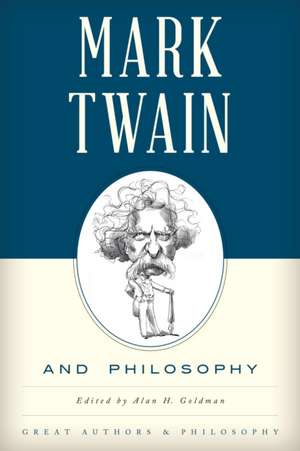
Mark Twain and Philosophy: Great Authors and Philosophy
Editat de Alan Goldmanen Limba Engleză Paperback – 15 oct 2017
Preț: 110.89 lei
Preț vechi: 131.34 lei
-16%
Puncte Express: 166
Carte tipărită la comandă
Livrare economică 23 noiembrie-07 decembrie
Livrare prin curier în România Termenul estimat este afișat lângă disponibilitate.
Transport gratuit de la 400.00 lei Plată online sau ramburs, în funcție de opțiunile comenzii.
Retur gratuit în 14 zile Comandă securizată și suport în română.
Specificații
ISBN-13: 9781442261716
ISBN-10: 1442261714
Pagini: 220
Dimensiuni: 146 x 226 x 18 mm
Greutate: 0.36 kg
Editura: Bloomsbury Publishing
Colecția Rowman & Littlefield
Seria Great Authors and Philosophy
Locul publicării:New York, United States
ISBN-10: 1442261714
Pagini: 220
Dimensiuni: 146 x 226 x 18 mm
Greutate: 0.36 kg
Editura: Bloomsbury Publishing
Colecția Rowman & Littlefield
Seria Great Authors and Philosophy
Locul publicării:New York, United States
Cuprins
Introduction, Alan H. Goldman
Part I: Morality in Huckleberry Finn
Chapter 1: The Conscience of Huckleberry Finn, Jonathan Bennett
Chapter 2: Huckleberry Finn and Moral Motivation, Alan H. Goldman
Chapter 3: Sympathy, Principles, and Conscience: Getting to the Heart of Huck Finn's Moral Praiseworthiness, Robert Fudge
Chapter 4: Huckleberry Finn's Struggle between Sympathy and Moral Principle Reconsidered, Michael Lyons
Chapter 5: Twain's Last Laugh, Kristina Gehrman
Part II: Twain on Religion
Chapter 6: The Gospel According to Mark (Twain), Craig Vasey
Chapter 7: Mark Twain and the Problem of Evil: The Mysterious Stranger, Letters from the Earth, and The Diaries of Adam and Eve, James M. McLachlan
Part III: Moral Issues
Chapter 8: The Noble Art of Lying, James Edwin Mahon
Chapter 9: Twain's Critique of Human Exceptionalism: "The Descent of Man" and the Anti-Vivisection Movement, Emily E. VanDette
Part IV: Literary Devices
Chapter 10: Mark Twain's Serious Humor and that Peculiar Institution: Christianity, Chris A. Kramer
Chapter 11: Socratic Irony in Twain's Skeptical Religious Jeremiads, Dale Jacquette
Part V: Comparison to Other Philosophers
Chapter 12: The American Diogenes: Mark Twain's Sacred Profanity, Brian Earl Johnson
Chapter 13: An Epicurean Consideration of Superstitions in Mark Twain and in the Good Life, Jennifer Baker
Chapter 14: Moral Value and Moral Psychology in Twain's "Carnival of Crime", Frank Boardman
Chapter 15: Making the Heart Grow Fonder: Twain, Psychical Distance, and Aesthetic Experience, Jeffrey Dueck
Notes
Index
About the Editor and Contributors
Part I: Morality in Huckleberry Finn
Chapter 1: The Conscience of Huckleberry Finn, Jonathan Bennett
Chapter 2: Huckleberry Finn and Moral Motivation, Alan H. Goldman
Chapter 3: Sympathy, Principles, and Conscience: Getting to the Heart of Huck Finn's Moral Praiseworthiness, Robert Fudge
Chapter 4: Huckleberry Finn's Struggle between Sympathy and Moral Principle Reconsidered, Michael Lyons
Chapter 5: Twain's Last Laugh, Kristina Gehrman
Part II: Twain on Religion
Chapter 6: The Gospel According to Mark (Twain), Craig Vasey
Chapter 7: Mark Twain and the Problem of Evil: The Mysterious Stranger, Letters from the Earth, and The Diaries of Adam and Eve, James M. McLachlan
Part III: Moral Issues
Chapter 8: The Noble Art of Lying, James Edwin Mahon
Chapter 9: Twain's Critique of Human Exceptionalism: "The Descent of Man" and the Anti-Vivisection Movement, Emily E. VanDette
Part IV: Literary Devices
Chapter 10: Mark Twain's Serious Humor and that Peculiar Institution: Christianity, Chris A. Kramer
Chapter 11: Socratic Irony in Twain's Skeptical Religious Jeremiads, Dale Jacquette
Part V: Comparison to Other Philosophers
Chapter 12: The American Diogenes: Mark Twain's Sacred Profanity, Brian Earl Johnson
Chapter 13: An Epicurean Consideration of Superstitions in Mark Twain and in the Good Life, Jennifer Baker
Chapter 14: Moral Value and Moral Psychology in Twain's "Carnival of Crime", Frank Boardman
Chapter 15: Making the Heart Grow Fonder: Twain, Psychical Distance, and Aesthetic Experience, Jeffrey Dueck
Notes
Index
About the Editor and Contributors
Recenzii
Goldman (College of William and Mary) is a philosopher, and in this introductory study of philosophy, he uses Twain's texts as material. The 15 essays are organized into five sections. The first and strongest, "Morality in Huckleberry Finn," centers on Huck's developing conscience in relation to moral principles. "Twain on Religion" examines Twain's late writing critical of the Bible and organized religion. "Moral Issues" analyzes Twain's views on lying and animal rights. "Literary Devices" explains his usage of humor, satire, and irony. Finally, "Comparison to Other Philosophers" looks at Twain in relation to Diogenes, the Epicureans, Nietzsche, Hume, and Edward Bullough. All the essays are thoughtful and clearly written, and the collection is ideal for nonspecialists.. Summing Up: Recommended. Lower- and upper-division undergraduates through faculty; general readers.
This volume makes a valuable contribution to Twain studies and, in the bargain, to the interchange between philosophy and literature. Above all, it is a reminder, if we needed one, of our sheer pleasure when we read Twain.
This volume makes a valuable contribution to Twain studies and, in the bargain, to the interchange between philosophy and literature. Above all, it is a reminder, if we needed one, of our sheer pleasure when we read Twain.