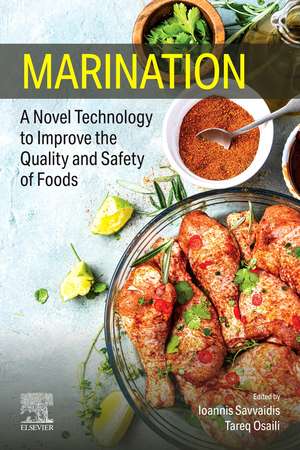
Marination: A Novel Technology to Improve the Quality and Safety of Foods
Editat de Ioannis Savvaidis, Tareq Osailien Limba Engleză Paperback – noi 2026
Edited by a team of experts in the field, this book is a unique resource for researchers, scientists and industry personnel interested in natural techniques for preserving food and preventing the growth of food pathogens.
- Covers marinade-applied research, bridging food safety issues and potential applications for the food industry
- Explores marination as a preservation treatment in foods and how it can be used to improve food quality and food safety
- Addresses solutions on novel eco-friendly natural marinating antimicrobial agents
Preț: 759.52 lei
Preț vechi: 1055.27 lei
-28% Precomandă
Puncte Express: 1139
Carte nepublicată încă
Livrare prin curier în România Precomanda se expediază când titlul devine disponibil.
Transport gratuit pentru acest produs Plată online sau ramburs, în funcție de opțiunile comenzii.
Retur gratuit în 14 zile Comandă securizată și suport în română.
Doresc să fiu notificat când acest titlu va fi disponibil:
Se trimite...
Specificații
ISBN-13: 9780443220753
ISBN-10: 0443220751
Pagini: 480
Dimensiuni: 152 x 229 mm
Editura: ELSEVIER SCIENCE
ISBN-10: 0443220751
Pagini: 480
Dimensiuni: 152 x 229 mm
Editura: ELSEVIER SCIENCE
Cuprins
1. Marination – types, definitions, history of marinades
2. Marination of meats (camel, beef, chicken, pork)
3. Marination of fish/seafood (salmon, fillets, octopus, prawns, etc.)
4. Marination of plant-based fresh produce (tofu, vegetables, etc.)
5. Marination of dairy-based products (mainly cheese)
6. Marination and technologies to improve the quality of foods
7. Marination and technologies to extend the shelf-life of foods
8. Marination in reassuring the food safety of perishable foods
9. Marination as a preservation technology of ready-to-eat/sous vide meals
10. Marination as a technology to produce novel foods for consumers
11. Marination and mathematical models combined with spectroscopic techniques
12. Marination and its effects on polycyclic aromatic hydrocarbons and heterocyclic amines formation in meats
2. Marination of meats (camel, beef, chicken, pork)
3. Marination of fish/seafood (salmon, fillets, octopus, prawns, etc.)
4. Marination of plant-based fresh produce (tofu, vegetables, etc.)
5. Marination of dairy-based products (mainly cheese)
6. Marination and technologies to improve the quality of foods
7. Marination and technologies to extend the shelf-life of foods
8. Marination in reassuring the food safety of perishable foods
9. Marination as a preservation technology of ready-to-eat/sous vide meals
10. Marination as a technology to produce novel foods for consumers
11. Marination and mathematical models combined with spectroscopic techniques
12. Marination and its effects on polycyclic aromatic hydrocarbons and heterocyclic amines formation in meats